Present Head

History
The Princely State of Shahpura, located in the central region of Rajputana (now the Bhilwara-Shahpura region of Rajasthan), was a historic nine-gun salute state. It holds a unique and anomalous position in Rajput history: its rulers held a dual political status, simultaneously serving as independent chiefs under the British Raj and as top-tier feudal barons (Omrao) under the Maharana of Udaipur (Mewar). The state was ruled by the Ranawat branch of the Sisodia clan of Rajputs.
Foundation and Imperial Grant (1629–1631)
The state was founded in the early seventeenth century by Rajwar Sujan Singh, a grandson of Maharana Amar Singh I of Udaipur and a great-grandson of the legendary Maharana Pratap.
- Sujan Singh left Mewar to seek fortune at the imperial court of Delhi, where his military brilliance caught the attention of the Mughal Emperor Shah Jahan.
- In 1629, Shah Jahan rewarded Sujan Singh's loyalty and valor by granting him an independent Pargana (estate) consisting of Phulia and surrounding crown lands, completely detached from Udaipur's jurisdiction.
- In 1631, Sujan Singh founded a well-fortified capital city on these lands and named it Shahpura in profound gratitude to his imperial benefactor, Emperor Shah Jahan.
The Complex Feudal Anomaly: Dual Allegiance
As the state expanded, it developed a fascinating political architecture. The rulers of Shahpura acquired two distinct sets of territories, resulting in a complex dual allegiance that lasted until the mid-twentieth century:
- The Shahpura Estate (Imperial/British Grant): This consisted of the capital and lands granted directly by the Mughals (and later recognized by the British). For these lands, Shahpura owed no allegiance to Mewar and functioned as an independent principality.
- The Kachhola Estate (Mewar Grant): To strengthen ties with their ancestral house, the rulers of Shahpura later accepted the estate of Kachhola from the Maharana of Udaipur. For this specific territory, the ruler of Shahpura was considered a premier noble (Omrao) of Mewar, required to attend the Udaipur court, pay feudal dues, and provide military service to the Maharana.
The Era of Maratha Tributes and Strategic Diplomacy
During the eighteenth-century decline of the Mughal Empire, the fertile plains around Shahpura became vulnerable to the rapid expansion of the Maratha Empire. The state was heavily pressured by the armies of Scindia and Holkar, who demanded regular, exorbitant financial tributes (Khiraj). Through a combination of defensive fortification, guerrilla tactics in times of crisis, and highly calculated diplomacy, the rulers successfully prevented the complete annexation or ruin of Shahpura, preserving their core autonomy.
The British Treaty of 1818
Following the Third Anglo-Maratha War, Shahpura sought relief from Maratha exactions by aligning with the British East India Company. A formal Sanad (Treaty) of Protection was concluded on June 27, 1818 under the administration of Raja Umaid Singh.
- The British guaranteed the external security of Shahpura and settled outstanding territorial boundary disputes.
- In return, the state came under British paramountcy, transitioning into a recognized princely state within the Rajputana Agency. This treaty brought a long-awaited era of civil peace, shielding the state from external predatory raids.
A Pioneer of Democratic Reform and Modernization (20th Century)
The late nineteenth and early twentieth centuries under Rajah Sir Nahar Singh and his successor marked a golden era of progressive administration, social reform, and agricultural modernization. Shahpura gained nationwide renown for being decades ahead of its larger princely neighbors in terms of governance.
- The First Constitutional State: Shahpura holds the historic distinction of being the very first princely state in India to grant full responsible democratic government to its people. Under the progressive vision of its last ruler, the state voluntarily adopted a constitution and established a legislative assembly with elected representatives long before the integration of India.
- Infrastructure and Water Security: The state implemented extensive rainwater harvesting systems, constructing a network of interconnected lakes and agricultural tanks (such as the Nahar Sagar) that effectively insulated the agrarian population from the harsh droughts of central Rajasthan.
Accession and Leading the Integration into Rajasthan
The last ruling monarch of the state was Rajah Sudhershan Dev. True to his state's progressive legacy, he enthusiastically welcomed the independence of India. Following the cessation of British paramountcy in August 1947, he signed the Instrument of Accession to merge Shahpura into the new nation. Because of its early adoption of democratic institutions, Shahpura played a foundational role in the regional merger of princely states. In March 1948, Shahpura officially joined the United State of Rajasthan during its initial phase of formation. This union was subsequently fully absorbed into the expanded modern state of Rajasthan, concluding the sovereign administrative history of the Shahpura Sisodia state.
Genealogy
- Rajadhiraj SURAJ MAL, 1st Raja of Shahpura 1629/- , second son of Maharana Amir Singh I of Udaipur, he joined the service of the Mughal Emperor, who gave him the district of Phoolia and a mansab (military posting) of 800 Zat (foot soldiers) and 300 Sowar (horse or horsemen), raised to 1,000 Jat and 500 Sowar in 1643, and to 1,500 Zat and 700 Sowar in 1645. Later, he went to Kandahar with Prince Aurangzeb and, in 1651, his mansab was again raised, to 2,000 Zat and 800 Sowar, married and had issue.
- Rajadhiraj Sujan Singh (qv)
- Kunwar Viram Deo, received the mansab of 800 Jat and 400 Sowar, later raised to 3,000 Zat and 1,000 Sowar. Fought in the battle of Samugadh, with Prince Dara's force against Prince Aurangzeb, but later went over to Aurangzeb. Served in Assam with Ram Singh of Jaipur, returning to Mathura where he died circa 1688.
- Rajadhiraj SUJAN SINGH, 2nd Raja of Shahpura -/1664, married and had issue. He died at the battle of Dharmat, along with five sons.
- Maharaj Fateh Singh, married and had issue. He died at the battle of Dharmat.
- Rajadhiraj Himmat Singh (qv)
- Rajadhiraj Daulat Singh (fourth son) (qv)
- Maharaj Fateh Singh, married and had issue. He died at the battle of Dharmat.
- Rajadhiraj HIMMAT SINGH, 3rd Raja of Shahpura 1664/1670, succeeded as a minor, deposed by his uncle after six years, ancestor of the Jagirdars of Gangwas and Barliawas.
- Rajadhiraj DAULAT SINGH, 4th Raja of Shahpura 1670/1685, married and had issue.
- Rajadhiraj Bharat Singh (qv)
- Rajadhiraj BHARAT SINGH, 5th Raja of Shahpura 1685/1729, fought for Maharana Sangram Singh II in the battle against Mewati Ranbaj Khan, imprisoned by his son, Umaid Singh, and died in prison, married Rani Gulab Kanwar of Khandela-Senior, and had issue. He died 1729.
- Rajadhiraj Umaid Singh (qv)
- Rajadhiraj UMAID SINGH, 6th Raja of Shahpura 1729/1769, married (amongst others), a daughter of Rao Shiv Singh of Sikar, and had issue. He died at the Battle of Ujjain.
- Kunwar Udyot Singh, married and had issue. He died vp (poisoned by his own father).
- Rajadhiraj Ram Singh (qv)
- Thakur Zalim Singh, married and had issue.
- Thakur Jay Singh, married and had issue.
- Kunwar Fateh Singh
- Thakur Bijay Singh, married and had issue.
- Thakur Sultan Singh, married and had issue.
- Thakur Zorawar Singh, married and had issue.
- Kunwar Kesri Singh
- Kunwar Sabal Singh
- Kunwar Anar Singh
- Kunwar Sundar Singh
- Thakur Zorawar Singh, married and had issue.
- Thakur Sanwant Singh, married and had issue.
- Thakur Balwant Singh of Dhanop, married and had issue.
- Thakur Dhirat Singh, married a daughter of Thakur Megh Singh of Kotri in Kishangarh, and had issue.
- HH Rajadhiraj Sir Nahar Singh (qv)
- Thakur Kalyan Singh, married and had issue.
- Kunwar Zalim Singh
- Kunwar Bahadur Singh
- Kunwar Chotu Singh
- Thakur Dhirat Singh, married a daughter of Thakur Megh Singh of Kotri in Kishangarh, and had issue.
- Thakur Balwant Singh of Dhanop, married and had issue.
- Thakur Sultan Singh, married and had issue.
- Thakur Suraj Mal, married and had issue.
- Kunwar Devi Singh
- Thakur Jay Singh, married and had issue.
- Thakur Ranjit Singh, married Thakurani Akhai Kanwar, daughter of Thakur Jait Singh of Auwa, and his third wife, Thakurani Gyan Kanwar.
- Kunwar Udyot Singh, married and had issue. He died vp (poisoned by his own father).
- Rajadhiraj RAM SINGH, 7th Raja of Shahpura 1769/1774, married and had issue.
- Rajadhiraj Bhim Singh (qv)
- Rajadhiraj BHIM SINGH, 8th Raja of Shahpura 1774/1796, married and had issue.
- Rajadhiraj Amar Singh (qv)
- Rajadhiraj AMAR SINGH, 9th Raja of Shahpura 1796/1827, married and had issue.
- Rajadhiraj Madho Singh (qv)
- Thakur Ranjit Singh, married and had issue.
- Thakurani Kishan Kanwar, married (as his first wife), Thakur Devi Singhji of Auwa, and had issue.
- Rajadhiraj MADHO SINGH, 10th Raja of Shahpura 1827/1845, married in Thikana Diggi and had issue.
- Rajadhiraj Jagat Singh (qv)
- Rajkumari (name unknown), married Maharaja Prithvi Singh of Kishangarh.
- Rajadhiraj JAGAT SINGH, 11th Raja of Shahpura 1845/1853, died sp 1853.
- Rajadhiraj LAKSHMAN SINGH, 12th Raja of Shahpura 1853/1870, he adopted Kunwar Nahar Singh of Dhanop in 1869; married Rani Roop Kanwar, daughter of Rao Laxman Singhji of Parsoli, and his first wife, a daughter of Chundawat Rawat Tej Singh of Athana, and had adoptive issue. He died sp 1870.
- (A) HH Rajadhiraj Sir Nahar Singh (qv)
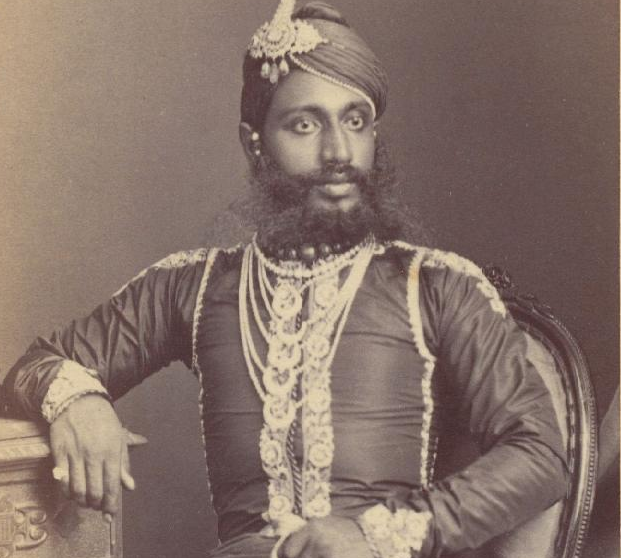
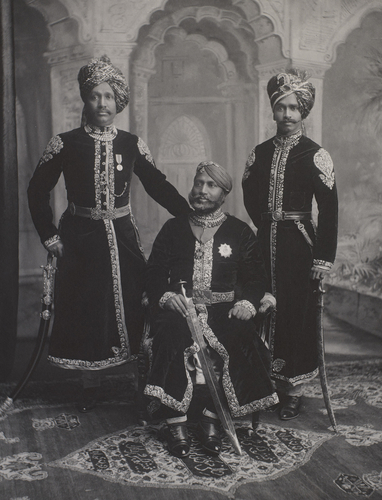
- HH Shriman Rajadhiraj Shri Sir NAHAR SINGH, 13th Raja of Shahpura 1870/1932, born , son of Kunwar Dhirat Singh of Dhanop (see above), adopted by Rajadhiraj Lakshman Singh, K.C.I.E. [cr.1903], awarded a 9-gun salute, Member of the Mahand Raj Sabha, married 1stly, 19th August 1870, daughter of Thakur Ram Singh of Baghera in Jaipur, married 2ndly, 16th May 1874, daughter of Thakur Chattar Sal of Maksundangarh, died before 1893, married 3rdly, 7th July 1889, Rani Swarup Kunwarba, daughter of Kumar Shri Harisinhji Ranmalji of Sokhada-Dhrangadhra, died before 1893, married 4thly, 4th March 1893, the sister of the Maharawal of Chhota-Udaipur, and had issue, two sons and two daughters (by 2nd wife). He died .
- HH Svasti Shri Rajadhiraja Sahib Umaid Singh II Bahadur (by 2nd wife) (qv)
- Rajakumar Sardar Singh (by 2nd wife), born , educated at Mayo College, Ajmer; married a daughter of Raj Gobardhan Singh, died of Bijwa Raj in Pargana Bhur of Kheri District in the United Provinces, a branch of the Jangre Chauhans, and had issue.
- A son who succeeded his maternal grandfather as the Raj of Bijwa; married and had issue.
- Raja Lokendra Deo of Bijwa.
- HH Maharani Prema Kumari Devi, married 25th November 1925, HH Maharaja Sir Pratap Chandra Bhanj Deo of Mayurbhanj.
- A son who succeeded his maternal grandfather as the Raj of Bijwa; married and had issue.
- HH Svasti Shri Rajadhiraja Sahib UMAID SINGH II Bahadur, 14th Raja of Shahpura 1932/1947, born , educated at Mayo College, Ajmer; Chief Minister of Shahpura 1912/1932, abdicated in favour of his eldest son on 3rd February 1947, awarded the Silver Durbar Medal (1911), Silver Jubilee Medal (1935) and Coronation Medal (1937); he married 1stly, 1894, HH Rani Suraj Kanwar, died at Shahpura 8th August 1913, daughter of Raja Ajit Singh Bahadur of Khetri, married 2ndly, December 1914 at Kishengarh, a daughter of Raja Shri Samvat Singhji Sahib, Raja of Ralaota (Kishengarh State), amd had issue, an only daughter by his first wife and one son and two daughters by the second.
- HH Rajadhiraj Sudershan Singh (qv)
- Rajkumari (name unknown), married (as his third wife), Hon. Lt. Maharaja Mahendra Maan Singh of Bhadawar.
- HH Rajadhiraj SUDERSHAN SINGH, 15th Raja of Shahpura 1947/-, born , married HH Rani Harshwant Kunwarba Sahiba, daughter of Major HH Maharana Shri Maharaja Shri Raj Sir Ghanshyamsinhji Ajitsinhji Sahib Bahadur of Dhrangadhra, and had issue.
- HH Rajadhiraj Indrajit Singh (qv)
- Rajkumari Mahendra Kumari [Princess Bapujija], born , married 10th December 1961, Thakur Amarjeet Singh of Gumanpura, born , died , son of General Thakur Nathu Singh (1900-1994), and has issue.
- Thakur Shatrujeet Singh Rathore, born , married 11th March 1993, Thakurani Maya Singh, daughter of Col. Apji Bharat Singh Hada of Koela-Kotah, and has issue, one daughter.
- Trisha Rathore, born .
- Thakur Jai Singh Rathore, born , married 21st February 1994, Thakurani Mandvi Kumari, and has issue, two daughters
- Tameksha Rathore born .
- Darshini Rathore, born .
- Thakur Shatrujeet Singh Rathore, born , married 11th March 1993, Thakurani Maya Singh, daughter of Col. Apji Bharat Singh Hada of Koela-Kotah, and has issue, one daughter.
- Rajkumari Mridul Kumari [Princess Shilujija], born , died in .
- HH Rajadhiraj INDRAJIT SINGH, 16th Raja of Shahpura (see above)
- HH Rajadhiraj JAI SINGH, 17th Raja of Shahpura (see above)
Notable Figures
Raja Sujan Singh (1631–1658)
Raja Sujan Singh was the illustrious founder of the Shahpura Princely State. A grandson of Maharana Amar Singh I of Udaipur (Mewar), Sujan Singh was a distinguished warrior who entered the imperial service of the Mughal Empire. Recognizing his exceptional military prowess and loyalty, Mughal Emperor Shah Jahan granted him the pargana of Phulia in 1631. Sujan Singh subsequently established his capital there and named it Shahpura in honor of the Emperor, carving out an independent territory distinct from the parent state of Mewar.
His reign was marked by active military participation in imperial campaigns. He met a heroic end on the battlefield of Dharmat in 1658, fighting alongside his sons in defense of the imperial throne during the Mughal war of succession. His legacy as a brave commander and the architect of Shahpura remains celebrated in Rajasthani history. For further details on the origins of the state, see the Wikipedia article on Shahpura State.
Raja Bharat Singh (1681–1729)
Raja Bharat Singh succeeded to the gaddi of Shahpura during a period of significant political transition in northern India. He was a shrewd diplomat and an able administrator who successfully steered his state through the turbulent latter years of Aurangzeb's reign. He was formally recognized as Raja by the Mughal court, a title that solidified the political autonomy of the Shahpura house within the regional hierarchy of Rajputana.
During his long and stable reign of nearly five decades, Bharat Singh focused on the internal consolidation and defense of his territories. He fortified the capital and fostered trade, laying down the administrative foundations that allowed Shahpura to survive the subsequent collapse of Mughal authority. Historical accounts of his tenure can be found in the Imperial Gazetteer of India.
Raja Umaid Singh I (1729–1769)
Raja Umaid Singh I was one of the most dynamic 18th-century rulers of Shahpura. Navigating the chaotic geopolitical landscape of Rajasthan during the rise of the Maratha Empire, Umaid Singh was frequently called upon to defend his territories and support his kinsmen in Udaipur. He was renowned for his military courage and participated in several regional coalitions aimed at checking Maratha expansion in the region.
Beyond his military endeavors, Umaid Singh I is remembered for his civic contributions, most notably the construction of the Umaid Sagar reservoir, which provided critical irrigation and water security to his drought-prone kingdom. He died in on the battlefield of Ujjain while fighting against the Maratha forces under Mahadji Scindia. His life is documented in major historical treatises on the region, including A History of Rajasthan.
Raja Dhiraj Sir Nahar Singh (1870–1932)
Raja Dhiraj Sir Nahar Singh was perhaps the most progressive and celebrated ruler in the history of Shahpura. Ascending the throne in 1870, his reign spanned over sixty years, a golden age of modernization for the state. Sir Nahar Singh was a visionary reformer who prioritized public welfare, introducing free primary education, establishing modern healthcare facilities, and initiating extensive judicial and land revenue reforms.
Under his administration, Shahpura emerged as a model state within the Rajputana Agency. In recognition of his exemplary governance and loyalty to the Crown, he was created a Knight Commander of the Most Eminent Order of the Indian Empire (KCIE) by the British government. He also enjoyed a close relationship with leading social reformers of his time, hosting Swami Dayanand Saraswati in Shahpura. More details of his life and reforms are available on the Wikipedia page of Nahar Singh of Shahpura.
Raja Sudharshan Dev (1947–1948)
Raja Sudharshan Dev was the last ruling chief of the Shahpura Princely State, whose short reign left an indelible mark on the democratic history of modern India. Following the independence of India in August 1947, Raja Sudharshan Dev took the remarkably progressive step of granting complete responsible government to his people. Shahpura thus became the very first princely state in Rajputana to establish a fully democratic constitution and cabinet, led by Chief Minister Gokul Lal Asawa.
In March 1948, demonstrating high patriotism and foresight, Raja Sudharshan Dev voluntarily signed the instrument of merger, integrating his state into the newly formed Rajasthan Union, which later merged into the Republic of India. His selfless transition from an absolute monarch to a constitutional head is highly praised in records of India's integration. His historic decision is detailed in the Shahpura State integration records on Wikipedia.