History
Introduction and Geographical Context
Dundlod is a historic town and a prominent Thikana (feudal estate) located in the heart of the Shekhawati region in the Jhunjhunu district of Rajasthan, India. Historically situated in the semi-arid terrains of northeastern Rajasthan, Dundlod emerged as a crucial node along the medieval caravan trade routes that connected the ports of Gujarat and the northern plains of India. To understand Dundlod’s history is to understand the legacy of the Shekhawat clan, a sub-branch of the Kachwaha Rajputs of Amber (Jaipur), who carved out independent and semi-independent fiefdoms in this region.
The Origin and Foundation
The foundation of Dundlod as an independent estate is closely tied to the division of the Jhunjhunu estate among the descendants of Shardul Singh, the ruler of Jhunjhunu who wrested control of the region from the Kaimkhani Nawabs in 1730. Upon Shardul Singh’s death in 1742, his territories were divided equally among his five surviving sons. This partition created five major estates collectively known as the Panchpana (the five estates of Jhunjhunu), which included Dundlod, Nawalgarh, Mandawa, Bissau, and Surajgarh.
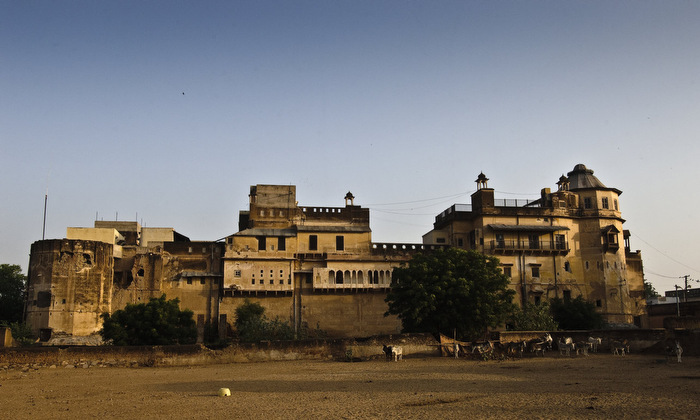
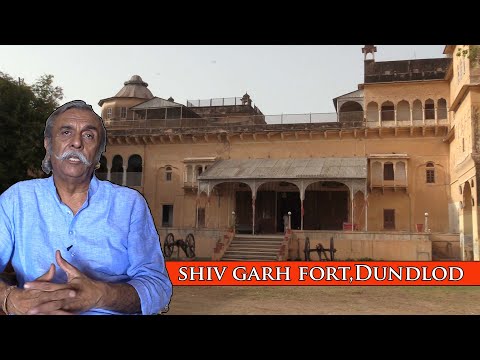
The fifth son of Shardul Singh, Keshri Singh, inherited the territory of Dundlod. In 1750 AD (Vikram Samvat 1807), Rawal Keshri Singh laid the foundation of the grand Dundlod Fort, marking the formal inception of the Dundlod principality. Keshri Singh also founded the nearby town of Bissau, establishing his authority firmly over the region.
The Era of Fortification and Architectural Expansion
During the late 18th and 19th centuries, Dundlod underwent rapid urbanization and architectural embellishment. The Rawals of Dundlod invited wealthy Marwari merchants (the Banias) to settle in the town to boost trade and commerce. This alliance between the martial Rajput rulers and the affluent mercantile class led to the construction of magnificent, intricately painted merchant mansions known as havelis.
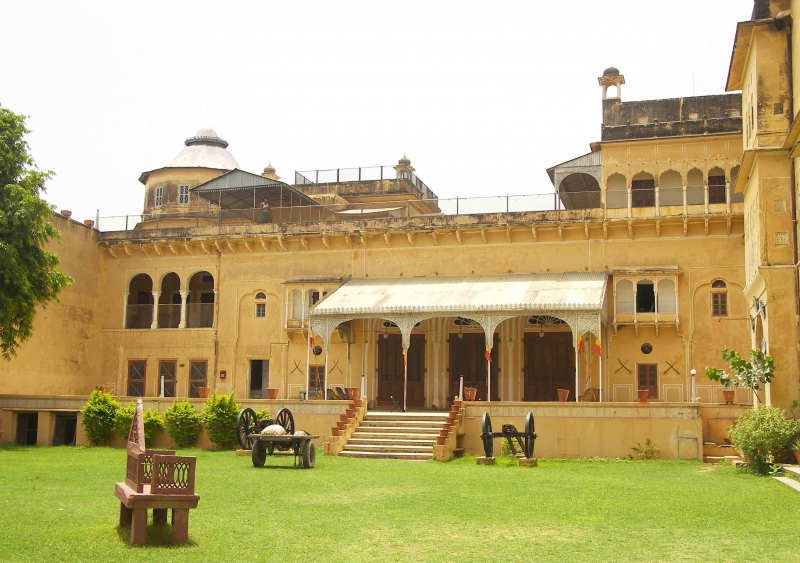
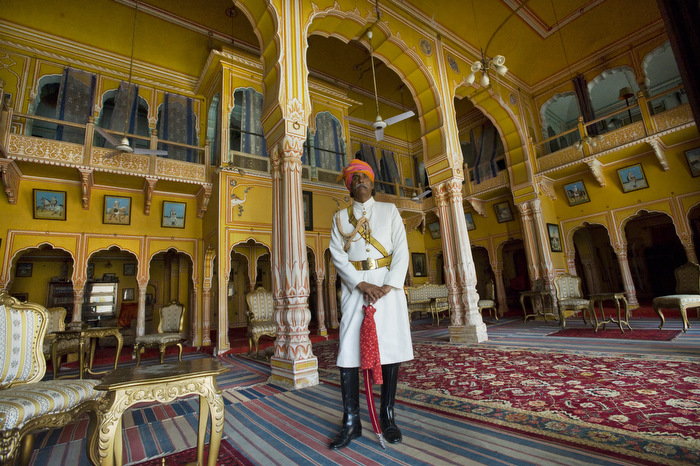
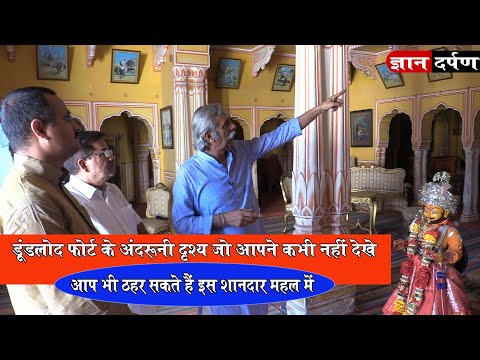
The Dundlod Fort itself stands as a monumental fusion of Rajput and Mughal architectural styles. Inside the fort, the grandest chamber is the Diwan-i-Khas (Hall of Private Audience), which features stained-glass windows, an impressive library of rare manuscripts, and antique furniture. Other architectural marvels constructed during this period include:
- The Chokhani Haveli: Renowned for its exquisite frescoes depicting traditional myths and the changing socio-political landscape under the British Raj.
- The Satyanarayan Temple: A religious center adorned with beautiful wall paintings.
- The Ram Dutt Goenka Chhatri: A grand cenotaph built in 1888 featuring murals depicting scenes from the Ramayana and local legends.
Mughal, Maratha, and British Interactions
The rulers of Dundlod, owing allegiance to the parent state of Jaipur, navigatived turbulent geopolitical waters during the decline of the Mughal Empire. In the mid-to-late 18th century, the rise of the Maratha Empire posed a severe threat to the Rajput principalities. Dundlod, alongside other Shekhawati estates, pooled military resources to repel Maratha raids and incursions led by commanders like de Boigne and George Thomas.
By the early 19th century, the unchecked raids of the Pindaris and local dacoits prompted the British East India Company to intervene in Shekhawati. In 1834, the British established the Shekhawati Brigade under the command of Major Henry Forster to restore law and order in the region. The rulers of Dundlod cooperated with the British administration to curb banditry, which eventually paved the way for peaceful trade and the secure movement of merchant caravans. This stabilization allowed the local Marwari traders to expand their businesses to major British port cities like Calcutta and Bombay, sending remittances back to Dundlod to construct even grander structures.
Prominent Reformers and Rulers
The late 19th and early 20th centuries saw the emergence of progressive leaders within the Dundlod administration. Notable among them was Rawal Harnath Singhji, who was a patron of education and modern infrastructure. Recognizing the importance of education in a rapidly modernizing India, he established some of the earliest schools in the region and worked toward eradicating social evils such as untouchability and the purdah system.
Under the guidance of its visionary rulers, Dundlod also saw the development of water harvesting systems, including deep stepwells (baoris) and johads, ensuring water security in the arid Shekhawati landscape. Details about these historic preservation efforts can be explored through the official portal of Rajasthan Tourism.
Post-Independence and the Modern Era
Following India's independence in 1947, the princely states and their respective thikanas were integrated into the Indian Union. Under the leadership of Sardar Vallabhbhai Patel, the Dundlod Thikana officially merged with the United State of Rajasthan in 1949. The feudal privileges and titles were formally abolished with the 26th Amendment to the Constitution of India in 1971.
Despite the end of feudal rule, the royal family of Dundlod, led by Kr. Raghavendra Singh Dundlod, transitioned successfully into the modern era by pioneering heritage tourism and conservation. In the late 20th century, the majestic Dundlod Fort was converted into a heritage hotel, attracting travelers and historians from across the globe. You can read more about this transition on the Dundlod Wikipedia Page.
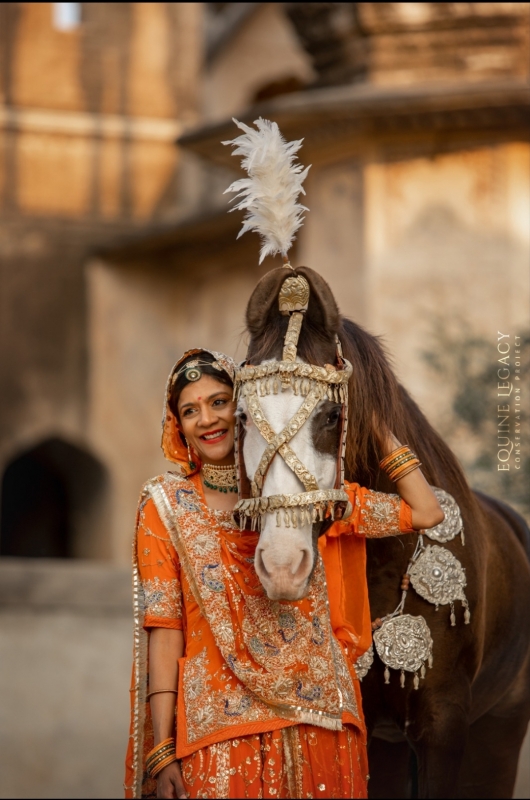
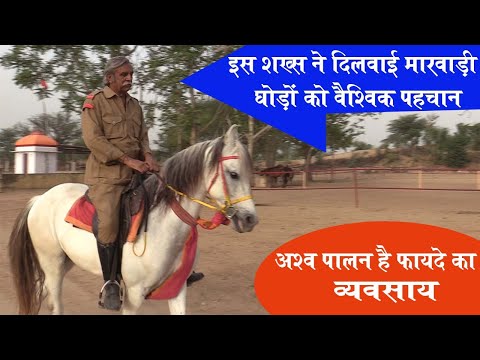
Today, Dundlod is internationally recognized not only for its spectacular frescoed havelis but also as the epicentre for the preservation of the indigenous Marwari Horse. The Dundlod stables host the Indigenous Horse Society of India, actively working to conserve and promote this rare, noble breed of desert horses, ensuring that Dundlod's rich equestrian heritage continues to thrive in the 21st century.
Genealogy
- Thakur KESHRI SINGH, 1st Thakur Saheb of Dundlod 1742/1768, born , the fourth son of Thakur Sardul Singh Shekhawat of Jhunjhunu, ancestor of the families of Bissau, Surajgarh and Dundlod, constructed the fort of Dundlod in 1750, married 1stly, Thakurani Kanlotji, married 2ndly, Thakurani Madhodasot, married 3rdly,Thakurani Bikawatiji, married 4thly, Thakurani Birad Kanwar, daughter of Thakur Devi Singh of Pokhran, she committed sati in 1768, and had issue. He died at Jhunjhunu.
- Kunwar Fateh Singh, died vpsp.
- Thakur Hanumat Singh (qv)
- Thakur Suraj Mal, he succeeded to the estate of Bissau.
- Thakur HANUMAT SINGH, 2nd Thakur of Dundlod 1768/1784, married, as his only wife, Thakurani Ranawatiji of Dhariawad, and had issue, one son. He died at Jhunjhunu.
- Thakur Ranjit Singh (qv)
- Thakur RANJIT SINGH, 3rd Thakur of Dundlod 1784/1808, married 1stly, Thakurani Ratan Kanwar, daughter of Thakur Sawai Singh of Pokhran, married 2ndly, a daughter of the Thakur of Khimsar, married 3rdly, Thakurani Nath Kanwar, daughter of Thakur Akhai Singh of Janiwara in Jodhpur, and had issue. He was killed on the orders of Shyam Singh of Bissau on 21st December 1808.
- Kunwar Pratap Singh (by Thakurani Ratan Kanwar), married a daughter of Thakur Indra Singh of Geejgarh. He was killed by Shyam Singh of Bissau on sp 21st December 1808.
- Thakur Shiv Singh (by Thakurani Karamsotji) (qv)
- Baisa Raj Kanwar [Maharani Raj Kanwar of Bikaner] (by Thakurani Ratan Kanwar), married 1806, Maharajkumar Ratan Singh of Bikaner, and had issue. She died .
- Thakur SHIV SINGH, 4th Thakur of Dundlod 1808/1850, married 1stly, Thakurani Udawatiji of Lambia, married 2ndly, Thakurani Mertaniji of Baghot, married 3rdly, Thakurani Baghelji from Sohawal, and had issue. He died .
- Kunwar Chiman Singh, died vpsp.
- Thakur Jai Singh (qv)
- Thakur JAI SINGH, 5th Thakur of Dundlod 1850/1875, born (Paush Sudi 5, 1894), married 1stly, Thakurani Kanlotji from Rawatsar, married 2ndly, Thakurani Udawatji from Lambia, married 3rdly, Thakurani Mertaniji from Baghot, and had issue, two sons from the second marriage. He died (Bhadwa Sudi 7, 1932).
- Thakur Panney Singh (qv)
- Thakur Chander Singh (qv)
- Thakur PANNEY SINGH, 6th Thakur of Dundlod 1875/1897, born , he succeeded to a half share in Dundlod, which was inherited by his brother on his death; married 1stly, Thakurani Tanwarji of Jetsisar, married 2ndly, Thakurani Mertaniji of Baghot, married 3rdly, Thakurani Kandhalotji of Rawatsar. He died sp 18th April 1897.
- Thakur CHANDER SINGH, 7th Thakur of Dundlod 1875/1905, born , he adopted Kanwar Harnath Singh, son of Thakur Chattar Singh of Malsisar, married 1stly, Thakurani Mertaniji of Maroth, married 2ndly, Thakurani Chanpawatji of Khatu, married 3rdly, Thakurani Bidawatji of Sobhasar. He died sp 1903. INTERREGNUM 1903/1905
- Rawal HARNATH SINGHJI Bahadur, 8th Thakur of Dundlod 1905/1976, born , he was granted the personal title of Rawal by HH Maharaja Sawai Man Singh II of Jaipur in 1947, married 26th January 1913 at Bera, Rani Sireh Kanwar, died , daughter of Rao Bahadur Thakur Shivnath Singhji of Bera in Jodhpur, and his wife, Rani Roop Kanwar, and had issue. He died at Dundlod.
- Bai Mohan Kanwar [Rani Mohan Kanwar of Kanore], married Rawat Karan Singh of Kanore.
- Thakur Ratan Singh, born , educated at Mayo College, Ajmer; married Kumari Shashi Prabhawati Kumari [Thakurani Shashi Prabha Devi], the eldest daughter of Maharaj Ranzor Singh of Sirmur, and had issue. He died .
- Kanwar Rajendra Singh, born , educated at Mayo College, Ajmer; married Kanwarani Shreelekha Kumari, daughter of Shri Narain Rao alias Shri Fateh Singh Rao Patankar of Gwalior, and had issue. He died in Nairobi, Kenya.
- Thakur Randeep Singh, married Thakurani Namrata Kumari, daughter of the Maharaj Sahib of Dhonswas in Ratlam, and his wife, Rani Usha Kiran.
- Thakur Rajat Singh, born in Assam, educated at Mayo College, Ajmer, then completed a Bachelor of Arts degree in English Honours, and a Masters in Business administration; employed with the Taj Group of hotels in Sales and Marketing for some years, he is presently (2009), along with his wife, the proprietor and manager of ‘SUVASA’, an apparel and home furnishing company.
- Thakur Veer Vijay Singh, educated at Mayo College, Ajmer; married Thakurani Savita Kumari of Kelwa in Mewar, and has issue.
- Kanwar Suryaveer Singh
- Kanwar Vishwaveer Singh
- Baiji Lal Loveleena Kumari, married Someshwar Bahadur Singh.
- Bai Navneeta Kumari [Rani Navneeta Kumari of Birwa], married Raja Baleshwar Singh of Birwa.
- Kanwar Rajendra Singh, born , educated at Mayo College, Ajmer; married Kanwarani Shreelekha Kumari, daughter of Shri Narain Rao alias Shri Fateh Singh Rao Patankar of Gwalior, and had issue. He died in Nairobi, Kenya.
- Lt.-Col. Thakur Raghuvir Singh, born in Bera, Jodhpur, educated at Mayo College, Ajmer. During World War II served in the Western Desert, Egypt. He also served in 19 Inf. Div. in Kashmir in 1948 as well as in the Defence Service Staff College in Wellington, India and in HQ Eastern Command in Calcutta. Later became the Military Secretary to HH the Rajpramukh of Rajasthan after independence. He was awarded the Meritorious Service Medal Class I of Jaipur State. He has had the honour of being cavalry officer with the Jaipur Lancers, Rajendra Hazari Guards, Kachhawa Horse, Gwalior Lancers and the 61st Cavalary of the integrated Indian Army; married April 1947, Thakurani Bharati Devi, eldest daughter of Maharaj Champaksinhji of Rajpipla, and has issue.
- Kanwar Ranjit Singh, educated at Mayo College, Ajmer and St Xaviers College, Bombay; married Kanwarani Brita Maitra , daughter of Sudhendu Kumar Maitra, and has issue.
- Bhanwar Vijit Singh, educated at Mayo College, Ajmer.
- Kanwar Raghuvendra Singh, educated at Mayo College, Ajmer; married Kanwarani Ganga Pande, daughter of Tribhuwan Narain Pande, and has issue, two daughters.
- Bai Mallika Singh
- Bai Mandira Singh
- Bai Urwashi Devi [Thakurani Urwashi Devi of Rohet], married Thakur Digvijay Singh Champawat of Rohet and has issue, one daughter.
- Bai Diksha Singh
- Kanwar Ranjit Singh, educated at Mayo College, Ajmer and St Xaviers College, Bombay; married Kanwarani Brita Maitra , daughter of Sudhendu Kumar Maitra, and has issue.
- Bai Brijraj Kanwar [Rajkumarani Brijraj Kanwar of Khairagarh], married Rajkumar Bikram Bahadur Singh of Khairagarh.
- Bai Raghuraj Kanwar [Rani Raghuraj Kanwarba Jadeja], married Lt.-Col. Maharaj Ranbirsinhji of Nawanagar.
- Thakur Ranbir Sinh, Playwright, Historian and Author, born , educated at Mayo College, Ajmer; Executive Secretary of Bharatiya Natya Sangh 1962/1965, Vice Chairman of Rajasthan Sangeet Natak Academy for two terms, Cultural Advisor to the Government of Mauritius 1976/1981; Vice President of the National Council of Indian People's Theatre Association {I.P.T.A.}; Fellow of Rajasthan Sangeet Natak Akademi; Hon. Member of Latvian Writers Association; Member of Progressive Writers Association {India}; Fellow of the Royal Asiatic Society of Great Britain and Ireland; as a Playwright, he has written more than nineteen plays, including Hai Mera Dil which has completed over 1500 shows, and is is the longest Hindi play to date; as a Historian he has authored a number of books and has contributed several articles on theatre, culture and Litrature to various Journals and Books, books include, Mauritius; The Key To The Indian Ocean, History of Shekhawats, Wajid Ali Shah:The Tragic King, Ranthambhor The Impregnable Fort, Vanshavali of the Rulers of Amber and Jaipur, as well as Parsi Theatre, Inder Sabha a critical assessment, Contribution in the Encyclopedea of Asian Theate published by Cambridge University, Contribution to the encyclopedea of World theatre published by Routledge, English translation of Banki Das Ki Khyat and Theatre Quotes, also in English, married Thakurani Kalyani Devi, the eldest daughter of General Shri Prakram Jung Bahadur Rana of Nepal, and has issue.
- Kanwar Ranvijay Singh, married Bhawna Kumari, daughter of Raja Briraj Singh of Halwapur, U.P., and has issue.
- Bai Kavita Kumari, married Maj. Shri Bishambhar Narsingh Rana.
- Thakur Rajvir Singhji, born , educated at Mayo College, Ajmer; married Thakurani Uma Kumari, daughter of Maharaj Narayan Singhji of Jodhpur, and has issue.
- Kanwar Rishiraj Singh, married Kanwarani Neeta, and has issue.
- Bhanwar Rahulraj Singh
- Bhanwar Jairraj Singh
- Kanwar Ridhiraj Singh
- Kanwar Rishiraj Singh, married Kanwarani Neeta, and has issue.
- Bai Gulab Kanwar [Thakurani Gulab Kanwar of Rohet], married Lt.-Col. Thakur Rajendra Singh of Rohet.
- Bai Chand Kanwar [Thakurani Chand Kanwar Bhist], married Lt.-Col. Thakur Narendra Singh Bhist.
- Bai Rajendra Kunwar [Rani Rajendra Kunwar of Ajabpur], married 7th March 1962 in Jaipur, Rawat Thakur Digvijai Singh of Ajabpur, and has issue.