
History
Origin and Foundation of Nawalgarh
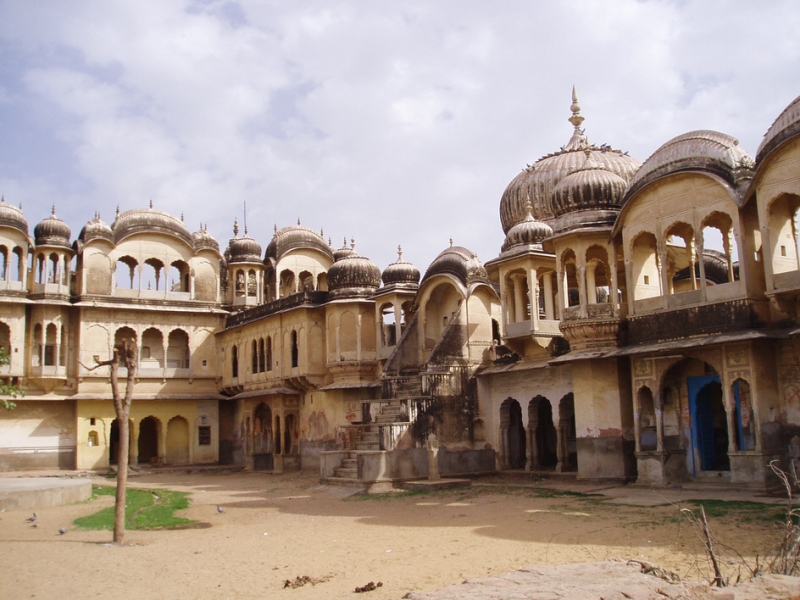
Nawalgarh was established as a prominent tributary Thikana (fiefdom) in the historic Shekhawati region of Rajasthan. The foundation of this illustrious town was laid in 1737 AD by Thakur Nawal Singh Ji Bahadur, the younger son of the legendary Thakur Shardul Singh of Jhunjhunu. Shardul Singh, a ruler of the Shekhawat clan of Kachwaha Rajputs, had successfully consolidated his rule over Jhunjhunu. Following his death, his territories were divided among his five sons, a division historically known as the Panchpana (the five estates of Jhunjhunu), of which Nawalgarh was a prime estate.
Thakur Nawal Singhji initially chose the strategic village site of Rohili, situated on the banks of a local pond, to establish his seat of power. It was here in 1737 that he laid the foundation stone of the formidable Bala Kila Fort (also known as Nawalgarh Fort). Under his visionary leadership, the small settlement of Rohili rapidly transformed into a well-planned, fortified city, which was subsequently renamed Nawalgarh in honor of its founder.
Fortifications and Defensive Architecture
To secure the newly founded capital against regional rivalries and external invasions, Nawalgarh was encircled by high, massive stone walls known as the Parkota. This defensive wall was punctuated by four monumental gates (Pols), each fitted with heavy iron doors and facing a cardinal direction to regulate and defend entry into the town:
- Agoona Darwaja (facing East)
- Bawadi Darwaja
- Mandi Darwaja
- Nansa Darwaja
While the majestic Bala Kila Fort stood secure in the heart of the Thikana, serving as the administrative and royal residence, an outer fort named Fatehgarh Fort was constructed outside the city walls. Fatehgarh functioned as a crucial military outpost to detect and repel advancing hostile forces before they could breach the main city gates.
Military Might and Royal Prestige
During the 18th and 19th centuries, Nawalgarh was highly regarded for its military preparedness. The Thikana maintained a prestigious Rasala, a cavalry unit comprised of exceptionally well-bred indigenous horses. It was also designated as a prestigious Hathiband Thikana, a rare honor indicating a fiefdom of sufficient wealth and status to keep royal elephants, which were maintained directly by the Nawalgarh ruling family.
In keeping with the martial traditions of the Rajputs, important state occasions—such as the coronation (Rajyabhishek) of a new ruler, the birth of a male heir to the Thakur Sahib, or the marriage of a royal daughter—were grandly announced to the public with a traditional cannon salute. To assert its sovereign administrative authority, each successive ruler of Nawalgarh also minted their own official state stamps.
The Mughal, Maratha, and British Periods
Throughout its history, Nawalgarh navigated the complex geopolitics of Northern India. Historically a vassal state of the Kingdom of Jaipur, Nawalgarh paid tribute to the Jaipur Maharaja. During the late 18th century, as the central authority of the Mughal Empire crumbled, the Shekhawati region faced frequent incursions from the Maratha Empire, particularly the forces of the Scindias and Holkars.
By the early 19th century, the British East India Company established paramountcy over Rajputana. In 1836, to curb the rampant lawlessness and cross-border raids in the region, the British raised the Shekhawati Brigade under Major Henry Forster. The rulers of Nawalgarh, along with other Shekhawati thikanas, subsequently entered into treaties that guaranteed internal autonomy under the overarching protection of the British Crown, bringing a long era of peace and stability to the region.
Economic Prosperity and the Rise of the Marwari Merchants
Thakur Nawal Singh Ji was not merely a military leader but an astute administrator. Recognizing that economic strength was vital for the survival of his state, he actively encouraged wealthy traders and business communities from Jaipur and other parts of Rajputana to settle within his estate.
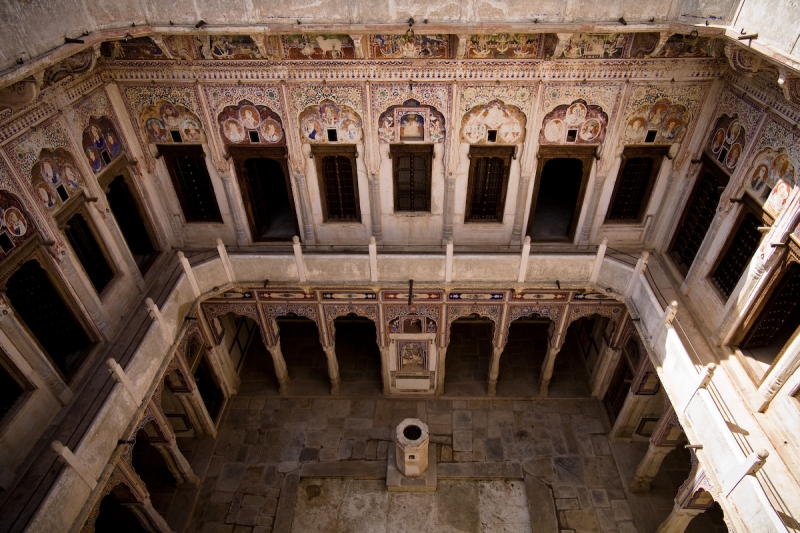
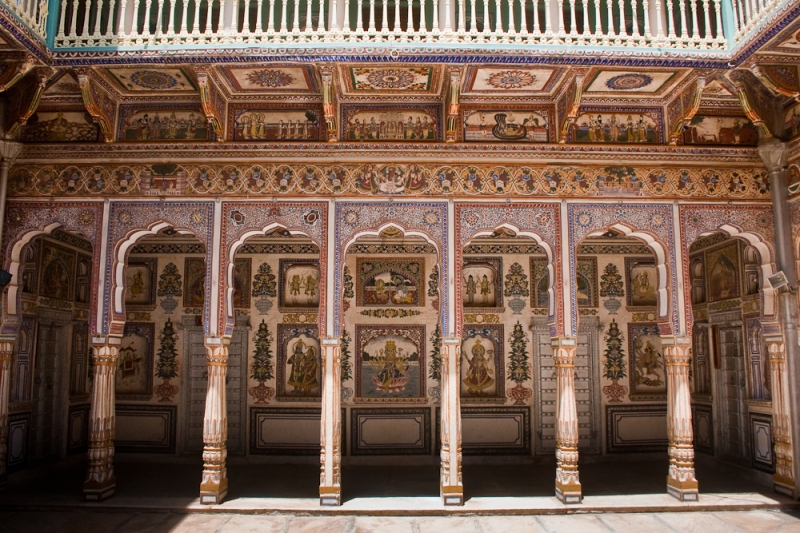
To incentivize these trading families, the Thakur Sahib allotted land and houses free of cost for both residential and commercial purposes. This welcoming atmosphere prompted several prominent Marwari business families (such as the Poddars, Biras, and Morarkas) to establish their headquarters in Nawalgarh. As these merchants grew fabulously wealthy from trans-regional trade along the ancient caravan routes, they built magnificent, extensively frescoed mansions known as Havelis, earning Nawalgarh the modern reputation of being the cultural heart of Shekhawati.
Post-Independence and the Modern Era
Following India's independence in 1947, the Thikana of Nawalgarh was integrated into the newly formed state of Rajasthan. The privy purses and royal privileges were eventually abolished by the 26th Amendment to the Constitution of India in 1971.
Today, Nawalgarh has transitioned from a medieval principality into a premier global heritage destination. Often referred to as an "Open-air Art Gallery," the town attracts historians, art lovers, and tourists from around the world who come to admire its preserved architectural marvels, including the Anandi Lal Poddar Haveli, the Aath Haveli complex, and the Roop Niwas Kothi (which has been converted into a heritage hotel). The legacy of Thakur Nawal Singh lives on in the vibrant, living museum that is modern Nawalgarh.
References
Genealogy
- Thakur NAWAL SINGH Bahadur, Thakur of Nawalgarh 1742/1780, born , fifth son of Thakur Sardul Singh of Jhunjhunu, and his third wife, Thakurani Bakhat Kanwar, he was granted the title of Bahadur and a mansab of 3000 zat and 2000 sawars in 1775, built Bala Kila Fort and Fatehgarh Fort both in Nawalgarh, built Dalelgarh Fort in Dalelgarh, later renamed Pilani, built Mandawa Fort in Mandawa; married 1stly, Thakurani Udawatji, daughter of Thakur Sangram Singh, and grand-daughter of Thakur Sabal Singh of Deh in Nagour, married 2ndly, Thakurani Bikawatji, daughter of Thakur Himmat Singh, and grand-daughter of Thakur Man Singh of Dadrewa in Bikaner, married 3rdly, Thakurani Champawatji, daughter of Thakur Hindu Singh, and grand-daughter of Thakur Amar Singh of Auwa in Jodhpur [or daughter of Thakur Harnath Singh of Auwa], married 4thly, Thakurani Bikawatji, daughter of Thakur Devi Singh, and grand-daughter of Thakur Mokal Singh of Bhadonda, and had issue, ten sons. He died at Singhana where his cenotaph was built.
- Thakur Narsinghdas (qv)
- Thakur Nahar Singh, he was granted the estate of 13 villages, later more were added and was founder of Mahansar.
- Thakur Dalel Singh, he was granted the estate of Pilani and Balonda with 12 other villages.
- Thakur Zalim Singh, he was granted the estate of Bhimsar and 12 other villages, married and had issue. He died .
- Kunwar Man Singh, died vpsp in 1793 in his Kunwarpadi.
- Kunwar Prithvi Singh, married Kunwarani Amar Kanwar Bidawatji, and had issue. He died vp 1816 in his Kunwarpadi.
- Bhanwar Jawan Singh, died young in his Bhanwarpadi vpsp before 1816.
- Kunwar Lal Singh, he was granted the estate of Sonthali with 12 other villages, died vpsp on 6th June 1775 in the battle of Mandan.
- Kunwar Anhey Singh
- Kunwar Sheva Singh
- Kunwar Fateh Singh
- Kunwar Jiwan Singh
- Kunwar Kharag Singh
- HH Maharani Chandan Kanwar Shekhawatji Sahiba, married 1752, Kunwar Raj Singh (later HH Maharaja Raj Singhji of Bikaner).
- Thakur NARSINGHDAS, Thakur of Nawalgarh 1780/1790, fought in the battles of Loharu, Kalund and Mandan, whilst his father was still alive, he married Thakurani Shyam Kanwarji, daughter of Thakur Devi Singhji of Pokhran, she built the Mahadas Mandir and Bawari in 1801 near Bawari Darwaja in Nawalgarh, and had issue. He died when the thikana of Nawalgarh was divided into two shares.
- Thakur Udai Singh, shared jointly with his brothers, in their father's inheritance (see below, Pana 1).
- Thakur Mohabat Singh, shared jointly with his brothers, in their father's inheritance (see below, Pana 3).
- Thakur Padam Singh, shared jointly with his brothers, in their father's inheritance (see Mandawa First Pana).
- Thakur Gyan Singh, shared jointly with his brothers, in their father's inheritance (see Mandawa Second Pana).
Nawalgarh - Pana 1 (1790-1923)
- Thakur UDAI SINGH, Thakur of Nawalgarh (Pana 1) 1790/1828, Tazimi noble of Jaipur, built Shri Gopinath Ji Mandir in 1813 in Nawalgarh; he married and had issue. He died when his share was further divided between his two sons.
- Thakur Sultan Singh (qv)
- Thakur Raghunath Singh (see below, Pana 2)
- Thakur SULTAN SINGH, Thakur of Nawalgarh (Pana 1) 1828/1835, married and had issue. He died .
- Thakur Ratan Singh (qv)
- Thakur Fateh Singh, adopted into Nawalgarh Pana 2 (see below)
- Thakur RATAN SINGH, Thakur of Nawalgarh (Pana 1) 1835/1855, died sp in 1855.
- Thakur MOHAN SINGH [or Mool Singh], Thakur of Nawalgarh (Pana 1) 1855/-, married and had issue.
- Thakur KARAN SINGH, Thakur of Nawalgarh (Pana 1), married and had issue.
- Thakur Shiv Singh (qv)
- Thakur SHIV SINGH, Thakur of Nawalgarh (Pana 1) and Nawalgarh (Pana 2), inherited the share (Nawalgarh - Pana 2) of Thakur Chandra Singh (see below), married and had issue.
- Thakur Kalyan Singh (qv)
- Thakur KALYAN SINGH, Thakur of Nawalgarh (Pana 1 and Pana 2), on his death without male issue, his share (Pana 1 and Pana 2) was added to that of Pana 3 (see below). He died sp 1923.
Nawalgarh - Pana 2 (1828-1889)
- Thakur RAGHUNATH SINGH, Thakur of Nawalgarh (Pana 2) 1828/-, second son of Thakur Udai Singh of Pana 2, he adopted his nephew, Kunwar Fateh Singh.
- Thakur FATEH SINGH, Thakur of Nawalgarh (Pana 2) 1835/-, son of Thakur Sultan Singh of Pana 1, succeeded by adoption, married and had issue.
- Thakur Chandra Singh (qv)
- Thakur CHANDRA SINGH, Thakur of Nawalgarh (Pana 2) -/1889, he adopted Kunwar Shiv Singh of Nawalgarh - Pana 1, who thus united the two shares, married. He died spm 1889 (his widow built the Kalyan Ji Mandir in Nawalgarh in 1903).
Nawalgarh - Pana 3 (1790-1953)
- Thakur MOHABAT SINGH, Thakur of Nawalgarh (Pana 3) 1790/1822, shared jointly with his brothers, in their father's inheritance, he was granted the honour of Tazimi Sirdar by HH Maharaja Sawai Pratap Singh of Jaipur in 1797, he married and had issue. He died when his share was further divided between his two sons.
- Thakur Govind Singh, shared jointly with his brothers, in their father's inheritance. (qv)
- Thakur Nathu Singh, shared jointly with his brothers, in their father's inheritance (see below Pana 4).
- Thakur GOVIND SINGHJI Saheb, Thakur of Nawalgarh (Pana 3) -/1837, married and had issue. He died .
- Thakur Chiman Singh (qv)
- Thakur CHIMAN SINGHJI Saheb, Thakur of Nawalgarh (Pana 3) 1837/1847, married and had issue. He died .
- Thakur Durjansal Singhji (qv)
- Thakur DURJANSAL SINGHJI Saheb, Thakur of Nawalgarh (Pana 3) 1847/1895, born posthumously 1847, married and had issue. He died .
- Thakur Berisal Singh, adopted by Thakur Mukund Singh in 1878, and adopted Thakur Bahadur Singh of Mandawa, who succeeded to Mukangarh. He died sp 1895 (same day as his father).
- Thakur Saheb ROOP SINGHJI Saheb, Thakur of Nawalgarh (Pana 3) 1899/1926, born , son of Thakur Ajit Singhji of Mandawa, adopted to Thakur Durjan Salji, he inherited the share (Pana 1) of Thakur Kalyan Singhji in 1924, thus re-uniting the thikana of Nawalgarh; he built the Roop Niwas Kothi, later finished by his son. He died sp 1926.
- Rawal MADAN SINGHJI Saheb, Thakur of Nawalgarh (Pana 3) 1928/2002, born in Mandawa, second son of Thakur Hari Singhji of Mandawa (Line II) and succeeded by adoption on 1st September 1928, educated at Mayo College, Ajmer 1923/1928, he was granted the title of Rawal by HH Maharaja Sawai Man Singh II of Jaipur on 12th March 1947 in his Rajat Jaiyanti Samahro in Jaipur; he constructed the road (Rajpath) from the Railway Station to Roop Niwas Kothi in Nawalgarh, he built the Nawalgarh Bhawan in Jaipur; married 1925, the daughter of Thakur Pratap Singhji of Auwa, died , and had issue. He died .
- Kunwar Sangram Singh, born , educated at Mayo College, Ajmer and Allahabad University; MA, LL.B., Director of Sawai Man Singh City Palace Museum for 10 years, married 1stly, 1949, Kunwarani Daulat Kumari, daughter of Thakur Laxman Singhji of Ghanerao, and his wife, Thakurani Prem Kumari, married 2ndly, Kanwarani Kusum Kumari of Nawanagar, and had issue. He died at Nawalgarh.
- Rawal Devendra Singh, born , educated at Mayo College, Ajmer; married 13th March 1974, Rani Ranjana Kumari, daughter of Rana Shivamber Singh of Khajurgaon, and his wife, Rani Mahendra Rajya Laxmi Kumari Devi, and has issue.
- Thakur Surya Vijay Singh, born , educated at Rajkumar College, Rajkot (1973); married (div.), Thakurani Brigitte Singh a French citizen.
- Thakur Sumer Singh, born , educated at Mayo College, Ajmer and the Pilani Institute of Engineering, Pilani; married 6th March 1954, Thakurani Chandra Vijai Kumari, elder daughter of Commander-in-Chief Gen. Maharaj Rajender Singh of Nawanagar, and has issue.
- Baiji Lal Ummed Kanwar, married Kumar Anirodh Singh Jadeja, son of Rajkumar Madhav Singh of Nawanagar (Jamnagar).
- Kunwar Sangram Singh, born , educated at Mayo College, Ajmer and Allahabad University; MA, LL.B., Director of Sawai Man Singh City Palace Museum for 10 years, married 1stly, 1949, Kunwarani Daulat Kumari, daughter of Thakur Laxman Singhji of Ghanerao, and his wife, Thakurani Prem Kumari, married 2ndly, Kanwarani Kusum Kumari of Nawanagar, and had issue. He died at Nawalgarh.
Nawalgarh - Pana 4 (1822-1859)
- Thakur NATHU SINGH, Thakur of Nawalgarh (Pana 4), he married and had issue.
- Thakur Mukand Singh (qv)
- Thakur MUKAND SINGH, initially Thakur of Nawalgarh (Pana 4) and later founder of Mukandgarh Thikana in 1859 where his descendants later resided.