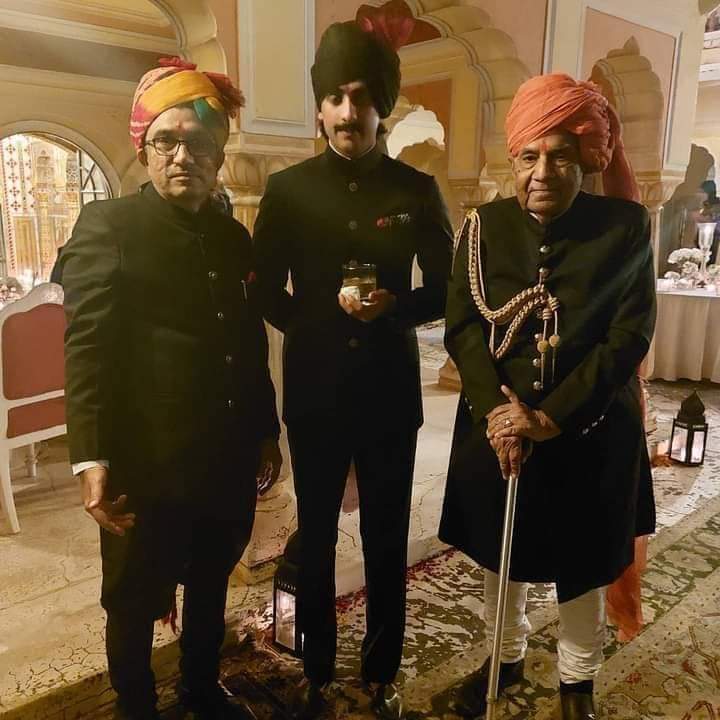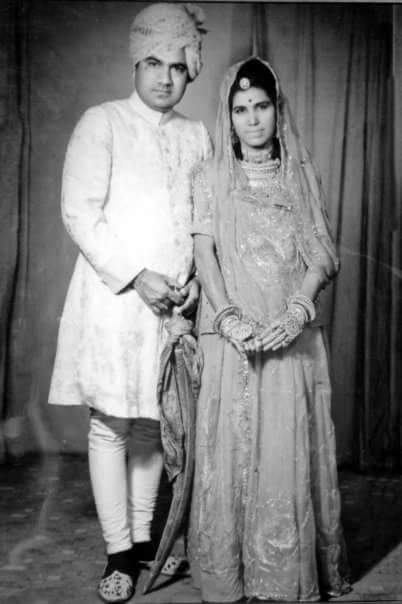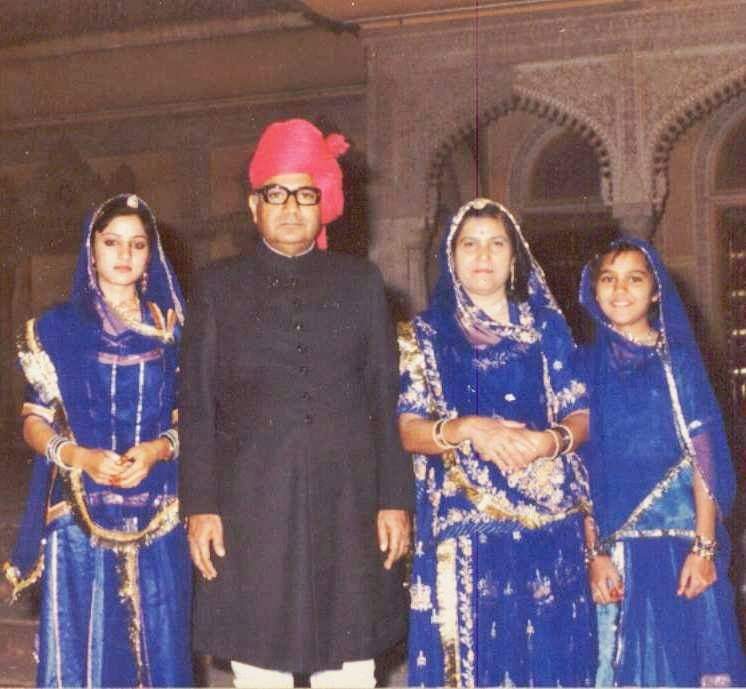
Present Head
History
Origin and Foundation of Malsisar Thikana
The historical town of Malsisar, situated in the Jhunjhunu district of Rajasthan, is a prominent Thikana (noble estate) of the historic Shekhawati region. The foundation of Malsisar is deeply intertwined with the rise of the Shekhawat clan of Kachwaha Rajputs, who established their hegemony over this arid yet strategically vital landscape of Rajasthan.
The lineage of Malsisar traces back to the legendary ruler Shardul Singhji of Jhunjhunu, who conquered the territory from the Kaimkhani Nawabs in 1730. Following Shardul Singh's demise, his vast territories were divided among his five surviving sons, a partition known historically as the Panchpana (five estates). The descendants of these rulers established several prominent vassal estates, or Thikanas, to defend the frontiers and administer the region.
Malsisar was founded as an independent estate by Thakur Maha Singhji, a descendant of Thakur Zorawar Singhji (one of the five sons of Shardul Singhji). In 1762 AD, Thakur Maha Singhji laid the foundation of the magnificent Malsisar Fort, which served as the administrative, military, and cultural epicenter of the fiefdom. Under his leadership, the small settlement of Malsisar grew into a well-fortified town, attracting merchants, artisans, and farmers who sought protection from the prevailing political instability of the 18th century.
The Shekhawati Era and Military Conflicts
During the late 18th and early 19th centuries, the Shekhawati region was a volatile frontier. Positioned between the major kingdoms of Bikaner, Jaipur, and the Delhi-centric Mughal Empire, Malsisar had to constantly defend its sovereignty. The rulers of Malsisar built an extensive network of watchtowers, bastions, and double-walled ramparts around the Malsisar Fort to withstand siege warfare.
The military forces of Malsisar, consisting of elite Rajput cavalry and local garrison units, frequently allied with neighboring Shekhawat estates to repel raids by predatory bands and rival principalities. Despite paying nominal allegiance to the Maharaja of Jaipur, the rulers of Malsisar maintained a high degree of administrative autonomy and operated as independent lords of their territory.
British Period and Economic Prosperity
With the signing of the Treaty of 1818 between the Jaipur State and the British East India Company, the political dynamics of Shekhawati underwent a drastic transformation. The early decades of the 19th century were marked by rampant banditry, which disrupted the lucrative trans-Saharan trade routes passing through the region. To curb this menace, the British established the Shekhawati Brigade in 1835 under the command of Lieutenant Henry Forster.
The restoration of law and order under British indirect rule ushered in a golden era of trade and commerce for Malsisar. The peace encouraged wealthy Marwari merchants, particularly from communities like the Chokhanis and Kanodias, to settle in the estate under the direct patronage of the Thakurs. These merchants constructed magnificent, multi-courtyard mansions known as havelis, adorned with intricate, colorful frescoes depicting mythological tales, British lifestyle, and historical events. This unique style of architecture turned Malsisar into an open-air art gallery.
Key Reformers and Cultural Contributions
The rulers of Malsisar were not only brave warriors but also progressive administrators and patrons of public welfare. During the late 19th and early 20th centuries, several rulers introduced significant social and civic reforms:
- Water Conservation: Due to the arid climate of the Thar desert, the Thakurs commissioned the construction of deep stepwells (baoris), reservoirs, and public wells to ensure a reliable water supply for the town and traveling caravans.
- Educational Initiatives: Rulers like Thakur Bhur Singhji supported the establishment of traditional schools and encouraged the wealthy mercantile class to fund modern educational institutions and libraries in the region.
- Religious Architecture: The family patronized the construction of several temples, including those dedicated to Lord Krishna and Shiva, which served as centers of community gathering and spiritual life.
Post-Independence and the Modern Era
Following India's independence in 1947, the princely state of Jaipur, along with its subordinate Thikanas, integrated into the newly formed United State of Greater Rajasthan in 1949. With the passing of the Rajasthan Land Reforms and Resumption of Jagirs Act in 1952, the traditional feudal system (Jagirdari) was dismantled, and the administrative powers of the Thikana of Malsisar were transferred to the democratic government.
In the post-independence era, the descendants of the Malsisar royal family adapted to the changing times by preserving their rich ancestral heritage. The grand Malsisar Fort was meticulously restored and converted into a premier heritage hotel, known globally as Malsisar Castle. This transition successfully put Malsisar on the international tourism map, attracting travelers seeking to experience authentic Rajput hospitality, royal architecture, and the world-famous Shekhawati frescoes.
Today, Malsisar stands as a testament to the resilient spirit of the Shekhawats. While it has embraced modern democratic structures, it continues to celebrate its rich historical legacy through its preserved monuments, vibrant festivals, and cultural preservation initiatives, bridging the gap between its heroic past and a progressive future.
Genealogy
- Thakur MAHA SINGH, Thakur of Malsisar 1745/1770, son of Thakur Zorawar Singh of Jhujhunu, started the construction of Malsisar Fort in 1762, married 1stly, Thakurani Bikawatiji of Kajala, married 2ndly, Thakurani Kanlotiji of Meloosar, and had issue, two sons (by 2nd wife) and seven daughters (by 1st wife). He died .
- Thakur Prithi Singh (by Thakurani Kanlotiji) (qv)
- Kunwar Zalim Singh of Sithal (by Thakurani Kanlotiji)
- Thakur PRITHI SINGH, Thakur of Malsisar 1770/1822, married and had issue. He died .
- Kunwar Devi Singh. died vpsp.
- Thakur Dungar Singh (qv)
- Kunwar Amar Singh, killed in 1831 (Bhadwa Sudi 12, 1888VS).
- Thakur DUNGAR SINGH, Thakur of Malsisar 1822/1825, married and had issue. He died .
- Thakur Duleha Singh (qv)
- Thakur DULEHA SINGH, Thakur of Malsisar 1825/1858, married 1stly, Thakurani Bidawatiji I of Senali, married 2ndly, Thakurani Bikawatiji of Baye, married 3rdly, Thakurani Bidawatiji II of Senali, and had issue. He died .
- Kunwar Chattar Singh (by Thakurani Bikawatiji), died young.
- Thakur UDAI SINGH, Thakur of Malsisar 1858/1878, born , second son of Thakur Roop Singh of Mandrella, and his wife, Thakurani Bikawatiji of Janwa, confirmed in the succession on 4th August 1863, married (as his only wife), Thakurani sa Bikawatji of Bajrangasar, died , and had issue. He died .
- Thakur Bhur Singh (qv)
- Thakur Chattar Singh, married Thakurani Gulab Kanwar of Lamia in Jodhpur, and had issue.
- Kunwar Harnath Singh, adopted by Thakur Chander Singh of Dundlod and succeeded there as Rawal Harnath Singhji Bahadur of Dundlod.
- Thakur Ishwari Singh
- Thakur Karni Singh, adopted to Chowkari, married and had issue.
- Thakur Jiwan Singh, a claimant for the gaddi of Malsisar (2000).
- Thakur Devi Singh, married to Thakurani Roop Kanwar, daughter of Thakur Jait Singh Rathore of Charwas and had issue, one son and a daughter.
- Thakur Bhawani Singh, a claimant for the gaddi of Malsisar (2000), adopted by Takhat Singh Ji (see below).
- Baisa Rajnigandha Shekhawat, a popular Rajasthan folk singer. (Wikipedia)
- Baiji Lal Bhallabh Kanwar
- Thakur Bhawani Singh, a claimant for the gaddi of Malsisar (2000), adopted by Takhat Singh Ji (see below).
- Thakur Bahadur Singh, married and had issue.
- Thakur Raj Singh
- Thakurani Sajjan Kanwar, married 1924 at Dundlod, Thakur Salim Singhji of Badu in Jodhpur.
- Rani Fateh Kanwar, married 1891, Rao Saheb Mod Singhji of Deolia.
- Thakur BHUR SINGH, Thakur of Malsisar 1878/1932, born at Mandrella, constructed Malsisar House at Jaipur, Member of the Council of Ministers of Jaipur State in 1895/1909, married the daughter of Thakur Shyam Singh Mertia of Baghot, died , and had issue. He died .
- Thakur Shivnath Singh (qv)
- Kunwar Bagh Singh, born , died .
- Thakur Takhat Singh (qv)
- Thakur SHIVNATH SINGH, Thakur of Malsisar 1932/1947, born , educated at Maharaja's College, Jaipur; married 1stly, 1900, a daughter of the Thakur of Jasana, died , married 2ndly, 1906 at Bikaner, daughter of Raja Jivaraj Singh Tanwar of Rori, died . He died sp on 21st November 1947 at Malsisar House in Jaipur.
- Thakur TAKHAT SINGH, Thakur of Malsisar 1947/1970, born , also Thakur of Mandrella 1942/1970, educated at Mayo College, Ajmer; married in 1906 (as his only wife), a daughter of the Thakur of Dadrera in Bikaner, died . He died sp on 5th May 1970.