Present Head

History

The princely state of Ali Rajpur was founded in 1437 by Anand Deo (or Ude Deo), a Rathore Rajput who established his stronghold in the rugged Malwa region of Central India. For centuries, the state maintained its independence amidst shifting regional powers, navigating complex relationships with neighboring Maratha kingdoms. By the late 19th century, under British suzerainty, the state maintained a structured internal defense system. In 1893, the ruling Rana was formally permitted to maintain a military force consisting of 11 cavalry, 169 infantry, and 7 guns, reflecting its recognized status among the minor salute states of the Central India Agency.
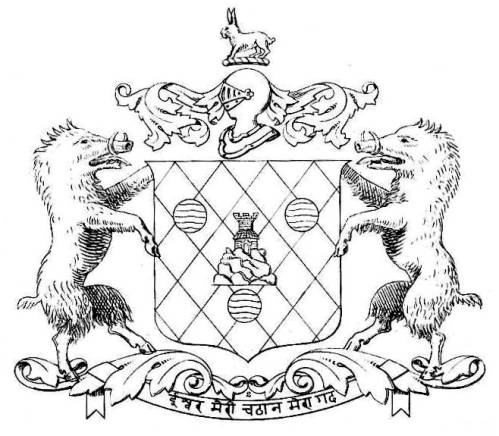
The state's deep geopolitical ties and cultural pride were visually immortalized in its heraldry and vexillology. The State Flag of Ali Rajpur featured alternating red and white stripes—a specific color scheme granted by the Holkar rulers of Indore as an enduring symbol of friendship, alliance, and mutual gratitude. In contrast to the state flag, the Personal Flag of H.H. The Raja of Ali Rajpur was a traditional Rajput Panchranga (five-colored banner) featuring horizontal stripes of saffron, red, white, blue, and green, representing the sovereign's proud solar lineage.
State Vexillology & Heraldry
- The State Flag: The colors red and white were the same as Indore, granted by the rulers of Indore as an enduring sign of friendship and gratitude.
- The Personal Flag of H.H. The Raja: In contrast to the state flag, the personal banner of the Raja was a traditional Rajput panchranga consisting of five horizontal stripes: saffron, red, white, blue, and green.
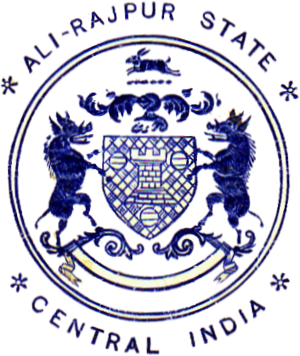
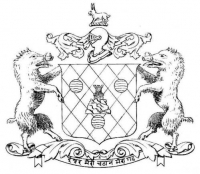
- The Coat of Arms: The official heraldic achievement of the state was intricately detailed and rich with martial symbolism:
- Arms (Shield): Lozengy Tenn and Argent (a diamond pattern of orange-brown and silver), featuring a central tower standing on a hill between three fountains proper (in natural colors).
- Crest: Placed on a helmet facing to the dexter (the viewer's left), with lambrequined Tenn and Argent (mantling of orange-brown and silver), featuring a hare courant proper (a running hare).
- Supporters: Two wild boars proper flanking the shield.
- Motto: "Isvara, meri Catan, mera Garh" — translating to "God, my Rock, my Fortress."
The Foundation and Early Rajput Sovereignty (15th–17th Centuries)
The historical genesis of Ali Rajpur lies in the migration of the Rathore Rajputs from the desert plains of Marwar (Jodhpur) into the rugged, forest-clad terrain of southwestern Malwa. In 1437, Anand Deo (also recorded in colonial-era genealogies as Ude Deo), a descendant of the illustrious Rathore line, conquered the local tribal chieftains of the region. He established his principal stronghold at Ali, a strategically fortified settlement nestled amidst the Vindhya and Satpura ranges.
For several generations, the rulers of this remote territory consolidated their power over the indigenous Bhil and Bhilala populations, establishing a highly decentralized feudal framework. This frontier outpost served as a buffer zone between the Gujarat Sultanate to the west and the Malwa Sultanate to the east. The capital was eventually moved from the ancient hill fort of Ali to the more accessible valley plains of Rajpur by Rana Lall Singh in the mid-18th century, thereby creating the compound name Ali-Rajpur.
Maratha Expansion and the Era of Turbulence
During the 18th century, the expansion of the Maratha Confederacy under the Peshwas severely disrupted the traditional sovereignty of the Rajput principalities in Central India. The Holkars of Indore and the Pawars of Dhar aggressively levied tribute (known as tanka or khiraj) on the rulers of Ali Rajpur.
The political stability of the state crumbled during the late 18th and early 9th centuries due to succession disputes and frequent incursions by Maratha armies, Pindari raiders, and local tribal insurgents. To defend the kingdom from complete disintegration, Rana Pratap Singh I employed a formidable contingent of Makrani mercenaries—descendants of soldiers originally hailing from the Makran coast of Balochistan. Under the leadership of their charismatic commander, Musafir Makrani, these mercenaries became the de facto arbiters of the state's political affairs, managing the administrative and military machinery of Ali Rajpur for several decades.
The British Protectorate and Administrative Modernization
Following the decisive defeat of the Marathas in the Third Anglo-Maratha War (1817–1818), the British East India Company established its hegemony over Central India. Under the Treaty of Mandsaur in 1818, British mediation resolved the conflicting tribute claims between the Holkars of Indore and the rulers of Ali Rajpur. The British formally recognized Ali Rajpur as a protected princely state under the political control of the Bhopawar Agency (which later merged into the Central India Agency).
In 1862, Rana Jaswant Singh died , leaving behind a complex succession struggle. After brief periods of administrative instability and British intervention, Rana Pratap Singh II succeeded to the gaddi in 1891. Educated at Daly College in Indore, Rana Pratap Singh II was a visionary administrator who championed institutional modernization. Under his long reign, the state emerged from its medieval isolation:
- Infrastructure Development: Metalled roads were constructed to connect Alirajpur with neighboring commercial hubs in Gujarat and the Central Provinces.
- Forestry and Agriculture: Scientific forest management practices were introduced to protect and monetize the state's vast reserves of teak and bamboo.
- Social Reforms: Modern healthcare dispensaries, veterinary clinics, and Western educational facilities were established, specifically catering to the indigenous tribal populations.
In recognition of his exemplary administrative reforms and loyalty to the British Crown, Rana Pratap Singh II was granted the hereditary title of Raja in 1911 and was subsequently invested as a Knight Commander of the Most Eminent Order of the Indian Empire (KCIE). The state was also accorded an 11-gun salute status.
Integration into Independent India and the Modern Era
On the eve of Indian Independence in 1947, the last ruling sovereign of the state, Raja Surendra Singh, signed the Instrument of Accession to the Dominion of India. On June 15, 1948, the state of Ali Rajpur officially merged into the newly formed United State of Gwalior, Indore, and Malwa, popularly known as Madhya Bharat. Under the States Reorganisation Act of 1956, Madhya Bharat was subsequently integrated into the linguistic state of Madhya Pradesh.
After serving as a subdivision of the Jhabua district for several decades, Alirajpur's distinct geographical, cultural, and administrative identity was officially recognized on May 17, 2008, when it was carved out to become the 49th independent district of Madhya Pradesh. Today, the modern district of Alirajpur retains its vibrant tribal heritage, globally renowned for its traditional Pithora paintings and local crafts.
Historical Sources and Bibliography
For further historical exploration, readers may refer to the following authentic historical references and archival material:
- Detailed administrative and historical overviews of the state can be accessed via the Digital South Asia Library - Imperial Gazetteer of India (Volume 5).
- Biographical details of the ruling family and early colonial interactions are recorded in The Golden Book of India by Sir Roper Lethbridge (1893).
- Genealogical lineages and state treaties are compiled in A Collection of Treaties, Engagements, and Sanads by C.U. Aitchison.
Genealogy
- Rana ANAND DEO, 1st Rana of Alirajpur 1437/1440, founder of the state in 1437, married and had issue.
- Rana Pratap Deo (qv)
- Rana PRATAP DEO, 2nd Rana of Alirajpur 1440/-, married and had issue.
- Rana Chanchal Deo (qv)
- Rana CHANCHAL DEO, 3rd Rana of Alirajpur, married and had issue.
- Rana Gugal Deo (qv)
- Kunwar Kesar Deo, he was the founder of Jobat.
- Rana GUGAL DEO, 4th Rana of Alirajpur
- Rana BACHCHHARAJ DEO, Rana of Alirajpur
- Rana DIP DEO, Rana of Alirajpur
- Rana PAHAD DEO I, Rana of Alirajpur
- Rana UDAI DEO, Rana of Alirajpur
- Rana PAHAD DEO II, Rana of Alirajpur -/1765, died .
- [Rana RAYA SINGH fl.1650, married Rani Devimati of Barwani.]
- [Rana PRITHI DEO, married and had issue. Rana SURAT DEO (qv)]
- [Rana SURAT DEO -/1765, married and had issue. Rana PRATAP SINGH (qv) generation Kunwar Kesari Singh, he attempted to supplant his cousin, Rana Jaswant Singh in 1818 after the death of Rana Pratap Singh, but was driven out by Musafir.]
- Rana PRATAP SINGH I, Rana of Ali Rajpur 1765/1818 (deposed), married and had issue. He died .
- Rana Jaswant Singh (qv)
- Musafir Mekran, an adventurer, a long-time manager of the state, he usurped the gaddi after the death of Rana Pratap Singh, but was deposed later that same year in 1818, he made himself useful in expelling his countrymen and other foreigners and was therefore recognised as Manager of the State during the minority of Jaswant Singh. REGENCY 1818/1839
- Rana JASWANT SINGH, Rana of Ali Rajpur 1839/1862, born posthumously in 1818, he was granted ruling powers on attaining his majority in 1839; married twice, Umaid Kunverba (died ), Tej Kunverba (died on ) and had issue. He died leaving a will by which he divided the State between his two sons.
- Rana Ganga Deo (qv)
- Rana Rup Deo (qv)
- Rana GANGA DEO, Rana of Ali Rajpur 1862/1869 (deposed), born about 1845, on his succession, a dress of honour was conferred on him by the British Government and a nazrana of Rupees 1,500 was taken; his incompetency and the anarchy which had prevailed since he was entrusted with power, compelled the British Government in 1869 to depose him and take the State under management, Muhammad Najaf Khan was appointed Superintendent; the deposed Rana was granted an allowance fixed at Rupees 1,000 per mensem; his excesses had rendered him an imbecile for several months previous to his death, he died in . Married to Solankiniji (Mahidaji) Dev Kunverba, daughter of Rana Raisinhji Kushalsinhji of Mandvi and Chasatiaji Anup Kunverba (she died on ).
- Rana RUP DEO, Rana of Ali Rajpur 1869/1881, born , he was recognized as his successor, but was only entrusted tentatively with the management of affairs in 1873 on the understanding that his continuance in power would depend on the manner in which he carried on the administration; he adopted Kunwar Bijai Singh from Sondwa, married and had adoptive issue. He died spm on 29th October 1881. REGENCY 1881/1890
- Rana BIJAI SINGH, Rana of Ali Rajpur 1881/1890, he succeeded by adoption, educated at Daly College, Indore then at Rajkumar College, Indore till 1888; he was succeeded by his cousin, Kunwar Pratap Singh, son of Thakur Bhagwan Singh of Sondwa, who was selected by the Government of India in 1891; he married twice and had issue, a daughter. He died spm on 16th August 1890.
- Maharajkumari Suraj Kunverba (by the Senior Rani), born , married to HH Maharawal Sir Indrasinhji Pratapsinhji of Bansda.
- (A) HH Maharaja Sir Pratap Singh II Bahadur (qv)
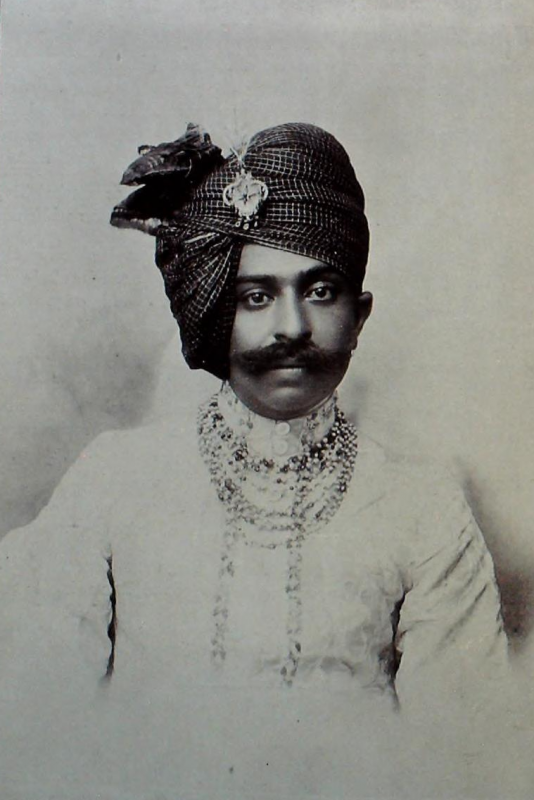
- HH Maharaja Sir PRATAP SINGH II Bahadur K.C.I.E., 1st Raja of Ali Rajpur 1891/1941 (abdicated) and Regent of Ali Rajpur 1941/1948, born as Kunwar Pratap Singh, son of Thakur Bhagwan Singh of Sondwa, educated at Daly College, Indore; succeeded 14th February 1891, he was formally installed in March 1892; during his minority the State was managed by a Kamdar under the supervision of the Political Agent till 1904 when he was granted full ruling powers; made a Magistrate First Class in 1902; C.I.E. [cr.1915], K.C.I.E., Raja [cr.1911], Maharaja (Personal) [cr.1941], salute raised to 11 guns in 1920 and made hereditary in 1921, married 1stly, 1900, Raj Kunverba, daughter of Thakore Bahadur Sinh of Kathiwada, married 2ndly, 1902, Dev Kunverba, daughter of Kumar Shri Chandrasinhji Jitsinhji of Chhota-Udaipur, and had issue, one son and two daughters. He died after 1950.
- HH Raja Fateh Singh (by 1st marriage) (qv)
- Rani Anand Kumari, married 28th February 1922 (as his first wife), Raja Kishor Chandra Mardraj Harichandan of Nilgiri, and had issue.
- Rani Samaj Kumari
- HH Raja FATEH SINGH, 2nd Raja of Ali Rajpur in 1941, born , engaged 19th July 1915 to Kunwari Sahiba Rajendra Kunwar Ba, daughter of Lt.-Col. HH Maharawal Sir Shri Ranjitsinhji Mansinhji, 16th Raja Saheb of Baria, maried and had issue. He died .
- HH Raja Surendra Singh (qv)
- HH Raja Kamlendra Singh (qv)
- Rajkumari Rohini Devi, married (as his first wife) 1945 (div.), Raja Narendra Singh of Sarila.
- [Rajkumari (name unknown), married (as his first wife), Raj Rajeshwar Shreeman Thakor Saheb Swaroopsinghji Chhatrasinghji, Thakore Saheb of Chorangala, and had issue.]
- HH Raja SURENDRA SINGH, 3rd Raja of Ali Rajpur 1941/1996, born , educated at Marlborough College, England; served with the I.F.S., Indian Ambassador to Spain around 1980, married (div.). He died sp on 30th March 1996 at the Shreemaya Hotel in Indore.
- HH Raja KAMLENDRA SINGH, 4th Raja of Ali Rajpur (see above)
Notable Figures
Rana Anand Deo (c. 1437 – 1440)
Rana Anand Deo, a Rathore Rajput descendant from the illustrious ruling house of Marwar, was the founder of the Alirajpur State in 1437. He carved out a sovereign principality in the rugged, hilly tracts of southwestern Malwa. Originally, he established his stronghold and capital at Ali, which gave the first half of the name to the princely state. His military prowess and strategic alliances allowed him to pacify the local tribal chieftains and secure his dynasty's hold over the region. More information about the foundation of the state can be explored on the Alirajpur State Wikipedia Page.
Rana Jaswant Singh (r. 1818 – 1862)
Rana Jaswant Singh's long reign occurred during a defining era of British expansion in Central India. Following the Third Anglo-Maratha War and the subsequent pacification of Malwa, Alirajpur entered into a treaty of protective alliance with the British East India Company in 1818. This brought much-needed stability to the state, which had previously suffered from continuous raids by the Marathas and Pindaris. Jaswant Singh's rule focused on restoring law and order, establishing fixed land revenues, and rebuilding the state's economy. Details of this transition are documented in the Imperial Gazetteer of India.
Rana Rup Deo (r. 1862 – 1881)
Succeeding his father, Rana Rup Deo managed the administration of Alirajpur with a focus on internal consolidation and infrastructure development. During his rule, the capital saw several improvements, and efforts were made to improve communication and trade routes connecting Alirajpur with neighbouring states like Baroda and Gwalior. His reign was characterized by peaceful relations with the British Central India Agency, which assisted in administrative reforms and boundary settlements.
Rana Bijai Singh (r. 1881 – 1890)
Rana Bijai Singh succeeded to the gadi in 1881. His tenure was relatively short but marked by efforts to reform the judicial and police systems within the state to curb banditry in the dense forest tracts. He worked towards educational advancement by establishing some of the earliest state-sponsored primary schools in the region. Upon his passing in 1890, he was succeeded by Pratap Singh II.
Rana Pratap Singh II (r. 1890 – 1941)
Rana Pratap Singh II was one of the most prominent, progressive, and longest-reigning rulers of Alirajpur. Ascending the throne in 1890, his administration transformed the state from a medieval principality into a modern, well-administered territory. He established modern courts, schools, hospitals, and a network of metalled roads. For his loyal services and administrative reforms, the British Crown elevated his personal title to Maharaja, and he was highly respected in the chamber of princes. Historical records of his administrative works can be referenced in the Digital South Asia Library - Imperial Gazetteer of India (Alirajpur).
Maharaja Surendra Singh (r. 1941 – 1947)
Maharaja Surendra Singh was the last official ruling prince of the Alirajpur State before its integration into the Union of India. He succeeded his grandfather, Rana Pratap Singh II, in 1941. In 1947, he signed the Instrument of Accession, merging Alirajpur into the newly formed state of Madhya Bharat, which later became part of Madhya Pradesh.
Following the integration of his state, Maharaja Surendra Singh transitioned into a highly distinguished career as a diplomat for the Republic of India. He served with distinction in the Indian Foreign Service (IFS) and held several key diplomatic assignments, including serving as the Ambassador of India to Spain. His life, diplomatic career, and legacy are detailed on the dedicated Surendra Singh of Alirajpur Wikipedia Page.