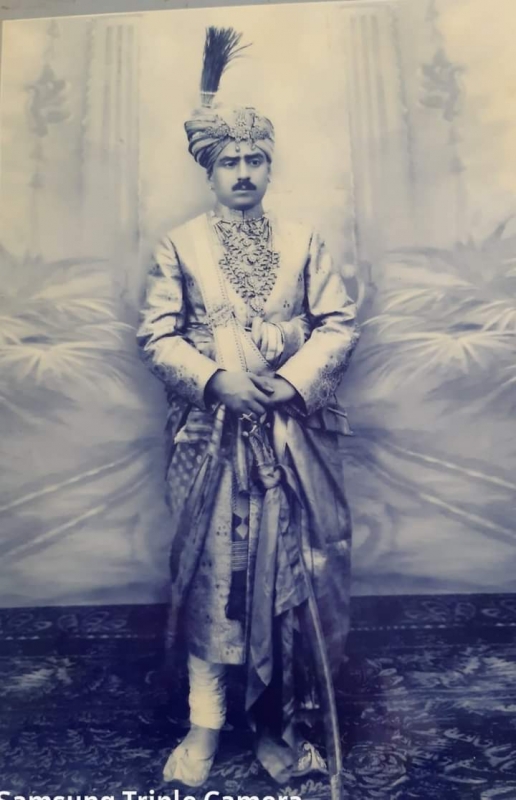
Present Head
- Tikka Sahib Nagendra Singh of Jaswan, born , married 1985, Tikka Rani Bhuvaneshwari Kumari, daughter of Thakore Shri Janakisinhji Chandrasinhji of Rajpur in Kathiawar, and has issue.
- Kunwar Prithviraj Singh, born .
- Rajkumar Vijaindra Singh, married Rajkumarani Ritu Kumari, daughter of Kanwar Devendra Narain Singh of Tirwa, and has issue.
- Kunwar Raghavendra Singh, born , married to Aditi Gudha, daughter of Lt. Kunwar Kishan Singh Gudha and Kunwarani Uma Singh of Thikana Gudha Chandraji, Rajasthan.
History
The History of Jaswan State
Jaswan State was an ancient principality of India, situated in the outer Shivalik hills of the Punjab Himalayas, in the modern-day Una district of Himachal Pradesh. Founded in the late 12th century, Jaswan holds the distinct historical reputation of being the very first offshoot of the prestigious and ancient Katoch dynasty of Kangra.
Origins and Foundation
According to historical chronicles, the state of Jaswan was founded around 1170 AD by Raja Purab Chand, a prince of the royal Katoch family of Kangra State (ancient Trigarta). For centuries, the Katoch dynasty ruled the vast hill tracts, but domestic rivalries and the expansion of the family eventually led to the creation of independent branches. Purab Chand carved out an independent territory in the fertile Jaswan Dun valley, establishing his capital at Rajpura. The rulers of Jaswan adopted the clan name "Jaswal" after the name of their newly established state.
A detailed account of this dynastic separation and the early genealogy of the Jaswal Rajas can be explored in the authoritative volume History of the Panjab Hill States (Vol. 1) by J. Hutchison and J.Ph. Vogel.
Mughal Suzerainty and Confrontations
During the medieval era, as the Mughal Empire expanded under Emperor Akbar, the hill states of the Punjab came under imperial influence. Jaswan was forced to acknowledge Mughal suzerainty. Despite their vassal status, the Rajas of Jaswan often allied with neighboring hill chiefs to assert their independence when opportunities arose.
During Akbar's reign, the state participated in various uprisings led by the hill chiefs, notably in 1589 and 1603. However, these rebellions were swiftly suppressed by Mughal commanders. Under the subsequent reigns of Jahangir and Shah Jahan, the Jaswal rulers maintained a largely peaceful relationship with Delhi, often serving in the Mughal military campaigns in the Deccan and the northwest frontier to preserve their ancestral fiefdoms.
Sikh Hegemony and the Annexation of 1815
With the decline of the Mughal Empire in the 18th century, the region witnessed a intense power struggle between Raja Sansar Chand of Kangra, the Gurkhas of Nepal, and the emerging Sikh Empire under Maharaja Ranjit Singh. Initially, Jaswan became a tributary to Sansar Chand of Kangra. However, the rise of Sikh power soon reshaped the geopolitics of the Punjab hills.
In 1815, Maharaja Ranjit Singh summoned all the hill chiefs to a grand assembly at Sialkot. The Raja of Jaswan, Umed Singh, failed to attend, which Ranjit Singh used as a pretext to levy a massive monetary fine. Unable to pay the exorbitant demand, Raja Umed Singh was forced to surrender his state to the Sikh Empire. The state was formally annexed, and Umed Singh was reduced to a jagirdar, receiving a small estate at Rajpura for his sustenance. More insights on this era can be found in the historical records of the Punjab District Gazetteers: Hoshiarpur District.
The British Era and the Rebellion of 1848
Following the First Anglo-Sikh War (1845–1846) and the subsequent Treaty of Lahore, the territory between the Satluj and Beas rivers—including Jaswan—was ceded to the British East India Company. Raja Umed Singh had actively supported the British during the conflict, expecting that his sovereign principality would be restored to him. However, the British chose to retain direct administrative control over the annexed territories, disappointing the local rulers.
This widespread discontent culminated in the Revolt of 1848 (aligned with the Second Anglo-Sikh War). Raja Umed Singh, in alliance with the Rajas of Kangra, Datarpur, and Nurpur, raised the banner of rebellion against British rule. The rebellion was swiftly crushed by British forces. The fort of Rajpura was dismantled, the royal palaces were plundered, and Raja Umed Singh, along with his son Jai Singh, was arrested and exiled to Almora in Kumaon, where they both eventually passed away in exile.
The Ramkot Connection and Later Restoration
The family's fortunes took a turn during the reign of Raja Ran Singh, the grandson of Umed Singh. Ran Singh married a daughter of Maharaja Ranbir Singh of Jammu and Kashmir. Utilizing this powerful marital alliance and lobbying the British government, Ran Singh managed to secure the restoration of some of his ancestral properties in Jaswan. Additionally, the British granted him the jagir of Ramkot in the Jammu region, which served as the seat of the family for several decades.
State Heraldry and Flag
The heraldic traditions of the Jaswan state closely aligned with their Suryavanshi (solar dynasty) Rajput lineage. The state flag was a sacred rectangular banner of saffron (Kesari), symbolizing sacrifice, purity, and valor. It featured a central representation of the Sun God (Surya), reflecting the clan's mythological descent from the solar line. The royal coat of arms prominently featured the sun, flanked by Rajput warriors, with a motto emphasizing devotion to truth and duty.
Post-Independence and Modern Era
Following the independence of India in 1947, the royal family's estates in Ramkot and Jaswan were integrated into the Indian Union. With the reorganization of states, the ancestral lands of Jaswan became a part of the Una district in Himachal Pradesh. Today, the descendants of the Jaswan royal family reside in both Himachal Pradesh and Jammu, actively preserving their historical heritage.
The ruins of the old fort at Rajpura and the ancestral temples in the Jaswan Dun valley remain quiet testaments to the long history and resilience of the Jaswal Rajputs, drawing historians and tourists interested in the rich heritage of the Western Himalayas.
Genealogy
- Raja PURAB CHAND, 1st Raja of Jaswan 1170/-
- Raja PARAB CHAND, 2nd Raja of Jaswan
- Raja BISWA CHAND, 3rd Raja of Jaswan
- Raja GOPAL CHAND, 4th Raja of Jaswan
- Raja SIRBAHK CHAND, 5th Raja of Jaswan
- Raja DHULA CHAND, 6th Raja of Jaswan
- Raja SULACHAN CHAND, 7th Raja of Jaswan
- Raja AUKI CHAND, 8th Raja of Jaswan
- Raja UDHAM CHAND, 9th Raja of Jaswan
- Raja NIRPAT CHAND, 10th Raja of Jaswan
- Raja UDHARN CHAND, 11th Raja of Jaswan
- Raja BHIKH CHAND, 12th Raja of Jaswan
- Raja SIRKAR CHAND, 13th Raja of Jaswan
- Raja MUBARAK CHAND, 14th Raja of Jaswan
- Raja GOVIND CHAND, 15th Raja of Jaswan fl.1572, he defended the fort of Kangra from the Mughal Emperor Akbar, in the absence of his kinsman Raja Jai Chand Katoch of Kangra.
- Raja BIKRAM CHAND, 16th Raja of Jaswan
- Raja ANIRUDH CHAND, 17th Raja of Jaswan fl.1589, he joined a general revolt of the hill-states against the Mughals led by his kinsman Raja Bidhi Chand of Kangra.
- Raja SAMIR CHAND, 18th Raja of Jaswan
- Raja MAN SINGH, 19th Raja of Jaswan
- Raja AJAB SINGH, 20th Raja of Jaswan
- Raja RAM SINGH, 21st Raja of Jaswan
- Raja AJIT SINGH, 22nd Raja of Jaswan
- Raja JAGHAR SINGH, 23rd Raja of Jaswan
- Raja ABHIRAI SINGH, 24th Raja of Jaswan
- Raja JAGRUP SINGH, 25th Raja of Jaswan
- Raja PRIT SINGH, 26th Raja of Jaswan
- Raja UMMED SINGH, 27th and last independent Raja of Jaswan 1800/1849, born about 1781, in 1815, Maharaja Ranjit Singh summoned all his forces, to assemble at Sialkot, but the Raja of Jaswan failed to obey the summons and a fine fixed beyond his resources was imposed. Submitting quietly to his fate Raja Ummed Singh resigned his state and accepted a jagir of 12,000Rs p.a., he joined unsuccessfully in a revolt against the British in 1848, his property was confiscated and he was exiled to Almora; he married and had issue. He died at Almora.
- Raja Jai Singh (qv)
- Raja Ran Singh (qv)
- Kunwar Prithi Singh
- Raja RAN SINGH, 29th Raja of Jaswan 1863/1892, born , received the jagir of Ramkot in Jammu when he married the Princess of Jammu. Title of "Raja" not recognized by the British. In 1877 the jagir in Jaswan, consisting of 21 villages in the Jaswan Dun was restored to the Raja, as well as the family garden at Amb and buildings at Rajpura, married 1stly, a (?grand) daughter of the Raja of Baghal, married 2ndly, a grand-daughter of HH Maharaja Gulab Singh of Jammu and Kashmir, and had issue. He died .
- Raja Raghunath Singh (qv)
- Kumari (name unknown), married Tikka Arimardan Sen of Suket.
- Raja RAGHUNATH SINGH, 30th Raja of Jaswan 1892/1918, born , he was granted the personal title of "Raja" on account of his ancient lineage and marriage connection with the Maharajas of Jammu & Kashmir. The title did not grant him the right to administer law and order in his jagir, and such title could not be passed on by inheritance. His property was divided among six children, married 1stly, 1871, a daughter of HH Maharaja Ranbir Singh of Jammu and Kashmir, married 2ndly, 1871, another daughter of HH Maharaja Ranbir Singh of Jammu and Kashmir, married 3rdly, Rani (name unknown) [? a daughter of Raja Kishan Singh, Raja of Baghal], married 4thly, 1901, a daughter of Raja Ram Palji of Kutlehar, and had issue. He died .
- Kumari (name unknown) (by a Jammu Rani), married HH Raja Shyam Singh of Chamba.
- HH Rani Dharam Deiji Saheba (by a Jammu Rani), married HH Raja Ram Singh of Chamba. She died in .
- Raja Lakshman Singh (by the 4th Rani) (qv)
- Rajkumar Santdev Singh (by the 4th Rani), born , he was mentally unsound and was looked after by his younger brother, Rajkumar Shivdev Singh. He died sp in 1960.
- Rajkumar Hardev Singh (by the 3rd Rani), born , married and had issue. He died .
- Kr. Rajinder Singh
- Kr. Virender Singh
- Kr. Late Sh. Narinder Singh
- Kr. Surinder Singh
- Rajkumar Shivdev Singh (by the 4th Rani), born , he served in the administration of Maharaja Hari Singh of Jammu & Kashmir and retired as Chairman of independent India's Union Public Service Commission, married and had issue. He died . (Jammu, India)
- Kunwar Rameshwar Singh, married Kunwarani Kamla Kumari of Bhikamkor in Rajasthan, and had issue. He died in Jammu.
- Kunwar Adhirath Singh
- Kumari Kaushalya Devi
- Kunwar Baldev Singh
- Kunwar Brijender Singh
- Kumari Vina Kumari, died .
- Kunwar Rameshwar Singh, married Kunwarani Kamla Kumari of Bhikamkor in Rajasthan, and had issue. He died in Jammu.
- Raja LAKSHMAN SINGH, 31st Raja of Jaswan 1918/1945, born , Head of the Royal family of Jaswan, resided at Ramkot; married 1stly, Rani Tottan Dei, daughter of Raja Kedar Chand of Chenani, married 2ndly, a daughter of Maj. Kunwar Ishar Singh Jamwal, and had issue. He died in Ramkot and was cremated at Khoon, seven kilometres from Ramkot.
- Rajkumari Hemlata Kumari (by Rani Tottan Dei), born O ctober 1923, married Tikka (later Raja) Udaibhan Chand of Datarpur, and had issue. She died .
- Raja Chain Singh (by Rani Tottan Dei)(qv)
- Rajkumar Devinder Singh (by 2nd Rani), married Rajkumar-Rani Sonia Kumari of Guler, and has issue.
- Kanwar Aaditya Singh Jaswal, born , married Kanwarani Bhawani Jamwal, born , daughter of Commandant V. S. Jamwal, and has issue, one son.
- Zorawar Singh Jaswal, born .
- Kanwar Aaditya Singh Jaswal, born , married Kanwarani Bhawani Jamwal, born , daughter of Commandant V. S. Jamwal, and has issue, one son.
- Rajkumari Krishna Kumari (by 2nd Rani), married Rai Sahib Karan Singh of Kathlour, Punjab.
- Raja CHAIN SINGH, 32nd Raja of Jaswan (see above)
- Kanwar Inder Singh, married Kumari Uttam Dei, daughter of Kanwar Saheb Shri Nihal Singhji of Chamba, and his first wife, Kanwarani Leela Devi, and had issue, one son and four daughters.
- Kumari Nina Devi
- Kumari Nitta Devi
- Kumari Nima Devi
- Kumari Neeru Devi, married Kanwar Vijay Singh of Sirmur, and has issue.
- Col. Vijay Singh, married and has issue.