Present Head
- Baiji Lal Roop Kanwar, married to Thakur Devi Singh Ji of Thikana Malsisar.
History
Origin and Lineage of Charwas Thikana
The Thikana of Charwas holds an esteemed position within the historical feudal hierarchy of the erstwhile princely state of Bikaner. The rulers of Charwas belong to the illustrious Bidawat clan of the Rathore dynasty, tracing their ancestry back to Rao Bida, the founder of Bidasar and the brother of Rao Bika (the founder of Bikaner State). The estate of Charwas was established when Thakur Saheb Gopaldas, a great-grandson of Rao Bida, granted this territory to his son, Thakur Saheb Tej Singhji. Under the leadership of Tej Singhji, the estate flourished, and its strategic importance was recognized by Maharaja Rai Singhji of Bikaner (who ruled from 1571 to 1612 AD), who formally granted the honour of Tazim to the Charwas chief. Over the generations, the estate grew to encompass 12 prosperous villages.
The Status of Charwas in Bikaner Darbar
As one of the prominent Bidawat estates, the Thakur of Charwas was recognized as an Umrao (premier noble) of the Bikaner State. In the royal court (Darbar), the chief of Charwas enjoyed the prestigious hereditary distinctions of Dohri Tazim (double tazim, a ceremonial reception where the Maharaja rises twice to welcome and dismiss the noble) and Kurab Hath (the privilege of the Maharaja placing his hand on the noble's shoulder in greeting). These honours signified high feudal standing and deep mutual respect between the ruling house of Bikaner and the thikana.
Conflict, Rebellion, and Reconciliation
During the late 18th and early 19th centuries, Charwas played an active and volatile role in the military and political affairs of Bikaner:
- The Johia Campaign (1763 AD): The rulers of Charwas demonstrated outstanding military valor by aiding the Bikaner state forces in suppressing the incursions of the warlike Johiya clan on the northern frontier.
- Demolition of the Fort and Rebellion (1813 AD): Relations with the center strained during the reign of Maharaja Surat Singhji. In his efforts to centralize administrative authority and secure tributes, the Maharaja ordered the demolition of several feudal fortresses, including the fort of Charwas in 1813 AD. This action provoked a major rebellion, with the Thakur of Charwas joining forces with other aggrieved Bidawat chiefs against the state. This period of unrest is well-documented in regional administrative histories, such as those found in Major P.W. Powlett's Gazetteer of the Bikaner State.
- Pardon and Reconciliation (1831 AD): The long-standing rebellion was eventually resolved during the reign of Maharaja Ratan Singhji. Through the diplomatic mediation of the influential Shekhawat chiefs, specifically the Thakurs of Mandawa and Dunlod (Dundlod), a peace agreement was brokered in 1831 AD, and the rulers of Charwas were formally pardoned and restored to their estates.
The 1857 Uprising and Late Colonial Period
During the Indian Uprising of 1857, Maharaja Sardar Singh of Bikaner actively supported the British East India Company. Aligning with the state policy, the Thakur of Charwas provided crucial military contingents and resources to assist the state forces during the rebellion. In recognition of this valuable service, the Bikaner Darbar conferred the honor of Siropav (a ceremonial robe of honor) upon the Thakur of Charwas, cementing their loyalty and status in the late 19th-century colonial hierarchy.
Post-Independence and Modern Era
Following India's independence in 1947, the princely state of Bikaner integrated into the United State of Greater Rajasthan in 1949, which eventually became the modern state of Rajasthan. With the passing of the Rajasthan Land Reforms and Resumption of Jagirs Act in 1952, the feudal privileges, jagirdari rights, and administrative powers of the Charwas Thikana were formally abolished. Today, the descendants of the Charwas estate preserve their rich heritage, historical artifacts, and ancestral legacy while actively contributing to modern professions, local development, and social initiatives in the Churu region of Rajasthan.
Genealogy
- Thakur Saheb Tej Singhji, 1st Thakur of Charwas.
- Thakur Saheb Ramchander, 2nd Thakur of Charwas.
- Thakur Saheb Pratap Singhji, 3rd Thakur of Charwas.
- Thakur Saheb Pem Singhji, 4th Thakur of Charwas.
- Thakur Saheb Mukund Singhji, 5th Thakur of Charwas.
- Thakur Saheb Vijay Singhji, 6th Thakur of Charwas.
- Thakur Saheb Bahadur Singhji, 7th Thakur of Charwas.
- Thakur Saheb Prithvi Singhji, 8th Thakur of Charwas.
- Thakur Saheb Sangram Singhji, 9th Thakur of Charwas.
- Thakur Saheb Gyan Singhji, 10th Thakur of Charwas.
- Thakur Saheb Jawahar Singhji, 11th Thakur of Charwas.
- Thakur Saheb Man Singhji, 12th Thakur of Charwas.
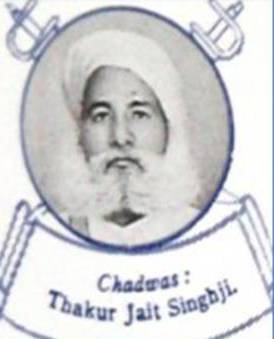
- Thakur Sahab Jait Singhji, 13th Thakur of Charwas (see above)