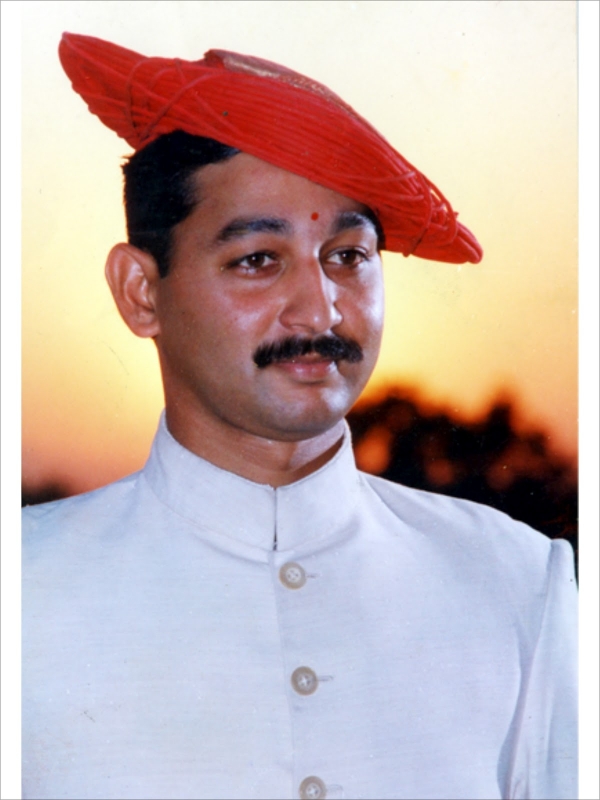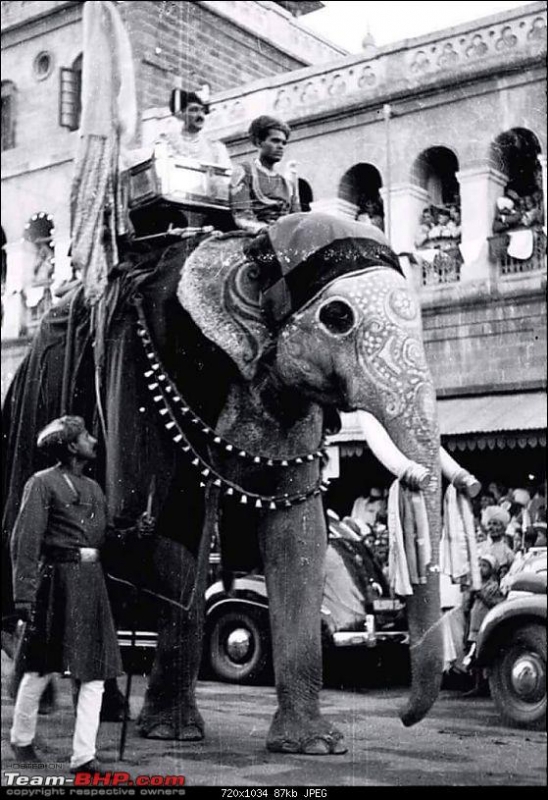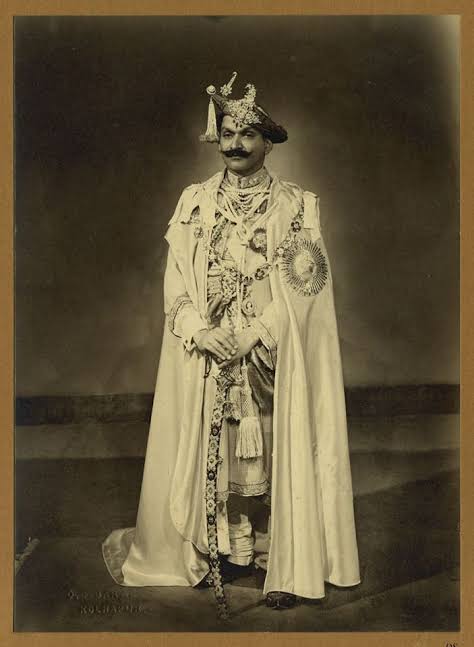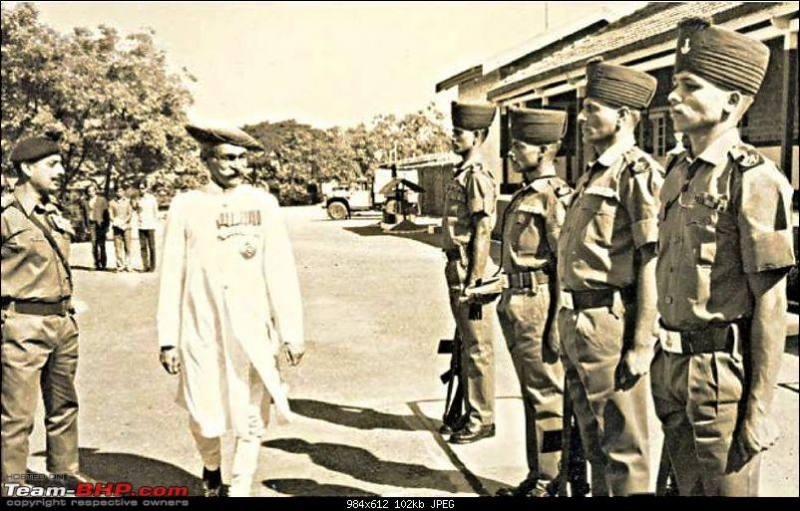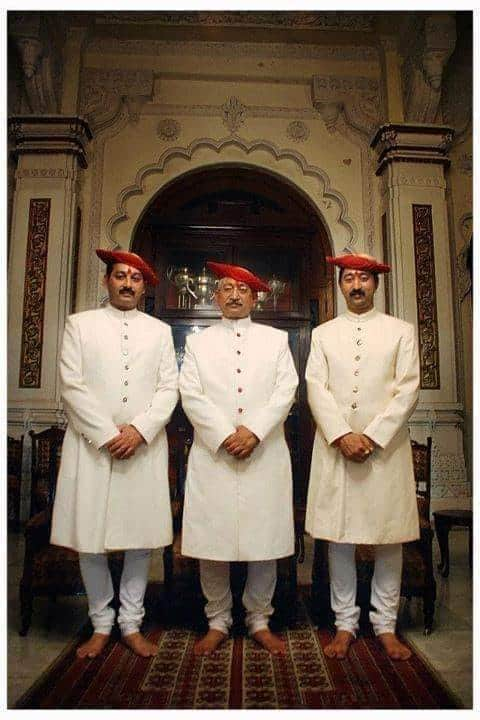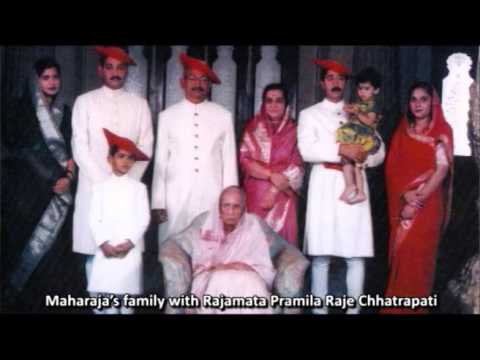
Present Head
- Yuvraj Shrimant Sambhaji Raje Chhatrapati Maharaj Sahib, born , married Yuvrani Sanyogeeta Raje Saheb of Dhamtari, and has issue, a son.
- Shrimant Shahajiraje Sambhajiraje.
- Maharajkumar Shrimant Malojiraje, born , graduate in Political Science; married Shrimant Dhawalshri Raje Saheb, daughter of Dr. Digvijay Khanvilkar, MLA from Kolhapur and Rajalaxmi Raje Saheb, and has issue, one son and one daughter.
- Shrimant Yashasviniraje, born .
- Shrimant Yashraj Malojiraje, born .
History
Origin and Foundation of Kolhapur State
The princely state of Kolhapur traces its origins back to the late 17th and early 18th centuries, emerging from the core of the Maratha Empire. Following the death of Chhatrapati Shivaji Maharaj's younger son, Rajaram I, in 1700, a war of succession broke out. Rajaram's widow, the formidable Maharani Tarabai, established a rival court to contest the claims of Shahu I (the son of Sambhaji Maharaj, who had been released from Mughal captivity). Tarabai crowned her minor son, Shivaji II, as the Chhatrapati of the Marathas at Vishalgarh in 1700, establishing Kolhapur as an independent Maratha kingdom.
The division of the Maratha Empire was formally institutionalized by the Treaty of Warna in 1731, signed between Shahu I of Satara and Sambhaji II of Kolhapur. This historic treaty designated the Warna River as the boundary between the two Maratha states, with Satara ruling the northern territories and Kolhapur administering the southern domains. To learn more about the diplomatic shifts of this period, refer to the Kolhapur District Administration Historical Records.
The Maratha Period and Struggles for Sovereignty
Throughout the 18th century, Kolhapur found itself embroiled in constant conflicts with neighboring powers, including the Peshwas of Pune, the Savantvadi State, and the Portuguese of Goa. Despite these external pressures, the Chhatrapatis of Kolhapur maintained their distinct sovereign identity. During the reign of Shivaji III (1760–1812), the state saw significant military challenges, particularly from the expanding British East India Company and the Peshwa's forces. However, Kolhapur managed to secure its frontiers through a mixture of defensive warfare and tactical diplomacy.
The British Raj and Subsidiary Alliance
As the British East India Company consolidated its grip over western India after the fall of the Peshwa in 1818, Kolhapur entered into a subsidiary alliance with the British. This treaty preserved the internal autonomy of the Chhatrapatis while placing their foreign relations under British supervision. Kolhapur was classified as a first-class princely state under the Bombay Presidency.
By the late 19th century, Kolhapur had evolved into a premier princely state. The state was founded in 1700. His Highness, with his feudatories, maintains a military force of 255 cavalry, 1902 infantry, and 67 guns, and is entitled to a salute of 19 guns (as of 1892). This substantial military apparatus reflected the state's strategic importance and its high status within the imperial hierarchy. Detailed statistical records of this era can be explored via the Imperial Gazetteer of India hosted by the University of Chicago.
The Era of Chhatrapati Rajarshi Shahu Maharaj
The late 19th and early 20th centuries marked the "Golden Age" of Kolhapur, ushered in by its most famous ruler, Chhatrapati Rajarshi Shahu Maharaj (reigned 1894–1922). Educated under both Indian and British tutors, Shahu Maharaj was a visionary social reformer who dedicated his life to dismantling the caste system and uplifting the marginalized sections of society.
Among his groundbreaking reforms were:
- First Reservation Policy (1902): Shahu Maharaj introduced 50% reservation in state administration for backward classes, making Kolhapur the pioneer of affirmative action in India.
- Universal Education: He made primary education free and compulsory for all citizens and built hostels for students of different castes and religions, including Muslims, Marathas, Mahars, and Lingayats.
- Patronage to Dr. B.R. Ambedkar: Recognizing the genius of Dr. B.R. Ambedkar, Shahu Maharaj financially assisted his education abroad and funded his weekly journal, Mooknayak. He famously declared Dr. Ambedkar as the true leader of the oppressed classes in India during the Mangaon Conference of 1920.
- Economic and Industrial Reforms: He established the Shahu Chhatrapati Spinning and Weaving Mill, built the Radhanagari Dam to boost agriculture, and established the famous Jaisingpur trading market.
For a deeper dive into his revolutionary reforms, read the biographical archives on Encyclopaedia Britannica.
Post-Independence and the Modern Era
Following India's independence in 1947, the last ruling Maharaja of Kolhapur, Chhatrapati Shahaji II, signed the Instrument of Accession. On March 1, 1949, Kolhapur State officially merged into the Dominion of India. It was initially integrated into the Bombay State, which was later reorganized in 1960 to form the modern linguistic state of Maharashtra.
Today, Kolhapur is a prosperous industrial and agricultural hub in Western Maharashtra. It is world-renowned for its hand-crafted leather footwear (Kolhapuri Chappals), its vibrant textile and sugar industries, and its rich tradition of wrestling (Kusti), centered around the historic Rajarshi Shahu Khasbag Maidan. The legacy of the Chhatrapatis continues to be preserved by the local populace, who look to Kolhapur's progressive past as a blueprint for the future.
Genealogy
- Raja Chhatrapati SHIVAJI I, 1st Raja of Kolhapur 1700/1714 (deposed), born at Jinji, married 1stly, Rani Shrimant Bhavanibai Raje Saheb, married 2ndly, Rani Shrimant Parvatibai Raje Saheb, commited sati March 1726. He died o f smallpox on 14th March 1726.
- Maharaja Chhatrapati Rajaram Rao II, succeeded to the Satara gaddi.
- Raja Chhatrapati SHAMBHUJI I, 2nd Raja of Kolhapur 1714/1760, born at Panhala, signed the Treaty of Warna formally separating Satara and Kolhapur, married 1stly, Rani Shrimant Anandibai Raje Saheb, from the Ghatge family of Budh, married 2ndly, Rani Shrimant Umabai Raje Saheb, from the Khanvilkar family, married 3rdly, Rani Shrimant Sakwarbai Raje Saheb, married 4thly, Rani Shrimant Jijabai Raje Saheb, died , daughter of Shrimant Narsojirao Murarrao Shinde Sena Khas Khel of Torgal, married 5thly, Rani Shrimant Sundrabai Raje Saheb, from the Ghatge family of Tutunde, married 6thly, Rani Shrimant Durgabai Raje Saheb, from the Mohite family, married 7thly, Rani Shrimant Kusabai Raje Saheb, from the Ghatge family of Mangaokar. He died sp 20th December 1760. REGENCY 1760/1762 Rani Shrimant Jiji Bai Raje Saheb (regent), died .
- Raja Chhatrapati SHIVAJI II, 3rd Raja of Kolhapur 1762/1813, born , adopted by Rani Shrimant Jijibai on 22nd September 1762, succeeded 27th September 1762, married 1stly, Rani Shrimant Saibai Raje Saheb, daughter of Tuljojirao Ghatge Sarjerao of Kagal, married 2ndly, Rani Shrimant Chimnabai Raje Saheb, daughter of Ranoji Shinde Chavrekar, married 3rdly, Rani Shrimant Sakwarbai Raje Saheb, daughter of Shrimant Lakshmanrao Shinde Sena Khas Khel, Chief of Torgal, married 4thly, Rani Shrimant Umabai Raje Saheb, daughter of Mukundrao Pawar, Desai of Jamboti, married 5thly, Rani Shrimant Sundrabai Raje Saheb, daughter of Ratnojirao Khanvilkar, married 6thly, Rani Shrimant Ahilyabai Raje Saheb, daughter of Ranojirao Ghatge Sarjerao of Kagal, married 7thly, Rani Shrimant Anandibai Raje Saheb, daughter of Janrao Patankar, married 8thly, Rani Shrimant Mainabai Raje Saheb, another daughter of Lakshmanrao Shinde of Torgal, married 9thly, Rani Shrimant Gangabai Raje Saheb, daughter of the Pawar Desai of Athani, married 10thly, Rani Shrimant Dayabai Raje Saheb, daughter of Sayajirao Ghatge of Murgud, married 11thly, Rani Shrimant Sakwarbai Raje Saheb, daughter of Khanderao Shinde Khilwarkar, married 12thly, Rani Shrimant Anandibai Raje Saheb, daughter of Dhondojirao Patankar, married 13thly, Rani Shrimant Kamalajabai Raje Saheb, daughter of Limaji Naik Nimbalkar of Bairag, and had issue, eight children. He died .
- Raja Chhatrapati Shambhuji III [Abasaheb Maharaj] (by Sundrabai) (qv)
- Raja Chhatrapati Shahji I [Buwasaheb Maharaj] (by Kamlajabai) (qv)
- Shrimant Aubai Raje Saheb, married Yeshwantrao Ghatge of Kagal.
- Shrimant Balabai Raje Saheb, married Sultanrao Nimbalkar Khardekar.
- Shrimant Baijabai Raje Saheb, married Narayanrao Ghatge Baji.
- Shrimant Yesubai Raje Saheb, married Sidhojirao Nimbalkar of Nipani.
- Shrimant Chimnabai Raje Saheb, married Nagojirao Patankar.
- Shrimant Akubai Raje Saheb, married Shankararo Shinde of Torgal.
- Raja Chhatrapati SHAMBHUJI III, 4th Raja of Kolhapur 1813/1821, born , married 1stly, Rani Shrimant Saibai Raje Saheb, daughter of Trimbakrao Khanvilkar, married 2ndly, Rani Shrimant Jijabai Raje Saheb, daughter of Dharrao Nimbalkar, married 3rdly, Rani Shrimant Saibai Raje Saheb, daughter of Narayanrao Shirke, married 4thly, Rani Shrimant Sundrabai Raje Saheb, another daughter of Trimbakrao Khanvilkar, and had issue. He was murdered on 16th July 1821 at Bhawani Mandap Palace.
- Shrimant Shivaji Rao [Balasaheb], born , died o f smallpox in 1822 before he could succeed.
- Raja Chhatrapati SHAHJI I, 5th Raja of Kolhapur 1821/1838, born , married 1stly, Rani Shrimant Ambaikabai Raje Saheb, daughter of Appajirao Naik Nimbalkar, married 2ndly, Rani Shrimant Sakwarbai Raje Saheb, daughter of Daulatrao Mohite Hambirrao, married 3rdly, Rani Shrimant Sagunabai [Babaisaheb], committed sati 1838, married 4thly, Rani Shrimant Anandibai Raje Saheb [Tarabai], daughter of Jyotirao Patankar, married 5thly, Rani Shrimant Narmadabai Raje Saheb, married 6thly, Rani Shrimant Rajasbai Raje Saheb, daughter of Manyajirao Khanvilkar, married 7thly, Rani Shrimant Umabai Raje Saheb, daughter of Yeshwantarao Ghatge Sarjerao of Kagal, married 8thly, Rani Shrimant Kamlabai Raje Saheb, daughter of Manyajirao Ingale, and had issue, 2 sons and 2 daughters. He died .
- Shrimant Au Bai Raje Saheb, married Ramchandrarao Patankar, and had issue.
- Raja Chhatrapati Rajaram I (Nagojirao Patankar) (qv)
- Shrimant Bala Bai Raje Saheb, married Shrimant Narayanrao [Abasaheb] Ghatge of Kagal-Junior, and had issue. She died about 1866.
- Raja Chhatrapati Shivaji III [Babasaheb] (by Anandibai)(qv)
- Shrimant Shahu [Chimnasaheb] (by Narmadabai), born , he was accused of taking part in the 1857 revolt in Kolhapur city and was exiled to Karachi, married Shrimant Sakwarbai Raje Saheb, commited suicide on 2nd April 1858. He died sp 1869 on Manora island at Karachi.
- Shrimant Au Bai Raje Saheb, married Ramchandrarao Patankar, and had issue.
- Raja Chhatrapati SHIVAJI III, 6th Raja of Kolhapur 1838/1866, born , married Rani Shrimant Ahilyabai Raje Saheb of Baroda, adopted his nephew. He died sp on 3rd August 1866.
- Raja Chhatrapati RAJARAM I, 7th Raja of Kolhapur 1866/1870, born as Nagojirao Patankar, married 1stly, Rani Tarabai Sahib, died , married 2ndly, Rani Sakwarbai Sahib. He died sp on 30th November 1870 in Florence, Italy.
- Raja Chhatrapati SHIVAJI V, 8th Raja of Kolhapur 1870/1883, adopted by Rani Tarabai, born as Shrimant Narayanrao Bhonsle, son of Dinkarrao Bhonsle of the Khanwatkar branch, married Rani Anandibai Saheb (she adopted Yeshwantrao Ghatge of Kagal as successor). He died sp on 25th December 1883 at Ahmednagar.
- Col. HH Maharaja Sir Shri Chhatrapati SHAHU I, 9th Maharaja of Kolhapur 1884/1922, born as Meherban Shrimant Yeshwantrao Jaisinhrao Ghatge, son of Meherban Shrimant Jaisinhrao Narayanrao [Abasaheb] Ghatge Sarjerao Vajarat-ma-ab, 4th Chief of Kagal-Senior, adopted to Kolhapur and succeeded to the gadi as a minor on 17th March 1884, granted full ruling powers on 2nd April 1894, Maharaja [cr. 24.5.1900]; made a G.C.V.O. on 1st January 1902, LL.D. (Hon.) [10.6.1902], Hon. Member of the Royal Agricultural Society; granted a personal salute of 21 guns on 1st January 1909, founded the Shahu Vedic School in 1920, made a G.C.I.E. on 12th December 1911 at the Delhi Durbar; married 1st April 1891, HH Maharani Lakshmi Bai Saheb, born , daughter of Meherban Gunajirao Khanvilkar of Baroda, and had issue. He died at Bombay.
- HH Maharani Radhabai Akka Sahib Maharaj, born , married 21st March 1908, HH Maharajah Sir Tukoji III Rao Puar, 6th Maharaja of Dewas-Snr, and had issue.
- HH Maharaja Chhatrapati Shahaji II Puar (qv)
- Maharajkumari Ambai Akka Sahib Raje, born , died young.
- HH Maharajah Chhatrapati Sir Shri Rajaram II (see below)
- Maharajkumar Shivajirao, born , married Shrimati Indumati Raje Saheb [Jamunakka], died (or 1975), daughter of Shankarrao Jagtap of Saswad. He died sp on 12th June 1918 at Miraj.
- HH Maharani Radhabai Akka Sahib Maharaj, born , married 21st March 1908, HH Maharajah Sir Tukoji III Rao Puar, 6th Maharaja of Dewas-Snr, and had issue.
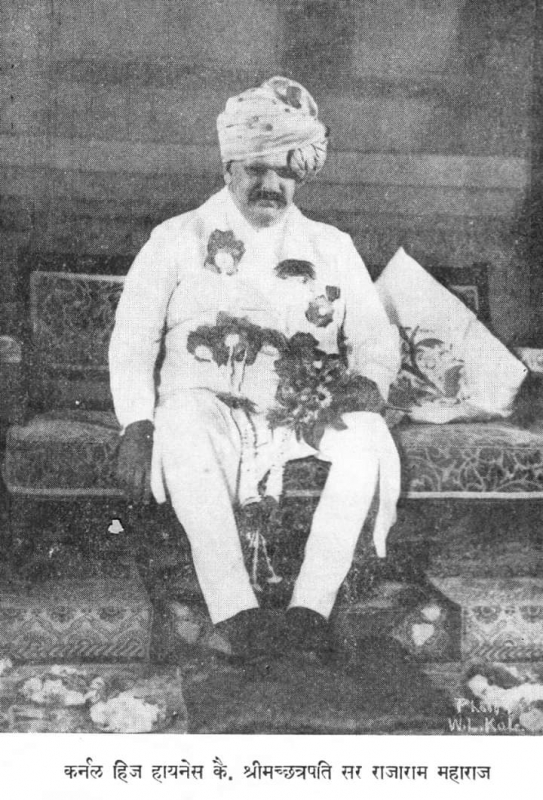
- HH Maharaja Chhatrapati Sir Shri RAJARAM II, 10th Maharaja of Kolhapur 1922/1940, born , G.C.I.E. [cr.1924], succeeded 21st May 1922, married 1stly 1918, HH Maharani Shrimati Indumati Devi Tarabai Sahib, daughter of Yuvaraj Fatehsinghrao Gaekwad of Baroda, and his wife, Yuvarani Padmavati Bai Saheba, married 2ndly, 1925, HH Maharani Shrimati Vijayamalabai Saheb, died , daughter of Meherban Shrimant Atmaramrao Mohite of Tanjore, and had issue. He died spm on 26th November 1940.
- Maharajkumari Padma Raje, born , married February 1959, Sardar Raghojirao Kadam Bande of Torkhed, and had issue, two sons. She died .
- Sardar Rajwardhan Kadambande
- Shrimant Yashodharman Kadambande
- Shrimant Priyadarshan Kadambande
REGENCY 1940/1942
- Maharajkumari Padma Raje, born , married February 1959, Sardar Raghojirao Kadam Bande of Torkhed, and had issue, two sons. She died .
- HH Maharaja Chhatrapati SHIVAJI V, 11th Maharaja of Kolhapur 1942/1946, born as Pratapsinh, second son of Shrimant Nanasaheb Shankarrao Charvekar of the Khanwatkar branch, born 22nd November 1941, died . REGENCY 1946/1947 HH Maharani Chhatrapati Tara Bai Saheb (regent)
- HH Maharaja Chhatrapati SHAHAJI II PUAR, 12th Maharaja of Kolhapur 1947/1983, born , also 7th Maharaja of Dewas-Snr 1937/1948, adopted to Kolhapur on 31st March 1947, married 30th December 1926, HH Maharani Pramilaraje of Jath, Regent of Dewas from 1946 to 1947, and had issue. He died
- HH Maharaja Powar Krishnaji III Rao Puar, 8th Maharaja of Dewas-Snr (qv)
- Maharajkumari Shaliniraje Puar, married Rajaramsinhrao of Nagpur and has issue.
- HH Maharaja Chhatrapati Shahu II (qv)
- Maharajkumari Vijayaraje Puar (by Pramilaraje), married Sardar Pratapsinh Shitole, Sardesai of Ankli.
- Maharajkumari Urmilaraje Puar (by Pramilaraje), married Shrimant Vijaysingh Ghorpade of Sandur.
- HH Maharaja Chhatrapati SHAHU II, 13th Maharaja of Kolhapur (see above)
Notable Figures
Maharani Tarabai (Regent: 1708–1714)
Maharani Tarabai was the founder of the independent Kolhapur court, which she established in opposition to Shahu I of Satara. The daughter of the Maratha commander-in-chief Hambirrao Mohite and the queen of Chhatrapati Rajaram I, Tarabai was an incredibly skilled military strategist and administrator. Following the death of her husband, she successfully led the Maratha resistance against the Mughal Emperor Aurangzeb from 1700 to 1707, keeping the empire intact during its most vulnerable era.
When Shahu I was released by the Mughals and claimed the Maratha throne, Tarabai championed the rival claim of her son, Shivaji II. Although she eventually lost control of Satara, she retreated south to Kolhapur, establishing it as a sovereign Maratha principality of the Bhonsle dynasty in 1708. Her life and military campaigns are documented extensively in historical archives, including the Wikipedia page on Tarabai.
Chhatrapati Sambhaji II (Ruled: 1714–1760)
Chhatrapati Sambhaji II was the son of Chhatrapati Rajaram I by his second wife, Rajasbai. In 1714, Rajasbai executed a palace coup, deposing Tarabai and her young son Shivaji II, and installed Sambhaji II on the throne of Kolhapur. Sambhaji II worked to consolidate his reign and secure the legitimacy of the Kolhapur state against the rival claims of the Satara branch of the Bhonsles.
In 1731, Sambhaji II signed the Treaty of Warna with his cousin, Shahu I of Satara. This landmark treaty formally partitioned the Maratha Empire into two distinct spheres of influence, officially recognizing Kolhapur as an independent kingdom south of the Warna River. His long reign laid the administrative and territorial foundations of the state. For further reference, see the Wikipedia entry on Sambhaji II.
Chhatrapati Shivaji III (Ruled: 1762–1813)
Chhatrapati Shivaji III, born in to the Khanwatkar Bhonsle family, was adopted by Jijabai, the widow of Sambhaji II, after the ruler died without leaving a direct heir. His exceptionally long reign of over five decades was marked by turbulent military conflicts with neighboring powers, including the Peshwas of Pune, the Patwardhan chiefs, and Hyder Ali of Mysore. It was during his reign that Kolhapur first came into direct contact with the British East India Company.
To curb piracy along the Konkan coast operated by Kolhapur's naval vessels, the British signed treaties with Shivaji III in 1765 and 1792. These agreements restricted Kolhapur's maritime power in exchange for trade privileges. Despite external pressures and internal court intrigues, Shivaji III managed to maintain the sovereign identity of his state. Details of his reign can be read on the Wikipedia page for Shivaji III.
Chhatrapati Rajaram II (Ruled: 1866–1870)
Chhatrapati Rajaram II (also known as Rajaram I of Kolhapur) succeeded to the throne in 1866. Unlike his predecessors, he received a modern, Western-style education under British tutelage and was known for his progressive outlook. He was deeply interested in administrative reforms, public health, and the modernization of the state's judicial system.
In 1870, Rajaram II became the first ruling Maharaja of Kolhapur to travel to Europe. He visited England, where he was received by Queen Victoria. Unfortunately, during his return journey, he fell ill and passed away in Florence, Italy, at the young age of twenty. A monument dedicated to him, known as the Rajaram Chhatrapati Monument, still stands at the Cascine Park in Florence. His life is chronicled on the Wikipedia article on Rajaram II.
Chhatrapati Shahu Maharaj (Ruled: 1884–1922)
Chhatrapati Shahu Maharaj, popularly known as Rajarshi Shahu, is widely regarded as one of the most visionary and progressive rulers in Indian history. Adopted into the ruling family from the Kadam family of Kagal, Shahu Maharaj dedicated his reign to social justice, the eradication of untouchability, and the upliftment of the backward classes. He was a close associate of Dr. B.R. Ambedkar and helped fund Ambedkar's weekly journal, Mooknayak.
In 1902, Shahu Maharaj made history by introducing 50% reservation in state services for backward communities, making Kolhapur the first state in India to implement an affirmative action policy. He also made primary education free and compulsory, promoted female education, banned child marriage, and legalized widow remarriage. A great patron of sports, he turned Kolhapur into the "wrestling capital of India." His monumental socio-political contributions are detailed on the Wikipedia page for Shahu of Kolhapur.
Chhatrapati Rajaram III (Ruled: 1922–1940)
Chhatrapati Rajaram III succeeded his father, Shahu Maharaj, and continued his progressive legacy. He focused heavily on the industrialization and modernization of Kolhapur. Under his patronage, the city saw the expansion of the Radhanagari Dam project, which drastically improved agricultural output in the region through irrigation.
Rajaram III also modernized the Kolhapur state infantry, promoted the local film industry (which earned Kolhapur the title of "Cradle of Marathi Cinema"), and expanded educational institutions. He maintained a strong relationship with the British Crown while preserving local autonomy. His biography and contributions are hosted on the Wikipedia entry for Rajaram III.
Chhatrapati Shahaji II (Ruled: 1947–1949, Titular: 1949–1983)
Chhatrapati Shahaji II was the Maharaja of Kolhapur during the critical period of Indian independence. Adopted from the Dewas Senior branch of the Bhonsle dynasty, he ascended the throne in 1947. He proved to be a highly pragmatic ruler during the transition of power from the British Crown to the newly independent Indian Union.
On 1 March 1949, Shahaji II signed the Instrument of Accession, merging the Princely State of Kolhapur into the Bombay State of the Dominion of India. Following the merger, he served as a diplomat and remained an influential public figure in Maharashtra until his death in 1983. His historical transition role is documented on the Wikipedia page for Shahaji II.
Chhatrapati Shahu II (Titular: 1983–present)
Chhatrapati Shahu II (born Shahu Chhatrapati) is the current titular head of the Bhonsle dynasty of Kolhapur. He was adopted by Maharani Pramilatai, the widow of Shahaji II, in 1983. He is highly respected across Maharashtra as a custodian of the historical and cultural heritage of the Maratha Empire.
Shahu II has stayed active in public life, supporting educational trusts, sporting organizations, and historical preservation societies. In 2024, he entered active politics and was elected as a Member of Parliament (MP) to the Lok Sabha representing the Kolhapur constituency, continuing the family's long tradition of public service. His modern achievements and political life can be explored on the Wikipedia article on Shahu Chhatrapati.