
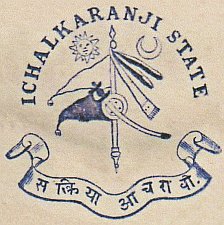
Present Head

- Yeshwantrao Ghorpade, born in .
- Suvarna Ghorpade, born in .
History
Origin and Foundation of Ichalkaranji Jagir
The Ichalkaranji Jagir was a prominent Maratha estate located in the southern part of Maharashtra, situated near the Panchganga River, about 47 kilometers east of Kolhapur. The state was founded in the early 18th century by Naro Mahadev Ghorpade, originally a member of the Joshi family, who took the surname Ghorpade after being adopted into the illustrious military clan of the Maratha Empire. Naro Mahadev rose to prominence under Chhatrapati Shahu Maharaj of Satara, the grandson of Chhatrapati Shivaji Maharaj. Recognizing his administrative abilities and loyalty, Shahu Maharaj granted him the jagir (estate) of Ichalkaranji around 1713.
The Maratha Empire and Peshwa Alliance
The Ghorpade rulers of Ichalkaranji maintained close dynastic and political ties with the Peshwas of Pune. A pivotal moment in the state's history was the marriage of Vyankatrao Ghorpade (the son of Naro Mahadev) to Anubai, the sister of Peshwa Baji Rao I. This marital alliance elevated the Ichalkaranji house to a position of immense influence within the Maratha Confederacy. Throughout the 18th century, the rulers of Ichalkaranji actively participated in several Maratha military campaigns across the Deccan and Northern India, securing their territory against local rivals, including the Rajas of Kolhapur and the Savanur State.
Detailed historical accounts of this period can be found in the Imperial Gazetteer of India, which outlines the political boundaries and administrative structure of the Jagir under the Maratha administration.
The British Era and Feudatory Status
Following the third Anglo-Maratha War and the fall of the Peshwa power in 1818, Ichalkaranji came under the suzerainty of the British East India Company. It was placed under the political supervision of the Kolhapur Residency as a feudatory state of the Kolhapur State, and later became part of the Deccan States Agency. Although classified as a non-salute state, the Ghorpade rulers retained substantial judicial and administrative powers over their territory. The British recognized the rulers as first-class Sardars of the Deccan, allowing them to govern with minimal colonial interference in internal affairs.
The Golden Era of Shrimant Narayanrao Babasaheb Ghorpade
The modern transformation of Ichalkaranji began during the reign of Shrimant Narayanrao Babasaheb Ghorpade (ruled 1892–1943). A visionary administrator and reformer, Narayanrao Babasaheb is widely regarded as the architect of modern Ichalkaranji. Highly educated and widely traveled, he visited Europe to study Western industrial and educational models.
Observing the power looms in Manchester, England, he sought to replicate this industrial model in his own state. In 1904, he established the first power loom in Ichalkaranji, providing financial assistance, subsidized land, and technical training to local weavers. This laid the foundation for the town's legendary textile industry, eventually earning Ichalkaranji the title of the "Manchester of Maharashtra."
In addition to industrialization, Babasaheb championed social and educational reforms. He established the State Library, opened schools for girls and marginalized communities, introduced piped water systems, and set up cooperative credit societies to free farmers and weavers from the debt traps of local moneylenders. His legacy is thoroughly documented on the Ichalkaranji State Wikipedia Page.
Post-Independence and Modern Legacy
Following India’s independence in 1947, the last ruler of Ichalkaranji, Shrimant Govindrao Ghorpade, signed the Instrument of Accession to the Dominion of India. The state was formally merged into the Bombay State on March 8, 1948, which was later reorganized into the modern state of Maharashtra in 1960.
Today, Ichalkaranji is a bustling industrial city in the Kolhapur district, renowned globally for its textile manufacturing, spinning mills, and export-quality fabric. The legacy of the Ghorpade dynasty survives in the city’s civic layout, the majestic Ichalkaranji Rajwada (palace), and the cooperative spirit that continues to drive its prosperous economy.
Genealogy
- Shrimant NARO MAHADEO JOSHI, Chief of Ichalkaranji 1698/1720, he was adopted by Shrimant Santaji Ghorpade, and was granted the inam of Ichalkaranji. He died
- Shrimant VENKATRAO NARAYANRAO GHORPADE, Chief of Ichalkaranji 1720/1745, born , married Shrimant Anubai Sahiba, daughter of the first Maratha Peshwa, Balaji Vishwanath of Poona. He died .
- Shrimant NARAYANRAO VENKATRAO GHORPADE, Chief of Ichalkaranji 1745/1770, died .
- Shrimant VENKATRAO NARAYANRAO II GHORPADE, Chief of Ichalkaranji 1770/1795
- Shrimant NARAYANRAO BABASAHEB GHORPADE, Chief of Ichalkaranji 1795/1827
- Shrimant VENKATRAO NARAYANRAO III GHORPADE, Chief of Ichalkaranji 1827/1838
- Shrimant KESHAVRAO VENKATRAO TATYASAHEB GHORPADE, Chief of Ichalkaranji 1838/1852
- Shrimant NARAYANRAO GOVINDRAO BABASAHEB GHORPADE, Chief of Ichalkaranji 1852/1864, led the industrial revolution in Ichalkaranji, which was considered to be the "Manchester of Western India". Ichalkaranji became an industrial super state with an income almost half as much as that of Kolhapur despite being just 10th its size.
- Shrimant GOVINDRAO ABASAHEB GHORPADE, Chief of Ichalkaranji 1864/1876, born , adopted the son of Laxman Joshi (descendant of Naro Mahadeo Joshi, early 17th century) in 1876, who assumed the name of Shrimant Narayanrao Govindrao Babasaheb Ghorpade (qv). He died .
- (A) Shrimant Narayanrao Govindrao Babasaheb Ghorpade (qv)
- Shrimant NARAYANRAO GOVINDRAO BABASAHEB GHORPADE, Chief of Ichalkaranji 1876/1943, born in Karkamb, Sholapur District, educated at Rajaram College, Kolhapur and Elphinstone and Law Colleges, Bombay, installed 1892, Member of the Bombay Legislative Council for 12 years; married in 1885, Shrimant Rani Gangabai [Maisaheb], daughter of Mohaniraj Paranjpe of Ahmednagar. They had no issue so he adopted his nephew Venkatrao in 1919. He died .
- (A) Shri Laxman Vishnu Joshi M.A. [After adoption he was known as Yuvaraj Venkatrao Narayanrao Ghorpade], nephew and adopted son, Professor of History at Kayastha Pathshala College in Allahabad 1915/1917, adopted by his uncle in 1919, Private Secretary to the Chief of Ichalkaranji, married May 1914, Smt. Soubhagyavati Anubai Vahinisaheb Ghorpade [Vimalatai Kanitkar], born at Alibaug, daughter of Shri Govindrao Wasudeo Kanitkar, District Court Judge at Alibaug, and his wife, Smt Kashitai, she was educated at Yeola Primary School, Girl's High School at Hujoorpaga, Pune and matriculated from the Theosophical School in Banares, Member of the Theosophical Society in Kolhapur, President of the Shree Krishna Theosophical Lodge in Kolhapur; and had issue, one son and two daughters. He died .
- Shri Keshavrao Venkatrao Ghorpade, born , died .
- Shrimati Shailajabai Ghorpade, married Shrimant Trimbakrao Bhawanrao Appasaheb Pant Pratinidhi, Chief of Vishalgadh, and had issue.
- Shrimati Nirmaladevi Taisaheb Sohoni (Ghorpade), married Shri Shridhar Vasudeo Sohoni, M.A., I.C.S., and had issue, two sons.
- Dr. Venkatrao Sohoni, educated at the Indian Institute of Technology (IIT), Kharagpur, with a degree in electronics engineering (1963) and at IIT, Mumbai in 1972 with a Ph.D. in information systems; worked with IBM World Trade Corporation Mumbai 1963/1970 and later with Sandoz India 1971/1985; President and C.E.O. of Wander 1985/1988; President, C.E.O. and Vice Chairman with Biosys, U.S.A. 1988/1995; Managing Director of Hindustan Ciba Geigy / Novartis, Mumbai, India 1996/1999; President and Managing Director of Pharmacia India, Gurgaon 1999/2003; Vice President of the Organisation of Pharmaceutical Producers of India (O.P.P.I.); Managing Director of Rallis India 2003/-; married Neera Kuckreja Sohoni,and has issue.
- Shrinivasrao Sohoni, Joined the Indian Administrative Service (IAS) in 1970; Served in various key assignments in the Central and the State Governments including the Union Cabinet Secretariat, Ministry of Defence and Ministry of Industry in the Government of India, and as Secretary to the President of India, and Secretary General of the Rajya Sabha, Parliament of India. He was also Vice President of the Indian Council of Cultural Relations (ICCR), Chairman of the Board of Governors of the Visvesaraya National Institute of Technology, Nagpur; and Senior Adviser, Cabinet Secretariat, in the Office of the President of the Islamic Republic of Afghanistan. Patron of the Bhandarkar Oriental Research Institute, Pune.
- (A) Shri Laxman Vishnu Joshi M.A. [After adoption he was known as Yuvaraj Venkatrao Narayanrao Ghorpade], nephew and adopted son, Professor of History at Kayastha Pathshala College in Allahabad 1915/1917, adopted by his uncle in 1919, Private Secretary to the Chief of Ichalkaranji, married May 1914, Smt. Soubhagyavati Anubai Vahinisaheb Ghorpade [Vimalatai Kanitkar], born at Alibaug, daughter of Shri Govindrao Wasudeo Kanitkar, District Court Judge at Alibaug, and his wife, Smt Kashitai, she was educated at Yeola Primary School, Girl's High School at Hujoorpaga, Pune and matriculated from the Theosophical School in Banares, Member of the Theosophical Society in Kolhapur, President of the Shree Krishna Theosophical Lodge in Kolhapur; and had issue, one son and two daughters. He died .
- Shrimant VINAYAK GHORPADE, Chief of Ichalkaranji 1943/1944, appointed by the Maharaja of Kolhapur, he claimed to be a descendant of Naro Mahadeo, and held the gaddi for a few months.
- Shrimant GOVINDRAO ABASAHEB GHORPADE, Chief of Ichalkaranji (see above)