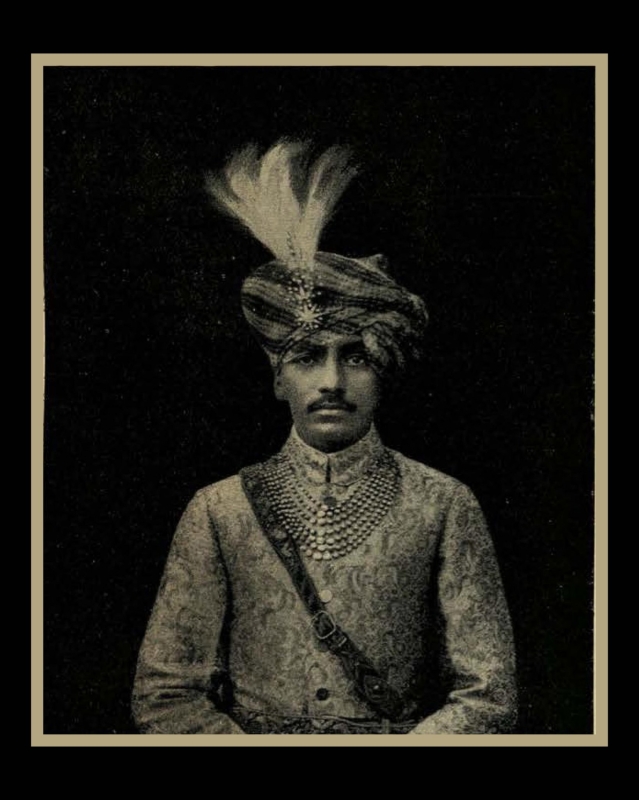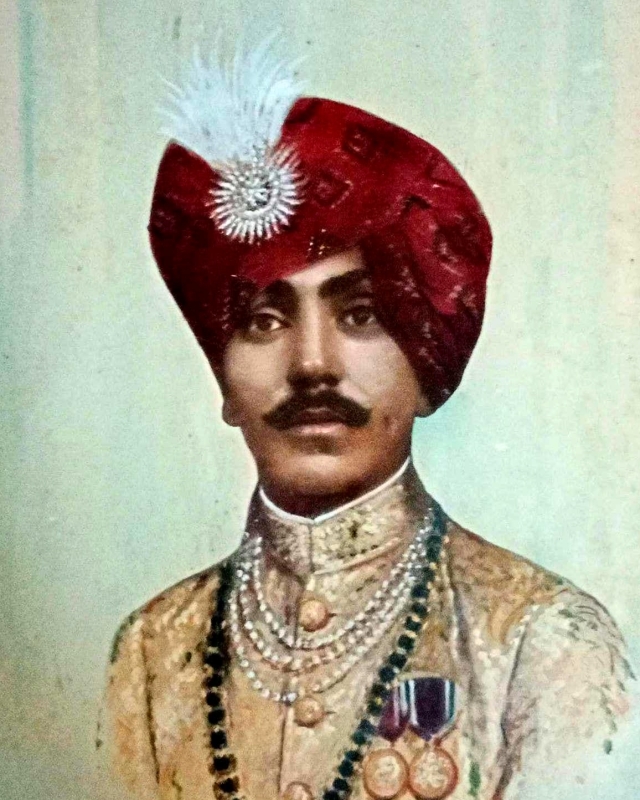
Present Head

History
History of Malpur Princely State
The history of Malpur, situated in the rugged Mahi Kantha region of northern Gujarat, is a fascinating narrative of a Rathore Rajput state that maintained its independence and local hegemony for nearly five centuries. Like its prominent neighbor, the state of Idar, Malpur represents the expansion of the martial Rathore clan into the borderlands of Gujarat during the medieval era.
Origins and Foundation (1466)
The state of Malpur was founded in 1466 by Rawal Virajmal, a younger son of Rao Ranmal (or a closely related prince) of the imperial royal house of Marwar (Jodhpur).
- The Southward Migration: Following the intense dynastic rivalries and successions that characterized 15th-century Rajputana, Virajmal marched south into the dense forests and hilly terrains of northern Gujarat.
- Subduing Local Tribes: The region was originally populated and controlled by independent local tribal chieftains. Rawal Virajmal successfully subdued the local resistance, established a fortified settlement, and founded the sovereign principality of Malpur, introducing a centralized Rajput administrative system over the territory.
Navigating the Mughals and the Marathas
Due to its strategic location on the frontier between the Sultanate of Gujarat (later the Mughal Empire) and the kingdoms of Rajputana, Malpur spent centuries navigating delicate geopolitical alliances.
- Mughal Era Suzerainty: During the height of the Mughal Empire, the Rawals of Malpur maintained internal autonomy by acting as regional guardians of the vital trade routes running from the ports of Cambay (Khambhat) to Delhi.
- The Maratha Onslaught: In the 18th century, as Mughal authority crumbled, Malpur faced severe destabilization from the rising Maratha confederacy. The state was repeatedly raided by the armies of the Gaekwad dynasty of Baroda and the Peshwa's commanders. To prevent complete annexation, Malpur was forced to pay a heavy regular tribute (ghasdana) to the Marathas.
British Protection and Class Status
Exhausted by decades of Maratha extortion and domestic economic strain, Malpur sought stability under the British East India Company at the dawn of the 19th century.
- The 1812 Settlement: In 1812, under the diplomatic supervision of Sir John Malcolm and the Mahi Kantha Settlement, Malpur entered into a protective treaty with the British.
- The Tribute Arrangement: The British stabilized the region by acting as financial mediators. Under this arrangement, Malpur's internal sovereignty was legally guaranteed. The British collected a fixed annual tribute from Malpur and channeled it to the Gaekwad of Baroda, legally barring the Marathas from launching further military or administrative incursions into Malpur territory.
- Class Status: Within the complex administrative hierarchy of colonial India, Malpur was classified as a Class III (Third Class) State within the Mahi Kantha Agency (later integrated into the Western India States Agency). The ruler held the hereditary title of Rawal and exercised full civil and limited criminal jurisdiction over his subjects.
Modernization under Rawal Gambhirsinhji (1923–1947)
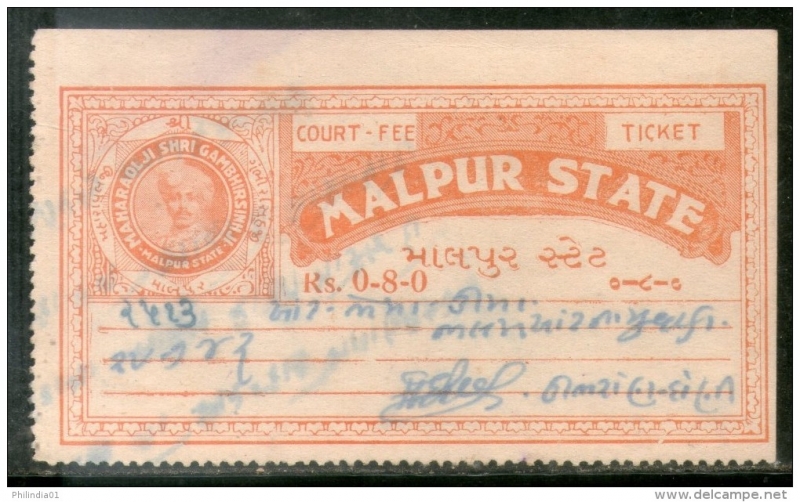
The early 20th century marked a period of peaceful administrative stability and structural modernization under Rawal Shri Gambhirsinhji Himatsinhji (r. 1923–1947).
Educated under modern British-Indian principles, Rawal Gambhirsinhji focused heavily on transforming his agrarian state:
- He established structured primary schools and state-funded medical dispensaries in Malpur town.
- He modernized the revenue system, moving away from archaic feudal collections to structured cash assessments, which greatly alleviated pressure on local farmers.
- He built metalled roads connecting Malpur to neighboring trading hubs, boosting the local agricultural economy.
Vexillology and State Symbols
- The State Flag: Honoring their elite northern desert ancestry, the flag of Malpur State was a traditional saffron (amaranthe) rectangular banner, the universal color of Rathore martial valor and sacrifice.
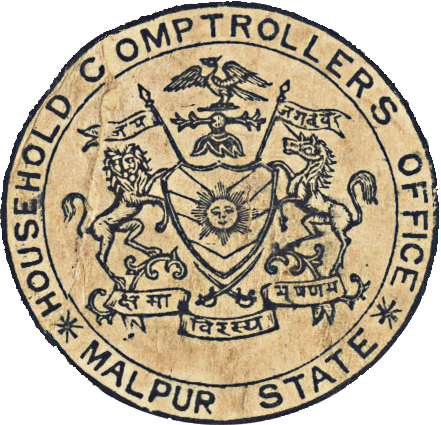
- The Coat of Arms: The official heraldic achievement of Malpur featured a shield supported on either side by two fierce leopards proper (in natural colors). The crest above the shield displayed a falcon or kite, a sacred nod to the goddess Karni Mata, the divine protector of the Rathores.
Accession and Attachment Scheme
As the winds of Indian independence blew in the 1940s, smaller princely states faced a crisis of economic viability.
- The Attachment Scheme (1943): In 1943, under the British "Attachment Scheme" designed to merge tiny administrative enclaves into larger, self-sustaining units, Malpur State was administratively attached to its larger, ancestral sister state of Idar.
- Final Accession: This arrangement was short-lived. Following the end of British paramountcy, the last Rawal signed the Instrument of Accession to the Union of India. On June 10, 1948, Malpur formally merged into the Bombay Province. Following the linguistic reorganization of states in 1960, the historic lands of Malpur became a permanent part of the Aravalli district in Gujarat.
Genealogy
- Raol VAGHSINHJI, 1st Raol of Malpur 1466/-
- Raol GOVINDSINHJI, 2nd Raol of Malpur -/1537, married and had issue.
- Raol Panchsinhji Govindsinhji (qv)
- Thakore Shri Ramsinhji Govindsinhji, he was granted the estate of Magodi in 1537, married and had issue, the Thakore Sahebs of Magodi.
- Raol PANCHSINHJI, 3rd Raol of Malpur
- Raol UDAIKARANSINHJI, 4th Raol of Malpur
- Raol JAGATSINHJI, 5th Raol of Malpur
- Raol JETSINHJI, 6th Raol of Malpur
- Raol ANOPSINHJI, 7th Raol of Malpur
- Raol BHIMSINHJI, 8th Raol of Malpur
- ......
- Raol INDRASINHJI, 11th Raol of Malpur 1780/1796
- Raol JAMALSINHJI, 12th Raol of Malpur in 1796, married and had issue. He was killed in 1796.
- Raol Takhatsinhji Jamalsinhji (qv)
- Raol TAKHATSINHJI JAMALSINHJI, 13th Raol of Malpur 1796/1816
- Raol SHIVSINHJI I, 14th Raol of Malpur 1816/1822
- Raol DIPSINHJI I, 15th Raol of Malpur 1843/-, born , died 18xx
- Raol SHIVSINHJI II KHUMANSINHJI, 16th Raol of Malpur 1875/1882, born , married and had issue. He died .
- Raol Dipsinhji Shivsinhji (qv)
- Raol DIPSINHJI II SHIVSINHJI, 17th Raol of Malpur 1882/1914, born , succeeded 12th April 1882, married and had issue. He died .
- Raol Jaswantsinhji Dipsinhji (qv)
- Raol JASWANTSINHJI DIPSINHJI, 18th Raol of Malpur 1914/1923, born (1893), died , married to daughter of Thakur Ratan Singh of Bansiya.
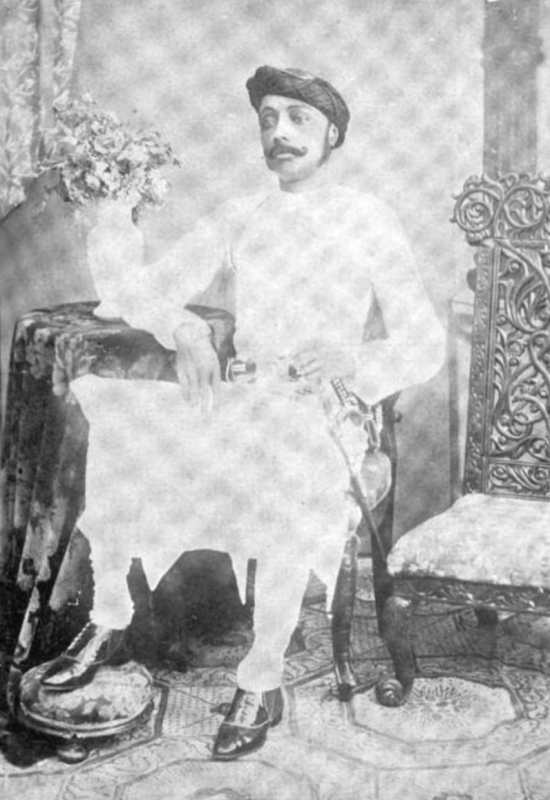
- Raol Shri GAMBHIRSINHJI HIMMATSINHJI, 19th Raol of Malpur 1923/1969, born and succeeded 23rd June 1923, educated at Scott College, Sadra and Mayo College, Ajmer. Married Nand Kanwar, eldest daughter of Raja Pratap Singh of Khandela Senior and his wife from Pisangan. He died sp 1969.