
Present Head
- Rajkumari Gopika Kumari, married to Kumar Saheb Manoharsingh Ji of Wadagam (Gujarat) and has issues, two sons.
- Kumar Devadityasinh
- Kumar Priyavardhansinh
History
Valasna (also spelled Walasna) was a minor princely state located in the Mahi Kantha region of northern Gujarat. Situated in the hilly tracts along the banks of the Sabarmati River, it represents one of the smaller independent territorial jurisdictions ruled by the Rathore Rajput clan. Throughout its modern history under the British Raj, Valasna navigated a complex landscape of Maratha dominance, British administrative reorganization, and the localized feudal politics of the Western India States Agency.
Origins and Lineage
The ruling house of Valasna belonged to the elite Rathore clan of Rajputs, claiming common ancestry with the premier ruling families of Jodhpur (Marwar) and its prominent local offshoot, the state of Idar.
- The Feudal Offshoot: The state was established by adventurous Rajput kinsmen who split from the main branches of the Malwa or Mahi Kantha Rathores to carve out an independent frontier estate.
- The Regional Stronghold: The Thakurs (and later Raos) of Valasna established their seat of power in a naturally fortified hilly tract, subduing or forming alliances with the local tribal populations to secure their agrarian boundaries.
The Maratha Sphere and the British Settlement (1812)
During the 18th century, the rapid decline of the Mughal Empire left the minor states of northern Gujarat completely exposed to the expansionist Maratha Confederacy. Valasna was frequently targeted by the armies of the Gaekwad dynasty of Baroda, who launched regular military incursions to collect revenue.
- The Mahi Kantha Settlement: To avoid absolute annexation by the Marathas, Valasna sought British intervention. In 1812, under the diplomatic and military arbitration of Sir John Malcolm, Valasna entered into the historic Mahi Kantha Settlement.
- The Tribute System: Under this arrangement, the British legally guaranteed Valasna's internal administrative autonomy. The state was required to pay a fixed annual tribute (ghasdana) of roughly 280 Rupees to the Gaekwad of Baroda. This tribute was collected and routed strictly through British channels, legally barring the Marathas from sending armed forces across Valasna's borders.
Administrative Status and the Class Hierarchy
Within the complex, tiered administrative framework of the British Raj, Valasna was relatively compact, spanning an area of roughly 22 square miles and encompassing a small cluster of revenue-generating villages.
- Class Jurisdictions: In the operational hierarchy of the Mahi Kantha Agency, Valasna was classified as a Class IV (Fourth Class) State. The ruler held full civil authority over his subjects but exercised limited criminal jurisdiction, with heinous or capital offenses referred directly to the British Political Agent stationed at Sadra.
- The Attachment Scheme (1943): During the twilight of the British Raj, smaller princely states faced severe crises regarding economic and administrative viability. Under the British "Attachment Scheme" of 1943, Valasna State was administratively attached to its larger, senior sister state of Idar, merging its public services and political representation into the larger principality until the end of colonial rule.
Vexillology and State Identity
- The State Flag: Honoring their elite northern desert ancestry, the flag of Valasna featured the traditional rectangular saffron (amaranthe) banner, the universal symbol of Rathore martial valor, solar descent, and dedication to defensive resilience.
- Cultural Landscape: The domestic life of the state revolved entirely around the agrarian cycles of the Sabarmati valley, with the rulers maintaining close, paternalistic ties with the local Rajput peasantry and tribal groups to maintain internal stability.
Accession to Independent India
Following the end of British paramountcy and the declaration of Indian Independence in August 1947, the last ruling Thakur signed the formal Instrument of Accession to merge the estate into the Dominion of India.
On June 10, 1948, Valasna formally merged into the Bombay Province. Following the systemic reorganization of Indian states along linguistic lines in 1960, the historic lands of Valasna were permanently integrated as a historical locality within the Mehsana district of the state of Gujarat.
Genealogy
- Rao VIRAMDASJI, 17th Maharaja of Idar, married and had issue (see Idar).
- Rao Gopaldasji Viramdasji (founder of Valasna State)
- Rao Gopaldasji Viramdasji, founder and first Thakore Sahib of Valasna; married and had issue, five sons.
- Thakore Sahib Shri Nathu Singhji, 1812-1880, married and had issue.
- Thakore Sahib Shri Man Singhji, 1850-1926, married and had issue.
- Thakore Sahib Shri Hamir (Habi) Singhji, 1881 - 1926, married and had issue.
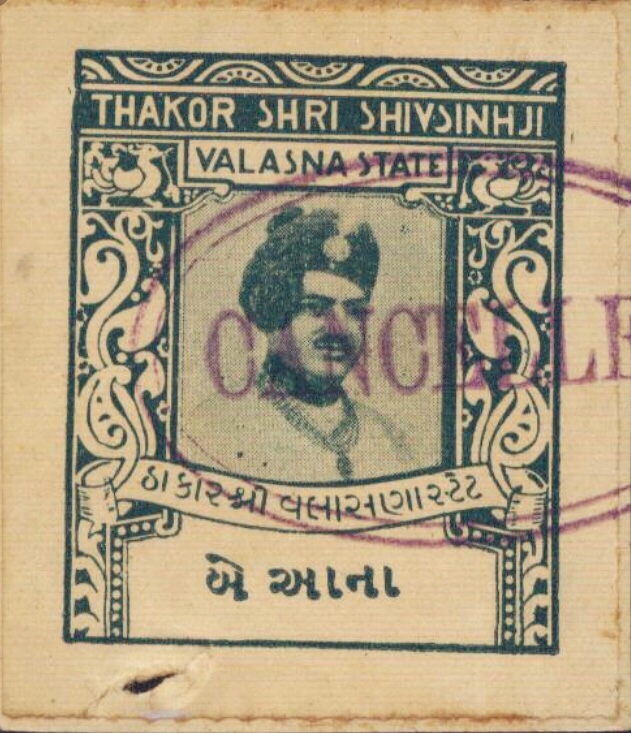
- Thakore Sahib Shri Shiv Singhji, born , succeeded the Raj Durbar Gadgi 1926-1947, married and had issues,2 daughters and 2 sons.
- Rajkumari Narendra Kumari, married Thakore Sahib Shri Gulab Singhji of Deodar, Banaskantha (Senior) and had issues, 3 sons and 5 daughters.
- Baisa Chandrika
- Kumar Mahendra Singh
- Baisa Sulochna
- Baisa Jyotisna
- Kumar Jaywant Singh
- Baisa Snehlata
- Baisa Archana
- Kumar Harishchandra Singh
- Rajkumari Jagat Kumari, married Thakore Sahib of Malwada, Rajasthan and has issue.
- Thakore Sahib Shri Badrinarayansingh (qv)
- Thakore Shri Satyanarayansinh Shivsinh Rathore, born (also known as S.S. Rathore). He received the Padma Shri honour in 2018 from the President of India for exemplary civil engineering work in the state of Gujarat, India. He joined the Gujarat state administration department as an engineer after graduation and retired as its chief secretary (ACS). He is credited for developing the national and major state highways of Gujarat and was recognised by the World Bank for his integrity and outstanding contribution as he introduced a road development model which was a first of its kind in India. He was appointed the CMD of the Sardar Sarovar Narmada Nigam Limited (SSNNL). As the CMD, S.S Rathore completed the Sardar Sarovar dam project which enabled the supply of irrigation and drinking water from the Narmada river, established various canal networks. He also led a team to complete the historic Statue of Unity project in Gujarat, India - the worlds tallest statue (height of 182 metres (597 ft) in 2019). S.S Rathore is the former President of the Institute of Engineers, India, Indian Road Congress, and the Vice-President of the World Federation of Engineering Organization; currently he's an Advisor to the Chief Minister of Gujarat. He married and had issues, one daughter and two sons.
- Kumari Gayatri Devi, married to Kunwar Samarveersingh Ji, son of Thakur Rajendra Singh Deora of Thikana Padeev (Sirohi, Rajasthan).
- Kumar Shri Bhismanarayansinh, married to Kumari Yamini Bhati, daughter of Vikram Singh Ji of Khejarla.
- Kumar Shri Vishwanarayansinh, married on 10th February 2022 to Bhavya Kumari, daughter of Upendra Singh Ji of Mandrella.
- Rajkumari Narendra Kumari, married Thakore Sahib Shri Gulab Singhji of Deodar, Banaskantha (Senior) and had issues, 3 sons and 5 daughters.
- Thakore Sahib Shri Badrinarayansingh, present Thakore of Valasna (see above)