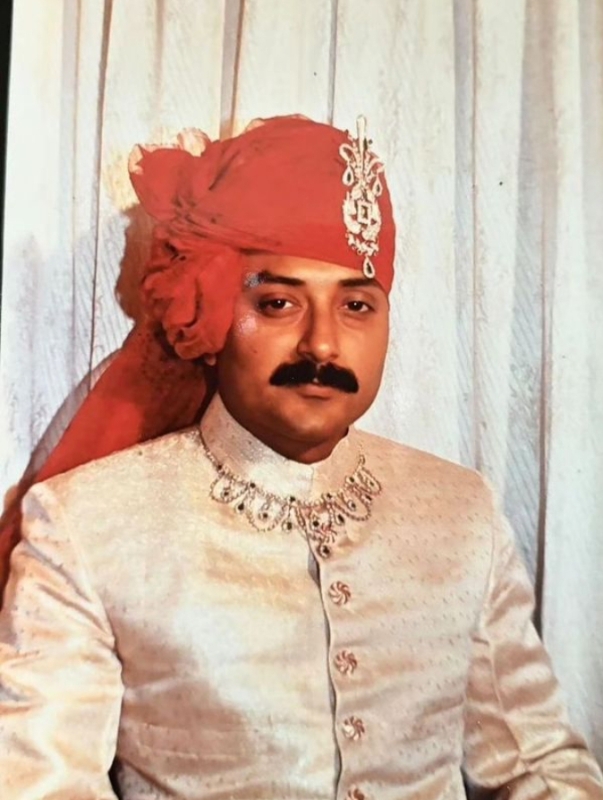
Present Head
At the suggestion of senior members of the Raikwar clan, his youngest daughter, Rajkumari Divyajyoti Singh, has been placed as a temporary custodian under the divine aegis of Shri Shri 1008 Lodheshwar Mahadev until such time as a suitable successor can be chosen from within the Raikwar clan to carry on the title of the Raja of Ramnagar Dhameri.
History
Origin and Puranic Lineage
The Raikwar clan of Rajputs, who established the principalities of Ramnagar Dhameri, Baundi, and Chahlari, trace their mythological descent from the Solar dynasty (Suryavansha). According to local tradition and genealogical records, the clan traces its lineage back to Bharat, the younger brother of Lord Rama of Ayodhya. Bharat's son, Pushkar, founded the city of Pushkalavati (modern-day Peshawar region) and became the progenitor of a line of rulers. Generations later, Raika Deva, a prominent descendant, established his capital in the Jammu region, naming it Raika. His descendants, migrating from this northern stronghold, adopted the clan name "Raikwar" to commemorate their ancestral seat.
The Migration and Conquest of Oudh
During the late 12th century, geopolitical upheavals in northern India prompted the migration of the Raikwar brothers, Pratap Shah and Dunde Shah, from Jammu to the fertile plains of Kannauj. This period coincided with the decline of the Gahadavala dynasty and the rise of early Islamic rule in Delhi. Pratap Shah established marital alliances with local powers, marrying the daughter of Manik Chand of Manikpur.
The military prowess of Pratap Shah's sons—Saldeo, Baldeo, and Bhairwanand—caught the attention of Qutb-ud-din Aibak, the founder of the Delhi Sultanate. Aibak commissioned the brothers to lead a military campaign against the Bhars, a powerful indigenous community that dominated the Awadh (Oudh) region. During the fierce campaign, Bhairwanand was killed in battle. He was laid to rest at Chand Sihali in the Fatehpur pargana, where a memorial stone (chabutra) remains a sacred site of worship for Raikwar Rajputs to this day.
Following their victory over the Bhars, the remaining brothers divided the conquered territories. Saldeo took control of the trans-Ghoghra lands, establishing the lines of Baundi and Rehwa. Baldeo received the pargana of Sailuk, laying the foundation for the southern branch of the family, which eventually settled at Ramnagar Dhameri.
Consolidation and the Mughal Era
For several generations, the descendants of Baldeo consolidated their hold over the Sailuk region. The eighth descendant of Baldeo, Ram Singh, formally consolidated his territories into the state of Ramnagar-Dhameri in the Barabanki district. Ram Singh, lacking surviving male heirs, adopted his kinsman Zorawar Singh. Raja Zorawar Singh was officially recognized as the first ruler of the state to bear the hereditary title of "Raja".
During the Mughal Empire, particularly under Akbar and Jahangir, the Rajas of Ramnagar Dhameri operated as semi-independent chieftains. They paid tribute to the Mughal subahdar at Awadh while retaining complete autonomy over their internal administration, land revenue collection, and local defense.
The Nawabi Period and British Annexation
With the decline of the Mughal Empire and the rise of the Nawabs of Awadh in the 18th century, the Raikwars of Ramnagar Dhameri frequently clashed with the Nawabi administration in Lucknow. The Rajas of Ramnagar were fierce defenders of their territorial sovereignty and repeatedly resisted the revenue demands of the Nawabi Amils.
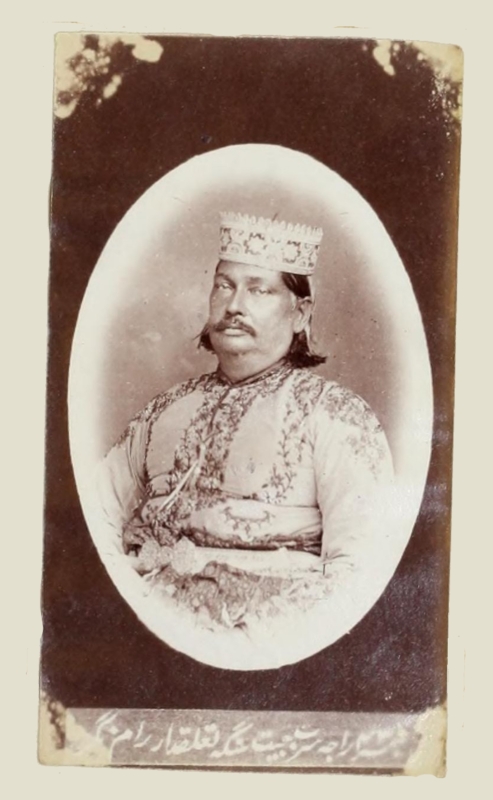
Following the British annexation of Awadh in 1856, the land settlement systems underwent drastic changes. During the Indian Rebellion of 1857 (often called the First War of Independence), the Raikwar clan displayed divided loyalties. While the northern Raikwar branch of Baundi, led by Raja Hardat Singh, rebelled fiercely alongside Begum Hazrat Mahal of Lucknow, Raja Sarabjit Singh of Ramnagar Dhameri maintained a cautious, neutral stance, eventually aiding the British forces.
As a consequence of his loyalty, Raja Sarabjit Singh's estates were spared from confiscation during the post-mutiny British settlements. The British government recognized him as one of the premier Taluqdars of Oudh, confirming his title of Raja and granting him extensive revenue-collecting rights over large portions of the Barabanki district.
Post-Independence and Modern Era
Following India's independence in 1947, the princely state of Ramnagar Dhameri was integrated into the Dominion of India. With the passage of the Uttar Pradesh Zamindari Abolition and Land Reforms Act in 1950, the formal revenue powers of the Taluqdari system were abolished.
Despite the loss of administrative privileges, the royal family of Ramnagar Dhameri transitioned into modern democratic India, engaging in politics, civic leadership, and agricultural development. The historical palace (Fort of Ramnagar) remains a significant cultural landmark in the Barabanki district of Uttar Pradesh, preserving the heritage of the Raikwar Rajputs.
References and Historical Citations
- To explore the detailed genealogical records and administrative history of Awadh during the British Raj, refer to the Gazetteer of the Province of Oudh, Volume II.
- For details on the Taluqdari families of Oudh and their noble titles, see Sir Roper Lethbridge's The Golden Book of India.
- The settlement history and territorial divisions of the Barabanki district can be studied in H.R. Nevill's Barabanki: A Gazetteer (1904).
Genealogy
- Raja ZORAWAR SINGH, 1st Raja of Ramnagar-Dhameri, he was the adopted son Rao Ram Singh of Ramnagar, who was appointed to the office of Chaudhuri, and formed the estate of Ramnagar-Dhameri; he was the first to bear the title of Raja; married and had issue.
- Raja Gharib Singh (qv)
- Raja Sheo Singh (qv)
- Raja GHARIB SINGH, 2nd Raja of Ramnagar-Dhameri, he had constructed the Sheo Sagar tank and the temple at Mahadeva, he died spm.
- Raja SHEO SINGH, 3rd Raja of Ramnagar-Dhameri, married and had issue.
- Kunwar Abdhut Singh, he died sp.
- Raja Anup Singh (qv)
- Raja Bhawani Singh (qv)
- Raja ANUP SINGH, 4th Raja of Ramnagar-Dhameri -/1751, he led a Hindu confederacy against Mughal power, but lost his life in the battle of Chheolaghat on the Gumti in 1751.
- Raja BHAWANI SINGH, 5th Raja of Ramnagar-Dhameri 1751/-, he served in Rohilkhand and elsewhere under the Nawab Wazir and received the parganas of Fatehpur, Kursi, and Dewa as well as Hisampur and Fakhripur in Bahraich in jagir in return for his services; married and had issue.
- Raja Basti Singh (qv)
- Raja Surat singh (qv)
- Raja BASTI SINGH, 6th Raja of Ramnagar-Dhameri, he died sp after one year
- Raja SURAT SINGH, 7th Raja of Ramnagar-Dhameri -/1826, during his tenure, the whole of the estate was taken under direct management of Nawab Sa'adat Ali Khan, he was restored to power in 1809, and became Chakladar of Ramnagar and Muhammadpur, he fell into arrears and was imprisoned at Lucknow, but was released on the security of Raja Goverdhan Das of Sandila, failing to pay, he was besieged in his fort at Chheda by the Raja, where he died ; married and had issue. He died at Chheda in 1826.
- Raja Gurbakhsh Singh (qv)
- Raja GURBAKHSH SINGH, 8th Raja of Ramnagar-Dhameri 1826/1857, he succeeded to the office of Chakladar in 1826, which he held till 1839, when the whole property was taken under the direct management of the Nazim, Raja Darshan Singh, he recovered his property in 1844, and was made Chakladar of Muhammadpur in 1844; he quarrelled with his son in 1854 who was granted the lease of Ramnagar and Muhammadpur, leaving Raja Gurbakhsh Singh with 47 villages later known as Bhitauli estate, it was confiscated in 1858 due to the Rajas rebellion and given to the Maharaja of Kapurthala; married and had issue. He died in .
- Raja Sarabjit Singh (qv)
- Raja SARABJIT SINGH, 9th Raja of Ramnagar-Dhameri 1857/1899, born , he succeeded to the gaddi in 1857, and began a life of extravagance and the estate became heavily encumbered; in 1888 it was taken under the management of the Court of Wards and was released only in July 1901; the title of Raja was recognized as hereditary on 4th December 1877; Chief of the Raikwar Clan, married 1stly, Rani Chandra Kunwar, she died sp, daughter of Thakur Durga Singh Chandel, married 2ndly, Rani Gulab Kunwar, a daughter of Thakur Beni Prasad Singh of Bahraich, and had issue, one son. He died in December 1899 at Suratganj.
- Raja Shri Udit Narain Singh (by Rani Gulab Kunwar) (qv)
COURT OF WARDS 1888/1901
- Raja Shri UDIT NARAIN SINGH, Raja of Ramnagar-Dhameri 1899/1927, born , married and had issue, two sons. He died .
- Rai Sahib Raja Shri Harnam Singh (qv)
- Kanwar Sarnam Singh, educated at Colvin Taluqdars' School, Lucknow; married Kanwarani Parbati Kuer, sister of Chaudhary Hardayal Singh Rawalot (Bhati) of Dhoom-Dadri (Gautam Buddha Nagar District) and had issue, one son. He died .
- Raja Shri Amar Krishna Narain Singh (qv)
- Rai Sahib Raja Shri HARNAM SINGH, Raja of Ramnagar-Dhameri 1927/1935; born , educated at Colvin Taluqdars' School, Lucknow; he succeeded to the gaddi on 5th June 1927; he was granted the title of Rai Sahib as a personal distinction in January 1927; married Rani Drigraj Kuer, Taluqdarani of Ganeshpur, died after 1959, 2ndly married daughter of Chaudhry Thakur Prithviraj Singh Raval (Rawalot Bhati) of Dhoom-Manikpur. He died sp in 1935.
- Raja Shri AMAR KRISHNA NARAIN SINGH, Raja of Ramnagar-Dhameri 1935/1990; born , he attained majority on 12th September 1940; married 1stly, Rani Sahiba (name unknown), she died sp, daughter of HH Maharaja Maharawal Sahib Shri Indrasinhji Pratapsinghji, 21st Raja of Bansda, married 2ndly, Rani Sahiba Chandraprabha, daughter of HH Svasti Shri Rajadhiraja Sahib Umaid Singhji II Bahadur, Raja Sahib of Shahpura, and his second wife, and had issue. He died 1990.
- Raja Vijay Singhji (qv)
- Rajkumar Abhay Singhji
- Raja Shri VIJAY SINGHJI, Raja of Ramnagar-Dhameri, married Rani Usha Kumari, daughter of Raja Ram Singh of Gangwal, and has issues.
- Rajkumar Shri Ratnakar Singhji (qv)
- Rajkumar Rajendra Singhji, married Rajkumari Karishma Singh, and has issue.
- Kumari Eshaanika Raje
- Rajkumari Shobha Raje, married Shri Udayan Singh of Kursela, and has issue, one son and a daughter.
- Raja Shri RATNAKAR SINGHJI, Raja of Ramnagar-Dhameri and Head of the Junior branch of the Raikwar clan, born , died , educated at Mayo College, Ajmer; married 1992, Rajkumari Mrinalini Kumari, daughter of Raja Digvijay Singhji, Raja Saheb of Raghogarh, and his wife, Rani Asha Kumari, and has issue, four daughters. He died on .