History
Origin and Foundation of Umatwara
The ruling dynasty of Rajgarh belongs to the Umat clan, a distinguished branch of the legendary Paramara Rajputs (or Pawars) who once ruled Malwa, boasting illustrious ancestors such as Raja Vikramaditya and Raja Bhoj. The origin of the state is deeply intertwined with the territory known as Umatwara, which comprised a vast tract of land in Central India. In 1448, the chief of this clan received the title of Rawat, establishing a strong local hegemony over the region. The Umat Rajputs maintained their autonomy through strategic alliances and fierce resistance against neighboring regional sultanates.
The Division and Establishment of Rajgarh (1681)
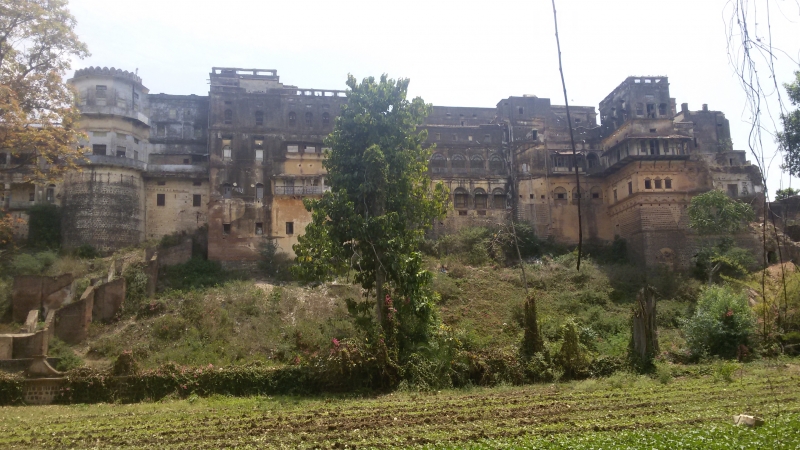
For over two centuries, Umatwara remained a singular political entity. However, in 1681, internal family divisions led to the partition of the territory between the two sons of the reigning Rawat. The elder line, under Rawat Paras Ramji, established the state of Rajgarh, naming the new capital in honor of his son, Raj Singh. The younger line, led by Rawat Mohan Singh, founded the neighboring state of Narsinghgarh. Rawat Paras Ramji constructed a fort and developed the town of Rajgarh, which became the cultural and administrative heart of the Umat clan.
Maratha Dominance and the British Treaty (1818)
During the late 18th and early 19th centuries, the decline of the Mughal Empire allowed the Maratha Confederacy to expand into Central India. Rajgarh fell under the sphere of influence of the Maratha Scindia dynasty of Gwalior and the Holkars of Indore, paying annual tributes to these powerful entities. This period was marked by administrative instability and frequent raids by Pindari freebooters.
Order was restored in 1818 when the British East India Company intervened under the administration of Sir John Malcolm. A treaty was mediated between Rawat Nawal Singh of Rajgarh and Maharaja Scindia of Gwalior. Under this British protectorate agreement, Rajgarh's territorial integrity was guaranteed, and the tribute payable to Scindia was regulated and mediated through the British political agent, bringing much-needed peace and administrative reforms to the region.
The Reign of Rawat Moti Singh and Later Rulers
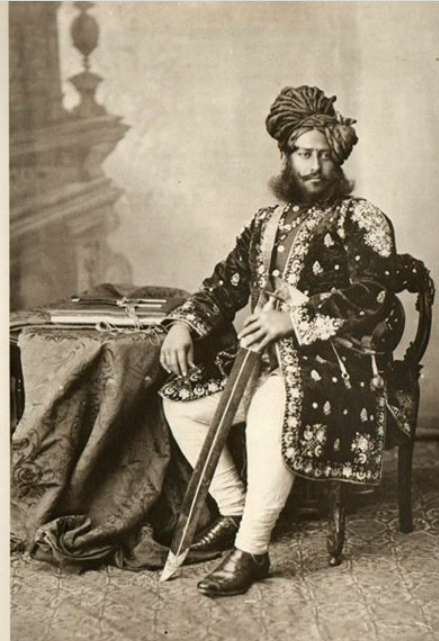
One of the most remarkable chapters in the history of Rajgarh occurred during the reign of Rawat Moti Singh, who ascended the gadi in 1831. In 1871, Rawat Moti Singh converted to Islam, adopting the name Muhammad Abd-ul-Wasih. Despite his conversion, he continued to govern with the support of his subjects. In recognition of his loyalty and administrative capabilities, the British government conferred upon him the hereditary title of Raja and an 11-gun salute in 1872.
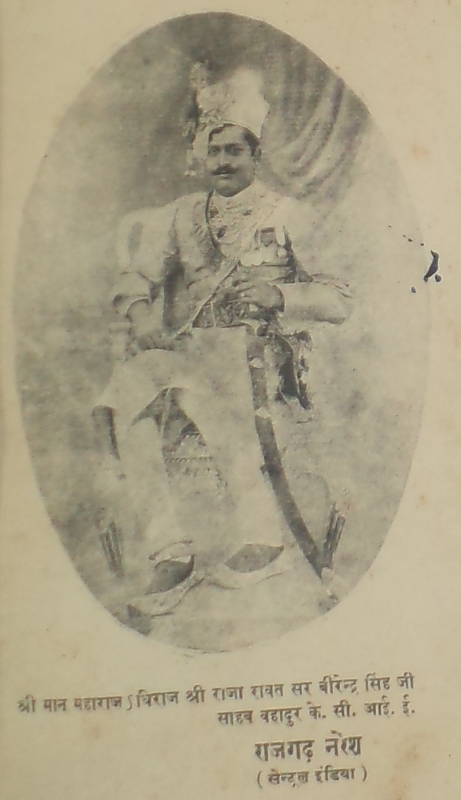
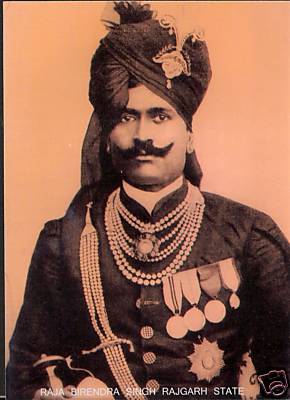
Upon his death in 1880, he was succeeded by his son, Raja Bakhtawar Singh, who reverted to the Hindu faith and restored the traditional Rajput rituals of the royal court. He was succeeded by Raja Bane Singh (reigned 1882–1916), who was a visionary reformer. Raja Bane Singh built modern schools, hospitals, and roads, and was appointed a Knight Commander of the Indian Empire (KCIE) for his contributions to the welfare of his state. He was followed by Raja Sir Birindra Singh (reigned 1916–1936), who further modernized the judicial and revenue departments.
Post-Independence and Modern Era
The last ruling Maharaja of Rajgarh, Maharaja Bikramaditya Singh, signed the Instrument of Accession to the Dominion of India on June 15, 1947. In 1948, the state was formally merged into the newly created state of Madhya Bharat. When the states of India were reorganized on linguistic lines in 1956, Madhya Bharat was integrated into the state of Madhya Pradesh. Today, Rajgarh remains a prominent district of Madhya Pradesh, celebrated for its rich historical forts, temples, and cultural heritage.
References and Citations
- To read more about the administrative division and history of the state, visit the Rajgarh State Wikipedia Page.
- For detailed archival records of Central India States, refer to the Digital South Asia Library (DSAL) hosted by the University of Chicago.
- Historical records of the treaty of 1818 can be explored via the National Archives and the Imperial Gazetteer of India.
Genealogy
- Rawat CHHATAR SINGH, Rawat of Rajgarh 1621/1638, married and had issue.
- Rawat Mohan Singh (qv)
- Rawat Paras Ramji, disputed the succession of his brother, and founded the Princely State of Narsinghgarh.
- Rawat MOHAN SINGH, Rawat of Rajgarh 1638/1697, died .
- Rawat AMAR SINGH, Rawat of Rajgarh 1697/1740
- Rawat NARPAT SINGH, Rawat of Rajgarh 1740/1747
- Rawat JAGAT SINGH, Rawat of Rajgarh 1747/1775
- Rawat HAMIR SINGH, Rawat of Rajgarh 1775/1790
- Rawat PRATAP SINGH, Rawat of Rajgarh 1790/1803
- Rawat PRITHVI SINGH, Rawat of Rajgarh 1803/1815, married and had issue.
- Rawat Newal Singh (qv)
- Thakur Khok Singh, he was briefly in charge of the state from 1846 to November 1847.
- Rawat NEWAL SINGH, Rawat of Rajgarh 1815/1831, he adopted his nephew; married and had adoptive issue. He committed suicide in 1831.
- (A) Rawat Moti Singh (qv)
- Rawat MOTI SINGH, Rawat of Rajgarh 1831/1871, due to his mismanagement, the state was placed in the care of his uncle and the Diwan until November 1847, when a British officer subordinate to the Political Agent in Bhopal was appointed, the Rawat took charge again in 1856 and in 1871 he converted to Islam, see next line.
- Nawab MUHAMMAD ABD al-WASIH KHAN (aka Rawat Moti Singh), Rawat of Rajgarh 1871/1880, born , he was granted the title of Nawab by the British government in 1872; he abolished all transit duties on salt in 1880; married and had issue. He died in .
- Rawat Bakhtawar Singh (qv)
- HH Raja Rawat Sir Bane Singh (qv)
- Rawat BAKHTAWAR SINGH, Rawat of Rajgarh 1880/1882, married and had issue. He died in .
- HH Raja Rawat Balbhadra Singh (qv)
- HH Raja Rawat BALBHADRA SINGH, Rawat of Rajgarh 1882/1902, born , succeeded 6th July 1882, he was granted the title of Raja as a hereditary distinction on 1st January 1886, married Rani Uday Kunwar, daughter of Thakur Takhat Singhji of Namli in Ratlam, and had issue. He died spm in 1902.
- Thakurani Jadhav Kunwar, married Thakur Jodh Singhji of Ghanerao, and had issue.
- HH Raja Rawat Sir BANE SINGH, Rawat of Rajgarh 1902/1916, born , K.C.I.E. [cr.1908], married and had issue.
- HH Raja Rawat Sir Birendra Singh Bahadur (qv)
- Colonel Maharaja Bijayendra Singh
- Maharaja Vivek Singh
- Maharaja Balveer Singh
- Maharaja Balram Singh
- Maharaja Vishwanath Singh
- Maharaja Vikram Singh
- Rajkumari Lakshmi Kumari, died after 1947.
- Rani Man Kanwar Sahiba, maerried Maharaj Shri Bhim Singhji Sahib, son of Maharaj Arjun Singhji of Jodhpur [1876-1933]
- HH Raja Rawat Sir BIRENDRA SINGH Bahadur, Rawat of Rajgarh 1916/1936, born 17th Janaury 1892, succeeded 10th January 1916; K.C.I.E. [cr.1918], married (amongst others) (a), HH Rani Songariji, married (b), a daughter of Cdg. Gen. Maharajkumar Padma Jung Bahadur Rana of Lambjung and Kaski (see Nepal), and had issue, one son and a number of daughters. He died .
- HH Raja Rawat Bikramaditya Singh Bahadur (qv)
- HH Raja Rawat BIKRAMADITYA SINGH Bahadur, Rawat of Rajgarh 1936/-, born posthumously on 18th December 1936 and succeeded at birth on 18th December 1936, married HH Rani Indra Kumari, daughter of HH Maharao Shri Bhim Singhji II Bahadur of Kotah, and his wife, HH Maharani Shiv Kumari.
- HH Raja Rawat Varunaditya Singh Bahadur, Raja of Rajgarh. He died in .
- Thakur Narayan Singh, born , thakur of Jagir Kila Amargarh (collateral branch of Rajgarh family), studied from Daly College Indore, Law degree from London and a retired IAS officer. Married to Hemant Kumari of Dhargaon in 1946 and have two issues.
- Kanwar Nitranjan Singh married to Poornima Singh of Kothi
- Bhanwar Aditya Singh
- Kanwar Ajay Singh married to Amita Singh of Ransi (Rajasthan)
- Kumari Radhika Singh
- Kumari Ambika Singh
- Kanwar Nitranjan Singh married to Poornima Singh of Kothi
- Kanwar Ram Pratap Singh of Jagir Kila Amargarh (collateral branch of Rajgarh family), married Rajkumari Amba Devi, daughter of Rana Krishen Chand of Kuthar, and his wife, Rani Krishna Devi, and has issue, four children.
- Kumar Abhay Singh
- Kumari Prithi Kumari
- Kumar Viki Singh
- Kumari Ira Kumari
Notable Figures
Rawat Mohan Singh (1638–1681)
Rawat Mohan Singh was a prominent early ruler of the Umat clan of Parmar Rajputs in the region of Umatwara, which today comprises the districts of Rajgarh and Narsinghgarh in Madhya Pradesh. He initially ruled the unified Umatwara territory from his capital at Duparia. Under his leadership, the Umat Rajputs consolidated their political and military influence in the Malwa region, maintaining a delicate balance of power with both the declining Mughal Empire and neighboring Rajput clans.
His reign is remembered as a period of consolidation for the Umatwara state. Following his death in 1681, a succession dispute arose among his descendants, leading to the partition of the territory. His son, Rawat Gaj Singh, established the independent state of Rajgarh, while another branch of the family established the neighboring state of Narsinghgarh. For further reading on this period, see the Rajgarh State Wikipedia Page.
Rawat Gaj Singh (1681–1710)
Rawat Gaj Singh was the founder of the modern town of Rajgarh, establishing it as the capital of his partitioned state in 1681. He erected a defensive fort and laid the foundations of the town's administrative structure. His reign was largely dedicated to securing the newly defined borders of the Rajgarh state against rival factions and preventing Maratha encroachments in the Malwa plateau.
Under his administration, Rajgarh began to develop as a distinct political entity independent of the parent Umatwara state. Detailed accounts of the territorial division during his reign can be found in the historical records of the Imperial Gazetteer of India.
Rawat Newal Singh (1815–1831)
Rawat Newal Singh ruled Rajgarh during a critical transitional era in Central Indian history, marked by the decline of the Maratha Empire and the expanding hegemony of the British East India Company. In 1818, following the Third Anglo-Maratha War, he concluded a historic treaty of subsidiary alliance with the British, negotiated by the British statesman and diplomat Sir John Malcolm.
Under the terms of this treaty, Rajgarh became a British protectorate. The British guaranteed the security of the state from external threats, particularly from the Scindias of Gwalior, in exchange for an annual tribute (tanka). This alliance brought much-needed stability to Rajgarh after decades of devastating Pindari raids. The details of this treaty are preserved in A Collection of Treaties, Engagements and Sanads Relating to India.
Rawat Moti Singh / Nawab Mohammad Abd-ul-Wasih Khan (1831–1880)
Rawat Moti Singh is one of the most remarkable and unique figures in the history of the Rajgarh Princely State. Succeeding to the gaddi in 1831, he initially ruled as a traditional Hindu Rajput prince. However, in 1871, he embraced Islam and adopted the name Mohammad Abd-ul-Wasih Khan. This conversion was a highly unusual event among the ruling houses of Central India, and he was subsequently recognized with the personal title of Nawab by the British administration.
Despite his conversion, he continued to manage the affairs of Rajgarh efficiently, constructing several civic amenities, palaces, and public buildings in the capital. Upon his death in 1880, his son succeeded him and restored traditional Hindu Rajput customs to the state court. His life and career are documented in Sir Roper Lethbridge's The Golden Book of India.
Raja Balbhadra Singh (1882–1902)
Raja Balbhadra Singh succeeded to the gaddi in 1882. During his reign, in 1886, the British Government elevated the hereditary title of the rulers of Rajgarh from "Rawat" to "Raja". This elevation reflected the state's growing strategic importance and its cooperative relationship with the British Raj.
Balbhadra Singh was a reformist ruler who established modern schools, built dispensaries, and introduced systematic land revenue reforms in the state. He was highly regarded for his benevolence during the devastating Indian Famine of 1899–1900, during which he opened state granaries and initiated relief works to assist his subjects. More information about his administrative reforms is available on the Rajgarh State Wikipedia Page.
Raja Bane Singh (1902–1916)
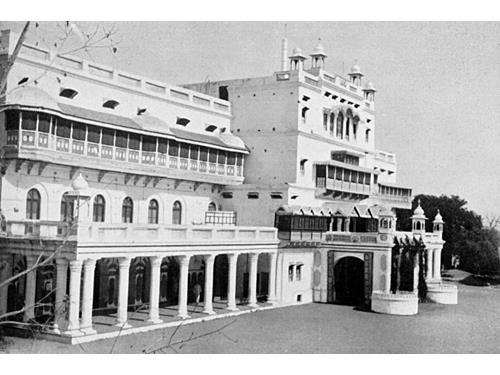
Raja Bane Singh was an energetic and visionary ruler who accelerated the modernization of Rajgarh. He represented the state at the grand Delhi Durbars of 1903 and 1911. He focused heavily on infrastructure development, commissioning the construction of the iconic Bane Singh Palace, which showcased a blend of traditional Rajput and European architectural styles.
To support agriculture, which was the backbone of Rajgarh's economy, he initiated several irrigation projects, including the construction of various tanks and reservoirs. He also expanded primary and secondary education across the state's districts. His contributions are recorded in the historical archives of the Imperial Gazetteer of India.
Raja Sir Birindra Singh (1916–1936)
Raja Sir Birindra Singh succeeded his father in 1916. He was a highly educated and progressive ruler who maintained close ties with the British Indian Empire. For his administrative acumen and contributions to the British war effort during the First World War, he was created a Knight Commander of the Most Exalted Order of the Star of India (KCSI) in 1918.
Birindra Singh's reign saw the introduction of electricity, piped water supply, and improved road connectivity in Rajgarh town. He also reorganized the state's military forces and police department along modern lines. A chronicle of his titles and rule can be accessed on the Rajgarh State Rulers Section on Wikipedia.
Raja Bikramaditya Singh (1936–1948)
Raja Bikramaditya Singh was the last ruling chief of the Rajgarh Princely State. Ascending the throne in 1936, he navigated the complex political transition leading up to India's independence. He was known for his supportive stance toward democratic reforms and local self-governance within the state.
Following India's independence in August 1947, Raja Bikramaditya Singh signed the Instrument of Accession on June 15, 1948, formally merging his state into the newly formed Union of Madhya Bharat. This union was later integrated into the modern state of Madhya Pradesh in 1956. His role in the integration of princely states is detailed on the Rajgarh State Wikipedia Page.