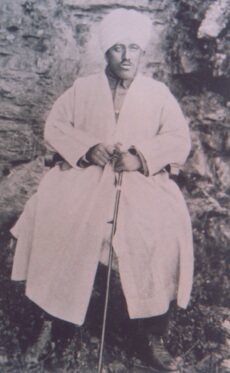
Present Head
- Tikka Saheb Kartikey Singh Sisodia, schooling from La Martiniere College, Lucknow.
- Rajkumari Saheb Padmakshi Singh, schooling from La Martiniere Girls College, Lucknow.
- Kunwar Devmanya Pratap Singh, schooling from La Martiniere College, Lucknow.
History
Origin and Foundation of Tharoch
The princely state of Tharoch (also historically spelled as Taroch or Tiroch) was established in the rugged, mountainous tracts of the Shimla Hills during the late medieval period, around the 15th century. The ruling family of Tharoch traces its illustrious lineage directly to the Suryavanshi Sisodia Rajputs of Mewar (Udaipur). According to local chronicles and historical records of the Simla Hill States, Prince Deokaran, a Maharaj Kumar of Mewar, migrated northward to the Himalayan foothills and initially settled in the Sirmur State.
Over generations, the descendants of Deokaran established deep roots in the region. Tharoch was originally a fiefdom under the suzerainty of the Raja of Sirmur. It was eventually bestowed as an independent gift upon Kishan Singh, a direct descendant of Deokaran, marking the formal birth of Tharoch as an independent principality. The chiefs of Tharoch originally held the ancient and prestigious title of Rana, symbolizing their sovereign status in the hill regions.
The Gurkha Occupation and British Suzerainty (1803–1815)
At the dawn of the 19th century, the expansionist Gurkha Empire of Nepal launched a massive invasion of the Western Himalayas, conquering the Simla Hill States one by one. Tharoch fell under the heavy military occupation of the Gurkhas between 1803 and 1815. During this tumultuous period, the traditional administration was disrupted, and the Rana of Tharoch was forced to pay heavy tributes to the Nepalese commanders.
The Gurkha hegemony ended with the outbreak of the Anglo-Nepalese War (1814–1816). The British East India Company, allied with local hill chiefs, successfully expelled the Gurkha forces. Following the British victory and the signing of the Treaty of Sugauli, the political landscape of the region was reorganized. In 1815, the British administration granted a sanad (patent of protection and recognition) to the ruling chief, Thakur Karam Singh. However, under the new British paramountcy, the traditional title of the ruler was downgraded from "Rana" to "Thakur."
The Succession Crisis and British Intervention (1819–1843)
The death of Thakur Karam Singh in 1819 precipitated a long and complex succession dispute that severely affected the stability of the state. Because of factional intrigues, the British authorities bypassed the immediate line of succession and conferred the chiefship on Jhobu, a prominent family member, via a fresh sanad in 1819.
Jhobu’s legitimacy remained largely unchallenged until 1838, when his ambitious nephew, Ranjit Singh, asserted his rightful claim to the gaddi (throne). Ranjit Singh successfully rallied a powerful faction of local nobility and peasantry, culminating in a widespread insurrection in 1838–1839. To quell the rebellion and restore order, the British forced Jhobu to abdicate in favor of his son, Shyam Singh.
This political compromise proved short-lived. Shyam Singh was widely regarded as incompetent, and his court remained a hotbed of intrigue fueled by both the deposed Jhobu and the rebel Ranjit Singh. Realizing the state's administration was collapsing, the British deposed Shyam Singh in 1841. Tharoch was temporarily stripped of its administrative autonomy and placed under the direct management of the neighboring Jubbal State.
This period of joint British-Jubbal administration lasted until April 1843. After a detailed inquiry by the Superintendent of the Simla Hill States, the claims of Ranjit Singh were officially recognized as legitimate. On June 27, 1843, a definitive British sanad was issued to Ranjit Singh, restoring the state’s autonomy and securing the hereditary rulership for his descendants in perpetuity, subject to the standard conditions of loyalty and military service to the British Crown.
Modernization, Reforms, and Restoration of the Title
Thakur Ranjit Singh’s restoration ushered in a period of relative peace and administrative consolidation. He was succeeded by Thakur Kidar Singh in 1871, who ruled until his death in 1902. During the late 19th century, Tharoch began adopting modern administrative practices, particularly in forestry management and revenue collection, which greatly boosted the state's economy.
In 1902, Thakur Surat Singh ascended the throne. Because he was a minor, the state was initially managed by a council of regency under British supervision. Upon attaining full ruling powers, Surat Singh proved to be a progressive administrator. He built modern schools, improved road connectivity through the difficult mountainous terrains, and modernized the judicial system. In recognition of his administrative capabilities, loyalty during World War I, and ancestral lineage, the British government officially restored the hereditary title of Rana to the rulers of Tharoch in 1929.
Post-Independence and Modern Era
The last ruling chief of the state was Rana Baljit Singh, who ascended the gaddi in 1944. Following India's independence in 1947, the process of political integration began. On April 15, 1948, Rana Baljit Singh signed the Instrument of Accession, merging Tharoch State into the newly formed Indian Union territory of Himachal Pradesh.
Initially, the territories of Tharoch were made part of the Mahasu district. Following subsequent administrative reorganizations, the former state became an integral part of the Shimla District of modern-day Himachal Pradesh. Today, the royal legacy lives on in local festivals, traditional architecture, and the preserved cultural heritage of the region, which continues to celebrate its historic links to the Sisodias of Udaipur.
Genealogy
- Rana KISHAN SINGH, 1st Rana of Tharoch, founder of the state fl.15th century
- ......
- Thakur LACCHU SINGH, Thakur of Tharoch 1787/1815, in the 19th generation from the founder, married and had issue. He died .
- Thakur Karam Singh (qv)
- Thakur Jhobu Singh (qv)
- Kanwar Bir Singh
- Thakur KARAM SINGH, Thakur of Tharoch 1815/1819, married and had issue. He died .
- Tikka Lal Singh, died vpsp in 1813.
- Thakur Ranjit Singh (qv)
- generation
- Thakur Kesar Singh, founder of the Princely State of Dhadi. (cf. below)
- Thakur JHOBU SINGH, Thakur of Tharoch 1819/1838, succession confirmed by a sanad of 1819, married and had issue. He died .
- Thakur Shyam Singh (qv)
- Kanwar Bhan Singh, married and had issue.
- Kanwar Kesar Singh, 1st Thakur Sahib of Dhadi. (cf. above)
- Kanwar Kanshi Ram, married and had issue.
- Kanwar Rup Singh
- Kanwar Mallu Ram of Behrog, married and had issue.
- Kanwar Sher Singh, married and had issue.
- Kanwar Krishen Singh, married Kumari Pamela, daughter of Col. Sardar Mehr Singh of Mukerian, and has issue.
- Kumari Padma Kumari, married Col. Sardar Jai Ganesh Singh of Mukerian, and has issue.
- Kumari Uma Devi, married Col. Kanwar Raghubir Singh of Ghund, and has issue.
- Kumari Sheila Devi, married Kanwar Birendra Singh of Jubbal, and has issue.
- Kanwar Madhan Singh, married and had issue.
- Kanwar Bahadur Singh
- Kanwar Baldev Singh
- Kanwar Devi Singh, married and had issue.
- Kumari Vimla Devi, married Kanwar Narendra Singh of Jubbal, and has issue.
- Kumari Manki Devi, married Kanwar Madan Singh of Jubbal, and had issue.
- Kumari Dharam Devi, married Kanwar Bhim Singh of Jubbal, and had issue.
- Kumari Jantu Devi, married (as his first wife), Kanwar Nar Singh of Jubbal, and had issue.
- Kanwar Sher Singh, married and had issue.
- Thakur SHYAM SINGH, Thakur of Tharoch 1838/1841 (deposed)
- Thakur RANJIT SINGH, Thakur of Tharoch 1843/1877, succession confirmed by a sanad, married and had issue. He died .
- Tikka Kehar Singh, married and had issue. He died vp in 1866.
- Thakur Kedar Singh (qv)
- Kanwar Sadia Singh, died .
- Kanwar Tikam Singh, born .
- Kanwar Dhian Singh, died .
- Kanwar Sis Ram, born .
- Kanwar Rai Singh, died .
- Kanwar Rinkhu Singh
- Kanwar Mathra Singh, born .
- Kanwar Man Singh
- Tikka Kehar Singh, married and had issue. He died vp in 1866.
- Thakur KEDAR SINGH, Thakur of Tharoch 1877/1902, born , succeeded 20th May 1871 or 1877, married two Ranis from Bashahr and Thakurani Jamuna Devi of Darkoti, and had issue. He died .
- Rana Surat Singh (qv)
- Kanwar Partab Singh, born , died young.
- Kanwar Murat Singh, married 1stly, Kanwarani Durga Devi, daughter of Kanwar Gopal Singh of Baghat, died sp, married 2ndly, Kanwarani Sharda Devi, daughter of Rana Raghunath Singh of Darkoti, and had issue, five daughters. (Tharoch, Himachal Pradesh, India)
- Kumari Kamla Kumari, married Kanwar Harinder Singh of Ghund, and has issue, one son and one daughter.
- Kumari Kanta Kumari, married Rakesh Sharma from Kangra, and has issue, two daughters.
- Sonia Sharma
- Divya Sharma
- Kumari Shakuntala Kumari, married Kanwar Yashpal Singh of Dulehar, and has issue, one son and one daughter.
- Kanwar Rahul Singh
- Kumari Richa Singh
- Kumari Kunti Kumari [Rani Kunti Kumari of Dhadi], married Rana Sahib Surinder Singh of Dhadi, and has issue, two sons and one daughter.
- Kumari Kalpana Kumari, married Kanwar Uday Singh of Jubbal, and has issue, two sons.
- Rana SURAT SINGH, Rana of Tharoch 1902/1944 , born and succeeded 14th July 1902, he was granted the title of Rana as a personal distinction in 1929, married and had issue. He died .
- Rajkumari Ladli Kumari, married Rana Hardev Singh of Kunihar, and had issue.
- Tikka Mahendra Singh, born , married 1stly, Tikka Rani Ambika Kumari, daughter of Kanwar Rudra Singh of Koti, married 2ndly, Tikka Rani Kamla Kunwar, born , died , daughter of Shreeman Maharaj Bharat Singhji Sahib, Raja Sahib of Multhan, and his first wife, Rani Aman Kunwar, married 3rdly, a Kumari of Balsan. He died sp in 1938.
- Rajkumar Sumander Singh, died young.
- Rana Baljit Singh (qv)
- Rajkumar Pratap Singh
- Rajkumari Tara Devi, married Raja Shri Dalip Singh Bahadur of Dhami, and had issue, five children.
- Rajkumari Rajdulari, married to Brig. Apji Nahar Singh of Kunadi in Kotah, Rajasthan.
- Rajkumari Jeevan, married Shri Prakash Katoch of Kangra in Himachal Pradesh and has issues.
- Kumari Madhulika Katoch, born .
- Karan Singh Katoch, born .
- Navneet Singh Katoch, born .
- Rana BALJIT SINGH, (The Palace, Post Office Tharoch, Sub-Tehsil Nerwa, Tehsil Chopal, District Simla, Himachal Pradesh, India), born , succeeded to the gaddi in 1944, married 1961 at Dehra Dun, Rani Pratima Kumari of Patna in Bihar, and has issue. He died in .
- Rajkumari Mrignayni Kumari, married into Jamnagar in Gujarat.
- Tikka Saheb Rakesh Singhji (qv)
- Rana RAKESH SINGH, Thakur of Tharoch (see above)
- Kanwar Ishwar Singh, married and had issue.
- Kanwarani Pushpa Kumari, married Kanwar Gian Singh of Ghund, and had issue.
- Kanwar Mahinder Singh (cf. above), married 1924, Kumari Shankri Dei, died sp in 1945, daughter of Kanwar Surjan Singh of Jubbal, and his wife, Kanwarani Govinda Devi.
- Kanwar Jai Singh, married Kanwarani Padma Devi, daughter of Kanwar Budhi Singh of Kiri-Nerwa in Jubbal.
- Kanwarani Gyan Devi, married Kanwar Homendra Singh of Jubbal, and had issue.
- Mian Lal Singh, married and had issue.
- Kumari Krishna Kumari, married Kanwar Balbir Singh of Jubbal, and has issue, two sons.
Notable Figures
Thakur Kishan Singh
Thakur Kishan Singh was the founder of the Tharoch Princely State (historically also referred to as Taroach). He was a descendant of the royal Sisodia Rajput clan of Udaipur. Kishan Singh migrated to the western Himalayan region and managed to carve out an independent fiefdom from the territories of the neighboring princely state of Sirmur, establishing the foundations of the Tharoch dynasty in the Shimla hills.
Thakur Karam Singh
Thakur Karam Singh ruled during a highly tumultuous period in the early 19th century when the Gurkha Empire expanded into the Shimla Hill States. Following the defeat of the Gurkhas in the Anglo-Nepalese War, the British East India Company restored the local chieftains. In 1815, Karam Singh received a formal Sanad (charter) from the British government under the signature of Sir David Ochterlony, confirming his ancestral rights and sovereignty over Tharoch, subject to certain conditions of loyalty and tribute. He passed away in 1819.
Thakur Ranjit Singh
Following the death of Thakur Karam Singh, Tharoch witnessed internal political intrigues. Karam Singh's brother, Jhobu, took control of the administration but was eventually deposed due to mismanagement and high-handedness. In 1843, the British authorities formally recognized Thakur Ranjit Singh, the son of Karam Singh, as the rightful ruler of Tharoch. Ranjit Singh proved to be a capable administrator who consolidated the state's finances and maintained cordial relations with the British Raj, notably during the Indian Rebellion of 1857. He ruled until his death in 1871.
Detailed historical accounts of this transition can be found in the Gazetteer of the Simla Hill States, which records the administrative challenges and treaties of the era.
Thakur Kedar Singh
Thakur Kedar Singh succeeded his grandfather, Thakur Ranjit Singh, in 1871 as a minor. Born in , his early years on the throne were managed under a British-supervised regency council. He was granted full ruling powers in 1884 upon attaining majority. Kedar Singh's reign was characterized by modernization, particularly in the forestry sector. He organized the state's vast forest reserves, which became the primary source of revenue for Tharoch. He died in after a stable and progressive reign.
Thakur Surat Singh
Thakur Surat Singh succeeded to the gaddi (throne) in 1902 at the age of fifteen. He was educated at the prestigious Aitchison College in Lahore, where he received training in modern state administration. He assumed full administrative powers in 1908. Surat Singh is credited with introducing educational reforms, building roads, and establishing primary healthcare facilities in the state. He also leased out valuable forest tracts to the British government, ensuring a steady financial stream for the state's development. He ruled through both World Wars, maintaining strong ties with the colonial government.
Thakur Baljit Singh
Thakur Baljit Singh was the last ruling chief of the Tharoch Princely State. He ascended the throne in 1944 amidst the geopolitical shifts of World War II and the looming independence of India. Following India's independence in 1947, Baljit Singh signed the Instrument of Accession, merging Tharoch into the newly formed Indian Union. On April 15, 1948, the state officially integrated into the province of Himachal Pradesh, bringing an end to centuries of direct royal administration. Details on the integration of these hill states can be reviewed in historical records of the Simla Hill States.