Present Head
- Yuvraj Kamlendra Singh, married 25th November 2007 in New Delhi, Maharajkumari Vindeshwari Shah [Yuvrani Vindeshwari Kumari of Jhabua], eldest daughter of HH Saramad-i-Rajha-i-Bundelkhand Maharaja Mabindra Sawai Shri Madhukar Shah Ju Deo Bahadur, Maharaja Saheb of Orchha, and his wife, HH Maharani Snehlata Devi, and has issue.
- Bhanwar Baisa Vaishnavi Kumari Jhabua, born .
- Maharajkumar Jai Singh, married 10th December 2009 in Bhubaneshwar, Maharajkumari Rajyashree Manjari Bhanj Deo, eldest daughter of HH Maharaja Shri Praveen Chandra Bhanj Deo of Mayurbhanj, and his wife, HH Maharani Rashmi Bhanj Deo.
History
Pre-Founding: The Land of the Bhils
Before the 16th century, the dense forests and hills of the Jhabua region were completely dominated by independent Bhil chieftains. The area was highly fragmented, and the rugged terrain made it notoriously difficult for outside empires to control. The town of Jhabua itself takes its name from Jhabbu Naik, a powerful Bhil chief who ruled a stronghold in the area and frequently raided trading caravans passing between Gujarat and Malwa.
The Foundation by Rao Bir Singh (1584)
The foundation of the princely state of Jhabua is tied to the expansionist policies of the Mughal Empire and the martial prowess of the Rathore Rajputs.- The Jodhpur Origin: Rao Bir Singh (a grandson of Rao Jodha, the founder of Jodhpur) was a distinguished military commander. His family had earlier migrated from Jodhpur to establish the neighboring state of Ratlam.
- The Imperial Commission: The lawlessness of the western Malwa borderlands was disrupting crucial trade routes between Delhi and the ports of Gujarat. Emperor Akbar commissioned Rao Bir Singh to suppress the lawless elements and pacify the region.
- The Campaign: In 1584, Rao Bir Singh defeated Jhabbu Naik in battle. Instead of merely clearing the route, Bir Singh consolidated his position, established a fortress, and founded the sovereign principality of Jhabua, bringing the local Bhil population under a centralized administration while respecting many of their local customs.
Maratha Domination and Destabilization
During the 18th century, the decline of the Mughal Empire left Jhabua vulnerable to the rising Maratha powers. Due to its strategic position on the border of Gujarat and Malwa, it became a frequent target for raids.
- The Holkar Subjugation: The state was repeatedly invaded by the armies of the Holkar dynasty of Indore. By the mid-18th century, the rulers of Jhabua were forced to pay a heavy tribute (chauth) to Indore.
- Internal Chaos: The financial strain of Maratha extortion, combined with internal succession disputes among the Rathore princes, plunged Jhabua into near-anarchy. Large portions of the state's territory were mortgaged or leased to neighboring states, and the central authority of the Raja was severely weakened.
British Protection and Recovery (1818)
Exhausted by decades of Maratha dominance and domestic turmoil, Jhabua sought stability under the British East India Company.
- The 1818 Treaty: Following the defeat of the Marathas in the Third Anglo-Maratha War, Jhabua entered into a treaty of protection with the British in 1818, becoming part of the Bhopawar Agency (later integrated into the Central India Agency).
- The Indore Settlement: The British intervened to settle the long-standing territorial disputes between Jhabua and Indore. Under British arbitration, Jhabua's internal autonomy was guaranteed, and the tribute to the Holkars was strictly regulated and channeled through British authorities to prevent direct Maratha interference.
- The 1857 Uprising: During the Indian Rebellion of 1857, the young Raja Gopal Singh remained staunchly loyal to the British. He provided asylum and safe passage to British families fleeing from the mutinous troops at the nearby Neemuch cantonment. In gratitude, the British government rewarded him with honors and solidified his administrative authority over the region.
State Symbols and Vexillology
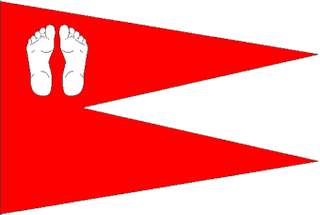
- The State Flag: The flag of Jhabua State was a triangular red banner, symbolizing the martial tradition of the Rathore clan, adorned with a white Hanuman carrying a mountain—a sacred symbol of protection, strength, and unwavering loyalty.
- The Coat of Arms: The official heraldic shield of Jhabua featured a central fortress on a hill, flanked by a sword and an arrow (representing the combined martial history of the Rajputs and the local Bhils). The supporters were a Rajput warrior and a Bhil archer, reflecting the dual demographic pillar of the state.
Integration into Modern India
Following India's independence, Raja Dilip Singh signed the Instrument of Accession to the Union of India. Jhabua formally merged into the new state of Madhya Bharat in June 1948. Following the States Reorganisation Act of 1956, Madhya Bharat was dissolved, and Jhabua became a permanent district within the westernmost frontier of Madhya Pradesh.
Genealogy
- Raja KESHO DAS, 1st Raja of Jhabua 1584/1607, he was granted the title of Raja by the Emperor of Delhi, as a reward for a successful campaign in Bengal, and for punishing the Bhil Chiefs of Jhabua, who had murdered an Imperial Viceroy of Gujarat, married and had issue.
- Raja Karan Singh (qv)
- Raja KARAN SINGH, 2nd Raja of Jhabua 1607/1610, married and had issue.
- Raja Mah Singh (qv)
- Raja MAH SINGH, 3rd Raja of Jhabua 1610/1677, married and had issue.
- Raja Kushal Singh (qv)
- Raja KUSHAL SINGH, 4th Raja of Jhabua 1677/1723, married and had issue.
- Raja Anup Singh (qv)
- Thakur Indar Singh of Bhagor, married and had issue.
- Raja Bahadur Singh (qv)
- Raja ANUP SINGH, 5th Raja of Jhabua 1723/1727, married and had issue.
- Raja Sheo Singh (qv)
- Raja SHEO SINGH, 6th Raja of Jhabua 1727/1758, ke adopted Kunwar Bahadur Singh, son of Thakur Indar Singh of Bhagor (see above); married and had adoptive issue. He died sp 1758.
- (A) Raja Bahadur Singh (qv)
- Raja BAHADUR SINGH, 7th Raja of Jhabua 1758/1770, born as Kunwar Bahadur Singh of Bhagor, he succeeded by adoption; married and had issue.
- Raja Bhim Singh (qv)
- Raja BHIM SINGH, 8th Raja of Jhabua 1770/1821, in consequence of the disturbed state of the country and the imbecility of the Raja, he was required to abdicate in favour of his son in 1821; married and had issue. He died .
- Raja Pratap Singh (qv)
- Maharaj Moti Singh, he was granted the estate of Khawasa in 1826; married and had issue.
- Maharaj Salim Singh, married and had issue.
- Raja Ratan Singh (qv)
- Maharaj Gulab Singh
- Raja PRATAP SINGH, 9th Raja of Jhabua 1821/1832, he adopted his nephew, Kunwar Ratan Singh (see above), married and had adoptive issue. He died sp 1832.
- (A) Raja Ratan Singh (qv)
- Raja RATAN SINGH, 10th Raja of Jhabua 1832/1840, adopted by his predecessor, he was granted a khilat by the Bengal Government in 1834; married (amongst others), Rani Pratap Kunwar, daughter of Raja Bhim Singhji II of Banera, and his wife, Rani Mertaniji, and had issue. He died .
- HH Raja Gopal Singh (qv)
- HH Raja GOPAL SINGH, 11th Raja of Jhabua 1841/1895, born , succeeded October 1841; he performed good service during the mutiny of 1857, in consideration of which he was allowed to exercise limited criminal powers within his State; in 1865, he permitted the mutilation of a person confined under suspicion of theft, the Raja was fined 10,000Rs, and required to grant the injured man a pension, the Rajmata was banished from Jhabua for a year, and the Kamdar and others were expelled from the state, also the Raja had his gun salute discontinued, which was restored at the expiration of a year from the date of its discontinuance, after a favourable report on his administration; he married and had adoptive issue. He died spm 1895.
- Baisa (name unknown) [HH Maharani (name unknown) Sahiba of Bundi], married Colonel HH Maharao Raja Shri Sir Raghubir Singhji Sahib Bahadur of Bundi.
- (A) HH Raja Udai Singh (qv)
- HH Raja UDAI SINGH, 12th Raja of Jhabua 1895/1942, born , son of Maharaj Raghunath Singh of Khawasa, married and had adoptive issue. He dspm after 1945.
- (A) HH Raja Dilip Singh (qv)
- HH Raja DILIP SINGH, 13th Raja of Jhabua 1942/1965 , born , son of Maharaj Kesar Singh of Khawasa, educated at Agra and Aligarh, Kamdar of Ratanmal, President of the Council of administration, Jhabua; married HH Rani Gopal Kumari, daughter of Thakur Chain Singh, and had issue. He died .
- HH Raja Ajit Singh (qv)
- Rajkumari Girija Devi [Rajmata Saheba of Balsan], born , educated at St. Raphael's School, Indore; married Rana Vidyabushn Singh of Balsan, and has issue, two sons.
- Maharaj Gajendrapal Singh, Thakur Saheb of Jhaknaoda 1946/-; educated at Daly College, Indore; he was adopted 15th July 1946, by the two surviving widows of the late Thakur Narayan Singh of Jhaknavda Thikana in Jhabua, who died ; he married Rajkumari Somlata Kumari, born , daughter of Rana Ran Bahadur Singh Jandaive of Balsan, and has issue.
- Rajkumar Jitendra Singh, married in 1996 to Rajkumari Priyanka Singh Bhikamkore and has an issue.
- Rajkumari Amba Singh Jhabua
- Rajkumari Chandrika Kumari, married January 1991 (div. 1992), Yuvaraj Shri Manvendrasinhji Raghubirsinhji Sahib of Rajpipla.
- Rajkumar Jitendra Singh, married in 1996 to Rajkumari Priyanka Singh Bhikamkore and has an issue.
- Maharaj Devendra Pal Singh, married 24th November 1968 at Wankaner in Gujarat, Rajkumari Bhagyawanti Devi [Rani Bhagyawanti Devi of Jhabua], daughter of Maharaj Saheb Chandra Bhanu Singhji of Wankaner, and his wife, Rani Kumud Manjli, and has issue, one son.
- Rajkumar Bhriguraj Singh, married Rajkumari Mahima Singh, daughter of Raja Dr. Sanjay Singh of Amethi, and his first wife, Rani Garima Devi.
- Rani Krishna Kumari, married Rao Ran Bahadur Singh of Churhat, and has issue.
- HH Raja AJIT SINGH, 14th Raja of Jhabua 1965/2002, educated at Daly College, Indore, married and had issue, three sons. He died .
- HH Raja Narendra Singh (qv)
- Maharaj Gopal Singh, educated at Daly College, Indore; married 1980, Rajkumari Prafulla Singh, daughter of Darbar Saheb Janak Sinhji of Rajpur, Saurasthra, and has issue. (Jhabua Farms, Indore)
- Rajkumar Mayur Singh, married 2006, Kumari Maheshwari, daughter of Darbar Shri Shivrajsinhji Harishchandrasinhji of Dhank, and has issue.
- Kumari Bhavika Singh Jhabua
- Rajkumar Mayur Singh, married 2006, Kumari Maheshwari, daughter of Darbar Shri Shivrajsinhji Harishchandrasinhji of Dhank, and has issue.
- Maharaj Ganesh Singh, married Rani Arunima Kumari, and has issue.
- Rajkumari Nandini Kumari, married, Kunwar Pitamber Pratap Singh, son of Thakur Dyanendra Singh of Orai (see Kotla), and his wife, Thakurani Maya Singh, M.P., Rajya Sabha, and has issue, one son.
- Bhanwar Rudra Pratap Singh
- Rajkumari Vijaya Kumari, married 25th February 2008 at Nahan in Sirmur, Kunwar Sangram Singh, son of Kunwar Abhay Singh of Sirmur, and his wife, Kumari Kunjana Devi.
- Rajkumari Nandini Kumari, married, Kunwar Pitamber Pratap Singh, son of Thakur Dyanendra Singh of Orai (see Kotla), and his wife, Thakurani Maya Singh, M.P., Rajya Sabha, and has issue, one son.
- HH Raja NARENDRA SINGH, 15th Raja of Jhabua (see above)
Notable Figures
Raja Keshav Das (r. 1584–1607)
Raja Keshav Das (also known as Kishan Das) was the founder of the Jhabua Princely State. A distinguished Rathore Rajput warrior and a descendant of Rao Jodha of Jodhpur, he entered the imperial service of the Mughal Emperor Akbar. In the late 16th century, the Malwa region was heavily troubled by lawless Bhil chieftains and bandits. Akbar commissioned Keshav Das to suppress these rebellions and restore order to the region.
After successfully defeating the notorious bandit chief Jhabbu Naik, Keshav Das founded the state in 1584, naming the capital Jhabua in commemoration of the defeated chief. Under his rule, the foundations of administrative order were laid in a volatile forest tract, establishing the Rathore dynasty's sovereignty in southwestern Malwa. His historical legacy is detailed in the Jhabua State Wikipedia Page.
Raja Kushal Singh (r. 1677–1723)
Raja Kushal Singh was a prominent ruler who succeeded in consolidating and expanding Jhabua's territories during a highly turbulent period of Mughal decline. He is best remembered for establishing the town of Kushalgarh and constructing several strongholds to secure the state's vulnerable borders against neighboring chiefdoms.
His long reign was marked by active military diplomacy, which allowed Jhabua to maintain its autonomy despite the rising Maratha influence in Central India. He successfully defended his territories and ensured that the Rathore authority remained absolute in the region.
Raja Gopal Singh (r. 1840–1895)
Raja Gopal Singh was one of the most influential and longest-reigning rulers of Jhabua. Adopted from the Ramgarh branch of the dynasty, he ascended the throne as a minor. His reign spanned over five decades, witnessing the critical transition of India under the direct administration of the British Raj.
During the Indian Rebellion of 1857, Raja Gopal Singh remained staunchly loyal to the British Crown. He provided critical asylum and protection to European refugees fleeing from nearby stations and sent state troops to assist in quelling local uprisings. In recognition of his loyalty, the British government rewarded him with a khillat (robe of honor), reduced the state's annual tribute, and granted him an 11-gun salute, cementing Jhabua's status as a recognized treaty state under the Central India Agency.
Raja Udai Singh II (r. 1895–1942)
Raja Udai Singh II succeeded to the gaddi in 1895 and assumed full ruling powers in 1898. He is widely regarded as the architect of modern Jhabua. Throughout his long reign, he initiated extensive administrative, judicial, and social reforms to uplift his state, which was predominantly inhabited by indigenous tribal populations.
He established modern schools, hospitals, and dispensaries, and improved connectivity by constructing roads and linking the state with regional rail networks. His progressive policies during the devastating famines of the early 20th century saved countless lives and earned him great respect from both his subjects and the British administration.
Raja Dileep Singh (r. 1942–1948)
Raja Dileep Singh was the last ruling Maharaja of the Jhabua Princely State. Ascending the throne during the height of the Second World War, his brief reign was marked by the intense political transitions leading to Indian independence.
Following the departure of the British, Raja Dileep Singh signed the Instrument of Accession to the Dominion of India on 15 June 1948. He formally merged Jhabua State into the newly created Union of Madhya Bharat, which was later integrated into the state of Madhya Pradesh. His cooperative stance during the integration of princely states ensured a peaceful transition for his people. For further context on the region's transition, see the Jhabua District Wikipedia Page.