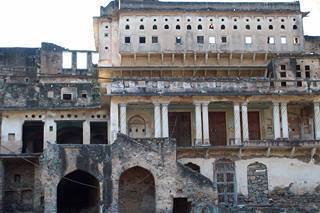
Present Head
- Rajkumari Deveshree Shekhawat, born , educated at Mayo College Girls' Ajmer and graduated from the National Law University, Jodhpur.
- Rajkumar Adhiraj Singh Shekhawat, born , studied at Mayo College, Ajmer; finishing up college at St. Xaviers College, Mumbai.
History
Origin and Foundation of Chowkari Thikana
The Thikana of Chowkari (also spelled Chokri), located in the historical Shekhawati region of modern-day Jhunjhunu district in Rajasthan, holds a distinguished place in the annals of Rajput history. The estate was ruled by the Bhojrajika branch of the Shekhawat clan of Rajputs, who trace their lineage back to Maharao Shekha, the 15th-century ruler of Amarsar and the eponymous founder of the Shekhawat clan.
The specific lineage of Chowkari stems from Thakur Bhojraj Ji, a prominent son of Raja Raisal Darbari of Khandela. Raja Raisal was a highly decorated general in the Mughal imperial army under Emperor Akbar. Thakur Bhojraj Ji received the Udaipurwati territorial division as his estate. Over the subsequent generations, his descendants—collectively known as the Bhojrajika Shekhawats—expanded their territorial influence across the region, leading to the division of lands and the eventual establishment of various sub-estates (thikanas), including Chowkari, under the nominal suzerainty of the Jaipur State.
The Mughal and Maratha Eras
During the 17th and 18th centuries, the chieftains of Shekhawati, including the rulers of Chowkari, navigated a complex political landscape dominated by the Mughal Empire and later the rising power of the Maratha Confederacy. The Shekhawat rulers maintained a dual identity: they acted as semi-independent rulers of their respective fiefdoms while fulfilling military obligations for the Amber (later Jaipur) State.
With the decline of Mughal authority after the death of Emperor Aurangzeb in 1707, the region witnessed frequent territorial skirmishes. In the latter half of the 18th century, the Marathas, led by commanders such as Mahadji Scindia, launched frequent incursions into Rajputana to extract tribute (Chauth). The Bhojrajika Shekhawats of Chowkari, alongside neighboring estates, put up fierce resistance and participated in significant regional military coalitions to defend the sovereignty of their estates and the Jaipur kingdom.
The British Period and the Shekhawati Brigade
By the turn of the 19th century, the continuous Maratha raids and internal factionalism had severely weakened the Rajput states. In 1818, the Kingdom of Jaipur signed a Treaty of Perpetual Friendship and Alliance with the British East India Company. This treaty brought the tributary estates of Shekhawati, including Chowkari, under the indirect influence of British paramountcy.
To curb local unrest, banditry, and border disputes between various thikanas, the British established the famous Shekhawati Brigade in 1835, under the command of Major Henry Forster. The rulers of Chowkari cooperated with the British administration to restore law and order, which facilitated a transition from a militarized society to an era of administrative reform and trade expansion. The estate paid a fixed annual tribute (known as mamla) to the Jaipur Durbar, which in turn was overseen by the British Resident at Jaipur.
Socio-Cultural Reforms and Architectural Legacy
The stabilization of the region under British oversight in the late 19th and early 20th centuries ushered in a golden age of art and architecture in Shekhawati. The thikana of Chowkari actively patronized the Marwari merchant community, encouraging them to establish trading hubs in the region. This partnership led to the construction of magnificent, intricately painted havelis adorned with vibrant frescoes, which have now made the Shekhawati region world-famous as an "open-air art gallery."
The rulers of Chowkari also focused on civic welfare and public infrastructure by constructing:
- Fortified castles (garhs) to protect the local population.
- Stepwells (baoris) and water reservoirs to combat the arid desert climate.
- Temples and dharamshalas to support religious pilgrims and travelers.
Post-Independence and Modern Era
Following India's independence in 1947, the geopolitical structure of Rajputana underwent a monumental transformation. Under the guidance of Sardar Vallabhbhai Patel, the princely state of Jaipur, along with its various vassal thikanas, officially integrated into the United State of Greater Rajasthan in 1949.
The formal passage of the Rajasthan Land Reforms and Resumption of Jagirs Act in 1952 brought an end to the centuries-old feudal Jagirdari system. The administrative and revenue-collecting rights of the Thikana of Chowkari were transferred to the democratic Government of Rajasthan. Today, Chowkari is a peaceful locality within the Jhunjhunu district, celebrated for its rich historical heritage, traditional Rajasthani architecture, and its enduring contributions to the cultural tapestry of the Shekhawati circuit.
Genealogy
- Raja BAKHAT SINGH, Thakur of Chowkari 1745/1754, born about 1720, son of Thakur Zorawar Singh of Jhunjhunu, married three wives, and had issue, four sons. He died at Singhana.
- Thakur Arjun Singh (qv)
- Kunwar Adhot Singh, died sp.
- Kunwar Duleh Singh, died sp.
- Kunwar Bhim Singh of Kumawas, he adopted his nephew, Kunwar Gyan Singh.
- Raja ARJUN SINGH, Thakur of Chowkari 1754/1793, married and had issue.
- Thakur Jawan Singh (qv)
- Thakur Gyan Singh, he succeeded by adoption to Kumawas, married and had issue.
- Thakur Shyam Singh (qv)
- Raja JAWAN SINGH, Thakur of Chowkari 1793/-, married and had adoptive issue.
- (A) Thakur Shyam Singh (qv)
- Raja SHYAM SINGH, Thakur of Chowkari, son of Thakur Gyan Singh of Kumawas, he succeeded by adoption, married and had issue.
- Thakur Abhey Singh (qv)
- Kunwar Devi Singh, died sp.
- Raja ABHEY SINGH, Thakur of Chowkari, married and had issue.
- Thakur Mangal Singh (qv)
- Raja MANGAL SINGH, Thakur of Chowkari -/1893, the estate was made khals in 1868, and only restored to him on payment of 30,000Rs, married and had issue. He died .
- Thakur Gopal Singh (qv)
- Kunwar Ganpat Singh, died sp.
- Kunwar Bhur Singh, died sp.
- Kunwar Shivnath Singh, died sp.
- Kunwar Ramlal Singh, died sp.
- Baisa Jadav Kanwar, married Kunwar Moti Singh of Badli in Ajmer Merwara.
- Baisa Gulab Kanwar, married Kunwar Shambhu Singh of Suthalia.
- Thakurani Chand Kanwar, married (as his first wife), 1907, Rajeshri Thakur Onkar Singh of Dotria, born . She died .
- Raja GOPAL SINGH, Thakur of Chowkari 1893/1940, born , he married the sister of Thakur Laxman Singh of Jawala, and had issue, one son and two daughters. He died .
- Thakur Ishwari Singh (qv)
- Raja ISHWARI SINGH, Thakur of Chowkari 1940/1982, born , married 1stly, a Thakurani from Agewa, she died sp, married 2ndly, a daughter of Maharaj Sher Singh of Jodhpur, and had issue, as well as adoptive issue. He died on 5th Dec 1978.
- Baisa Lal Kanwar (by 2nd marriage), married Thakur Raghubir Singh of Neema.
- (A) Thakur Sumer Singh (qv)
- Raja SUMER SINGH, Thakur Sahib of Chowkari [August 1982 - December 2018], born , married Thakurani Gopal Kanwar, daughter of Thakur Bagh Singh of Kheans, and has issue. He died on .
- Thakur Shivshankar Singh, born , married Kunwarani Rasal Kanwar, daughter of Thakur Zalam Singh of Agor, and has issue. He was granted Chirana.
- Kunwar Anirudh Singh, born , educated at Mayo College Ajmer.
- Bhanwar Akhilagya Singh
- Bhanwar Adidev Singh
- Kunwar Anirudh Singh, born , educated at Mayo College Ajmer.
- Thakur Satya Narayan Singh (qv)
- Rajkumari Chandar Kanwar, married Thakur Shankar Singh of Kasumi.
- Rajkumari Mohan Kanwar, married Kunwar Mangal Singh of Khanpur.
- Rajkumari Vishnu Kanwar, married Kunwar Himmat Singh of Khanpur.
- Thakur Shivshankar Singh, born , married Kunwarani Rasal Kanwar, daughter of Thakur Zalam Singh of Agor, and has issue. He was granted Chirana.
- Raja SATYA NARAYAN SINGH, Thakur Sahib of Chowkari (see above)