Present Head

- Yuvaraj Shrimant Ajaysinh Raje Murairao Ghorpade
- Rajkumar Shrimant Sujaisinh Raje Murarirao Ghorpade, born in Bangalore, married 11th November 1986, Shrimant Akhand Soubhagyavati Tanyadevi Raje Ghorpade, born 8th March 19xx, daughter of Shrimant Khushal Dhawan of Delhi, and his wife, Shrimati Gulshan Dhawan, and has issue, one son and one daughter.
- Rajkumari Supriya Raje Ghorpade, born 15th October 1988, educated at Queen Mary University of London, graduating in May 2010 with a degree in Economics and Finance.
- Rajkumar Samarth Sujai Raje Ghorpade, born , presently (2008) studying at Rugby School, U.K.
- Rajkumar Shrimant Kartikeya Raje Murarirao Ghorpade, born in Baroda, Chairman and Managing Director of Kartikeya Manganese and Iron Ore Pvt. Ltd.; married 5th December 1988 in Baroda, Shrimati Ambika Raje Ghorpade, and has issue, two daughters.
- Shrimant Krutika Raje Ghorpade, born , presently (2011) studying for a B.Sc. in Economics from Royal Holloway, London University.
- Shrimant Anushka Raje Ghorpade, born , presently (2011) studying for a B.Sc. in Hospitality from Cesar Ritz in Switzerland.
- Rajkumari Shrimant Akhand Soubhagyavati Anuradha Raje, married 1989, Shrimant Viresh Dhaibar, and has issue, two sons.
History
Origin and Foundation of Sandur State
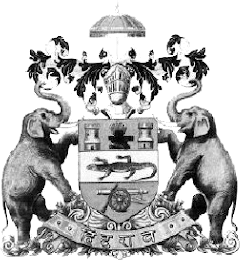
The state of Sandur, located in the present-day Bellary district of Karnataka, was a prominent Maratha princely state during the British Raj. The origin of the ruling dynasty of Sandur, the Ghorpade clan, is steeped in Maratha military valor. The family claims descent from the royal Bhonsle dynasty, the same lineage as Chhatrapati Shivaji Maharaj. The surname "Ghorpade" was earned by their ancestors after successfully scaling the steep walls of the Sinhagad fort using a trained monitor lizard (known as Ghorpad in Marathi).
The foundation of the independent principality of Sandur dates back to 1713 when Siddoji Rao Ghorpade, a Maratha military commander, captured the Sandur valley from the local Polegar of Kurugodu. The strategic geographical layout of Sandur, nestled within an amphitheater of forested hills, provided a natural fortress that allowed the dynasty to assert its independence and withstand external pressures. More details about the lineage can be explored on the Sandur State Wikipedia Page.
Maratha Era and Conflicts with Mysore
The mid-18th century was a tumultuous period for Sandur, characterized by regional power struggles between the Peshwas, the Nizams, and the Kingdom of Mysore. Under the leadership of Murari Rao Ghorpade, Sandur reached the zenith of its regional influence. Murari Rao was an exceptional military strategist who formed alliances with the British East India Company and the Peshwas to counter the rising power of Hyder Ali of Mysore.
In 1776, Hyder Ali besieged Sandur and successfully captured the fortress. Murari Rao was taken prisoner and died in captivity at the fort of Kabbaldurga. However, the resilient Ghorpades did not relinquish their claim. Following the fall of Tipu Sultan in the Fourth Anglo-Mysore War in 1799, the Marathas re-established their control. Siddoji Rao's descendants restored the family's hold over the valley, navigating the complex diplomacy of the decaying Maratha Empire.
The British Period and the Treaty of 1817
With the decline of the Peshwas after the Third Anglo-Maratha War, the British East India Company sought to consolidate its hold over southern India. In 1817, the British forces under General Munro entered the Sandur valley. Recognizing the strategic importance of the region and the legitimacy of the Ghorpade rulers, the British signed a treaty confirming Shiva Rao Ghorpade as the ruler of Sandur under British suzerainty.
Sandur was placed under the political supervision of the Madras Presidency. Unlike many other states that faced annexations under the Doctrine of Lapse, Sandur maintained its internal autonomy due to the unwavering loyalty and efficient administration of its rulers. A formal Sanad (charter) was granted to the rulers in 1826, guaranteeing their hereditary rights of governance.
Key Reformers and Modernization
Sandur was fortunate to be governed by highly enlightened rulers during the late 19th and early 20th centuries. The most notable among them was Raja Shrimant Yeshwantrao Ghorpade, who ascended the gadi in 1928. He was an administrative visionary who introduced sweeping social, educational, and economic reforms.
Under his reign, Sandur became one of the first princely states in India to issue the historic Temple Entry Proclamation of 1932, which opened all state-managed temples to the Scheduled Castes (then referred to as Harijans). This progressive move drew high praise from Mahatma Gandhi, who visited Sandur in 1934 and commended the Raja's reformist zeal. The state also witnessed the establishment of modern schools, healthcare facilities, and the development of the rich iron and manganese ore mines that define the region's economy today. You can read more about the Ghorpade clan's history on the Ghorpade Dynasty Page.
Post-Independence and Modern Era
Following India's independence in 1947, Raja Yeshwantrao Ghorpade signed the Instrument of Accession on 10 August 1947, merging the state of Sandur with the Dominion of India. The state was initially integrated into the Madras Province and was later transferred to the Mysore State (now Karnataka) during the linguistic reorganization of states in 1956.
The royal family continued to serve the public in democratic India. The late M. Y. Ghorpade, son of the last ruling Raja, was an eminent economist, photographer, and politician. He served as the Finance Minister of Karnataka and represented the Sandur constituency in the State Assembly for several terms, earning a reputation for impeccable integrity and public service. For more details on his life and political contributions, refer to the M. Y. Ghorpade Wikipedia Article.
Today, Sandur is recognized not only for its rich historical legacy and natural beauty but also as a major industrial hub for mining and steel production in Karnataka.
Genealogy
- Shrimant SIDALJI GHORPADE, Chief of Sandur, married and had issue. He died .
- Shrimant Gopalrao Sidaji Ghorpade (qv)
- Shrimant GOPALRAO SIDAJI GHORPADE, Chief of Sandur 1731/1777, married and had issue.
- Shrimant Shiva Rao Ghorpade II (qv)
- Shrimant SHIVA RAO GHORPADE II, Chief of Sandur 1777/1785, married and had issue. He died .
- Shrimant Sidalji Ghorpade II (qv)
- Shrimant SIDALJI GHORPADE II, Chief of Sandur 1785/1796, married and had adoptive issue.
- (A) Hindu Rao Shrimant Shiva Rao Ghorpade II (qv)
- Hindu Rao Shrimant SHIVA RAO GHORPADE II, Chief of Sandur 1799(1818)/1840, died .
- Hindu Rao Shrimant VENKATA RAO GHORPADE II, Chief of Sandur 1840/1861, he succeeded his uncle in 1840, married and had issue. He died .
- Raja Shrimant Shiva Sammukharao Ghorpade (qv)
- Raja Shrimant Ramchandra Vithalrao Ghorpade (qv)
- Raja Shrimant SHIVA SAMMUKHA RAO GHORPADE, Raja of Sandur 1861/1878, born , Raja [cr.1876], died .
- Raja Shrimant RAMCHANDRA VITHALRAO GHORPADE, Raja of Sandur 1878/1892, born , succeeded 5th February 1879.
- Raja Shrimant VENKATA RAO GHORPADE III, Raja of Sandur 1892/1927, born as the minor son of Shrimant Ramchandra Vithala Rao; he succeeded by adoption in 1892; died . INTERREGNUM 1927/1928
- Shrimant Maharaj Shri YESHWANTRAO HINDURAO ANNASAHEB GHORPADE, Mamlukatmadar Senapati, Raja of Sandur 1928/1996, born , he succeeded 5th May 1928 by adoption from Gajendragad, married 1929, and had issue. He died in .
- Shrimant Maharaj Shri Murarirao Yeshwantrao Ghorpade (qv)
- Rajkumar Shrimant Shivarao Yeshwantrao Raje Ghorpade, born .
- Rajkumari Shri Vijayadevi Raje, born , married Sardar Shri Pratapsinhji Raoji Rane of Sankli, and has issue.
- Rajkumar Shrimant Venkatrao Yeshwantrao Raje Ghorpade, born .
- Shrimant Maharaj Shri MURARIRAO YESHWANTRAO GHORPADE, Raja of Sandur (see above)
- Rani Shrimant Gayatri Raje Ghorpade, married 1997, Raja Babaji Rao Bhonsle Chatrapati of Tanjore, and has issue.