Present Head
History
Introduction and Origins
The historic province of Tanjore (now known as Thanjavur), situated in the fertile Kaveri Delta of Tamil Nadu, has long been a cradle of South Indian civilization. Historically referred to as the "Rice Bowl of Tamil Nadu," Tanjore's strategic and cultural prominence reached its zenith under successive powerful dynasties. While famously serving as the imperial capital of the medieval Chola Empire, Tanjore later transitioned into an independent Nayak kingdom, and eventually, a highly sophisticated Maratha principality under the Bhonsle dynasty.
The Nayak Predecessors
Before the rise of the Marathas, Tanjore was governed by the Thanjavur Nayaks, who initially ruled as viceroys of the Vijayanagara Empire. Following the decline of Vijayanagara after the Battle of Talikota in 1565, the Nayaks declared independence. Rulers like Sevappa Nayak and Raghunatha Nayak turned Tanjore into a major center for Telugu and Sanskrit literature, art, and temple architecture. However, internal conflicts and disputes with the neighboring Madurai Nayaks eventually paved the way for foreign intervention.
To read more about the transition of power in South India, visit the Encyclopaedia Britannica's Thanjavur Overview.
Establishment of the Maratha Dynasty
The Maratha rule in Tanjore was established in 1676 by Venkoji (also known as Ekoji I), the half-brother of the legendary Maratha emperor Chhatrapati Shivaji Maharaj. Venkoji was initially dispatched by the Adil Shahi Sultan of Bijapur to mediate a dispute between the Nayaks of Madurai and Tanjore. Recognizing the political instability of the region, Venkoji deposed the ruling Nayak prince, seized the throne of Thanjavur, and declared himself king, thereby founding the Thanjavur Maratha kingdom.
This southern branch of the Bhonsle clan maintained a unique identity, successfully blending Maratha military and administrative traditions with the local Tamil and Telugu cultural landscapes. Chhatrapati Shivaji himself marched to the south in 1677 during his Carnatic Expedition to assert overlordship, resulting in a treaty that solidified Venkoji’s reign under certain conditions.
The Golden Age of Thanjavur Marathas
Throughout the 17th and 18th centuries, Tanjore became a vibrant sanctuary for scholars, musicians, and artists fleeing the political turmoil of Northern and Central India. Rulers like Shahuji I, Serfoji I, and Tukkoji actively patronized local arts. During this era, the famous Carnatic music trinity—Tyagaraja, Muttuswami Dikshitar, and Syama Sastri—composed their legendary works in the Tanjore region, immortalizing the province as the heart of classical South Indian music.
The distinct Thanjavur painting style, characterized by rich, vivid colors, iconic gold leaf work, and the inlay of semi-precious stones, also developed and flourished under royal Maratha patronage, synthesizing traditional Tamil aesthetics with Deccan courtly influences.
Raja Serfoji II: The Great Reformer and Scholar
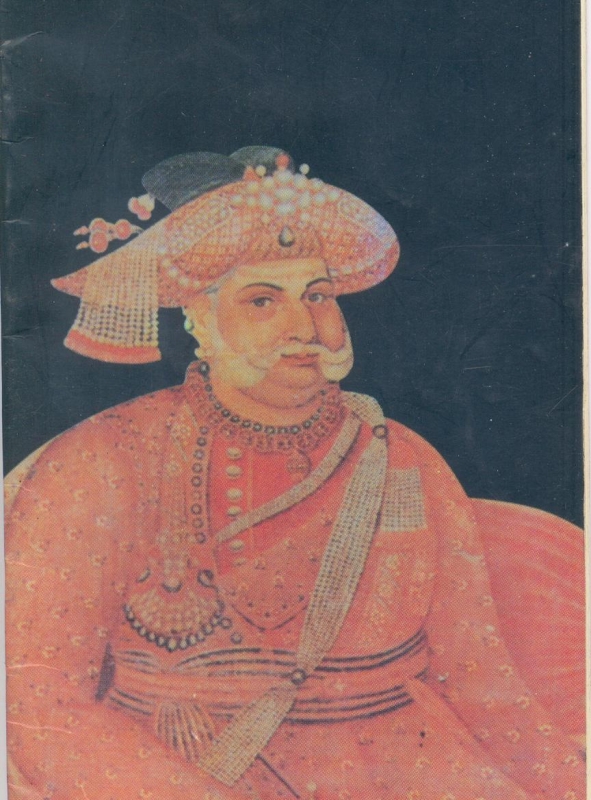
The most celebrated ruler of the Thanjavur Maratha dynasty was Raja Serfoji II (r. 1798–1832). Educated by the renowned Danish missionary Christian Friedrich Schwarz, Serfoji II was an extraordinary polymath, deeply versed in multiple languages, Western sciences, medicine, and literature.
His notable contributions to the province include:
- Saraswathi Mahal Library: Serfoji II expanded this ancient library into an institution of global renown, collecting thousands of rare Sanskrit, Tamil, Marathi, and European manuscripts. It remains one of the oldest and most important libraries in Asia. For more information, visit the Saraswathi Mahal Library Wiki.
- Educational and Medical Reforms: He established the Dhanvantari Mahal, a research institution where physicians practiced Ayurveda, Unani, and Siddha medicine, and maintained detailed medical case sheets including early ophthalmic studies.
- Printing Press: He established the first printing press with Devanagari moveable type in Southern India.
British Influence and the Doctrine of Lapse
The geopolitics of the late 18th century brought Tanjore under the heavy influence of the British East India Company. In 1799, under a treaty signed by Raja Serfoji II, the military and civil administration of the state was ceded to the British. The Raja was permitted to retain control over the Fort of Thanjavur and a small surrounding territory, while receiving a substantial pension.
The sovereign status of the state came to an end in 1855 upon the death of the last ruler, Shivaji II, who died without leaving a male heir. Under the controversial Doctrine of Lapse championed by Governor-General Lord Dalhousie, the British East India Company annexed the state of Tanjore, absorbing it into the Madras Presidency despite strong protests from the queen, Kamakshi Amamba Boyi Saheba.
Post-Independence and Modern Legacy
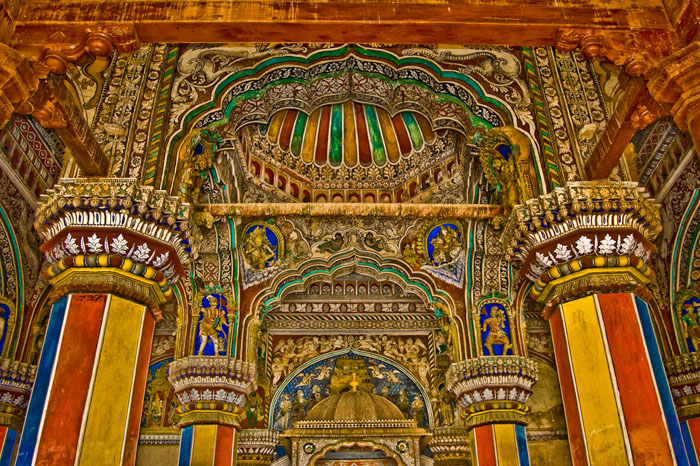
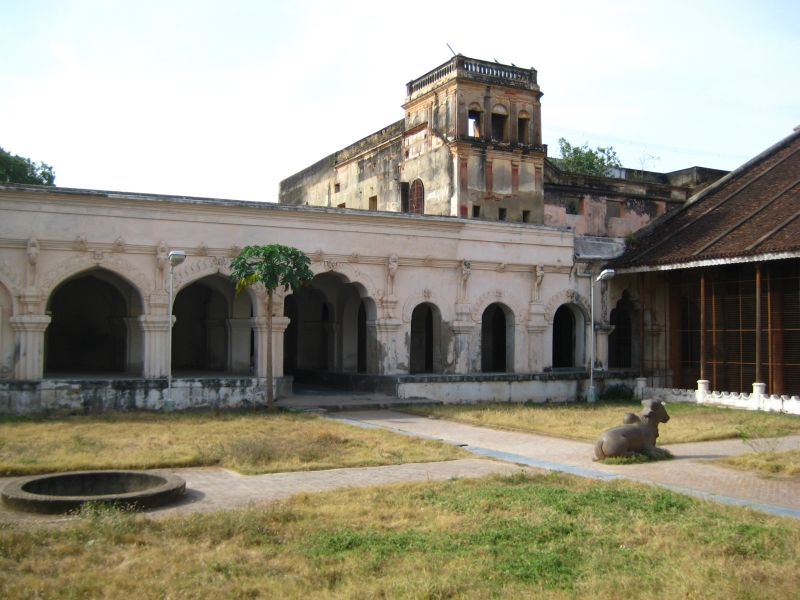
Following India’s independence in 1947, the region was integrated into the Madras State, which was later renamed Tamil Nadu. The descendants of the Tanjore royal family continue to reside in parts of the Thanjavur Palace complex, preserving their rich cultural heritage.
Today, Thanjavur is a bustling modern city that acts as a vital cultural capital. The world-famous Brihadisvara Temple, a UNESCO World Heritage Site built by Rajaraja Chola I, stands as a grand monument protected and maintained alongside the legacy of the Nayak and Maratha rulers who contributed greatly to its upkeep and expansion.
Genealogy
- H.H. Choladesadhipati Srimant Rajasri Maharaja Kshatrapati Sri Venkoji [Ekoji] Raje Sahib Bhonsle Chhatrapati Maharaj, Raja of Tanjore. (1676 - 1685)
- H.H. Choladesadhipati Shrimant Rajasri Maharaja Kshatrapati Sri Shahji II Raje Sahib Bhonsle Chhatrapati Maharaj, Raja of Tanjore.
- Shrimant Rajkumar Sharfoji Raje Sahib Bhonsle.
- H.H. Choladesadhipati Shrimant Rajasri Maharaja Kshatrapati Sri Tukoji [Thulaja I] Raje Sahib Bhonsle Chhatrapati Maharaj, Raja of Tanjore.
- H.H. Choladesadhipati Shrimant Rajasri Maharaja Kshatrapati Sri Sarabhoji [Serfoji I] Raje Sahib Bhonsle Chhatrapati Maharaj, Raja of Tanjore.
- Shrimant Rajkumar Raibhan Raje Sahib Bhonsle.
- H.H. Choladesadhipati Srimant Rajasri Maharaja Kshatrapati Sri Shahji II Raje Sahib Bhonsle Chhatrapati Maharaj, joint Raja of Tanjore. (1685 - 1712)
- H.H. Choladesadhipati Srimant Rajasri Maharaja Kshatrapati Sri Sarabhoji [Serfoji I] Raje Sahib Bhonsle Chhatrapati Maharaj, joint Raja of Tanjore. (1712 - 1729)
- H.H. Choladesadhipati Srimant Rajasri Maharaja Kshatrapati Sri Tukoji [Thulaja I] Raje Sahib Bhonsle Chhatrapati Maharaj, Raja of Tanjore. (1729 - 1736)
- H.H. Umdat ul-Mulk, Choladesadhipati Srimant Rajasri Maharaja Kshatrapati Sri Ekoji II [Bawa Sahib] Raje Sahib Bhonsle Chhatrapati Maharaj, Raja of Tanjore.
- Srimant Rajkumar Saiyaji Raje Sahib Bhonsle.
- H.M. Choladesadhipati Srimant Rajasri Maharaja Kshatrapati Sri Pratapsinha Raje Sahib Bhonsle Chhatrapati Maharaj, Raja of Tanjore.
- H.H. Umdat ul-Mulk, Choladesadhipati Srimant Rajasri Maharaja Kshatrapati Sri Ekoji II [Bawa Sahib] Raje Sahib Bhonsle Chhatrapati Maharaj, Raja of Tanjore. (1736 - 1737)
- H.H. Choladesadhipati Srimant Rajasri Maharaja Kshatrapati Sri Sawai Shahji [Kattu] Raje Sahib Bhonsle Chhatrapati Maharaj, Raja of Tanjore. (1740 - 1741)
- H.M. Choladesadhipati Shrimant Rajasri Maharaja Kshatrapati Sri Pratapsimha Raje Sahib Bhonsle Chhatrapati Maharaj [Nana Sahib], Raja of Tanjore. (1737 - 1740 & 1741 - 1763)
- H.H. Choladesadhipati Shrimant Rajasri Maharaja Kshatrapati Sri Tuloji II [Tulajaji] Raje Sahib Bhonsle Chhatrapati Maharaj, Raja of Tanjore.
- H.H. Choladesadhipati Shrimant Rajasri Maharaja Kshatrapati Sri Amirsinha [Ramaswami] Raje Sahib Bhonsle Chhatrapati Maharaj, Raja of Tanjore.
- H.H. Choladesadhipati Shrimant Rajasri Maharaja Kshatrapati Sri Tuloji II [Tulajaji] Raje Sahib Bhonsle Chhatrapati Maharaj, Raja of Tanjore. (1763 - 1773 & 1776 - 1787)
- H.H. Choladesadhipati Shrimant Rajasri Maharaja Kshatrapati Sri Serfoji II [Sarabhoji] Raje Sahib Bhonsle Chhatrapati Maharaj, Raja of Tanjore.
- H.E. Choladesadhipati Shrimant Rajasri Maharaja Kshatrapati Sri Amirsinha [Ramaswami] Raje Sahib Bhonsle Chhatrapati Maharaj, Raja of Tanjore. (1793 - 1798)
- H.H. Choladesadhipati Shrimant Rajasri Maharaja Kshatrapati Sri Serfoji II [Sarabhoji] Raje Sahib Bhonsle Chhatrapati Maharaj, Raja of Tanjore. (1787 - 1793 & 1798 - 1832)
- H.H. Choladesadhipati Srimant Rajasri Maharaja Kshatrapati Sri Shivaji Raje Sahib Bhonsle Chhatrapati Maharaj, Raja of Tanjore.
- H.H. Choladesadhipati Srimant Rajasri Maharaja Kshatrapati Sri Shivaji Raje Sahib Bhonsle Chhatrapati Maharaj, Raja of Tanjore. (1832 - 1855)
- Princess Sri Rajasa Baja Ammani Rajurajbai Raje Sahib.
- H.H. Srimant Akhand Soubhagyavati Chiranjiva Vijaya Mohana Muktambabai Ammani Raje Sahib Chhatrapati, Princess of Tanjore.
- H.H. Srimant Akhand Soubhagyavati Chiranjiva Vijaya Mohana Muktambabai Ammani Raje Sahib Chhatrapati, Princess of Tanjore. (1855 - 1885)
- Srimant Rajasri Serforji III Rajah Sahib Bhonsle Chhatrapati.
- Srimant Rajasri Serforji III Rajah Sahib Bhonsle Chhatrapati
- Srimant Rajasri Shivaji III Rajah Sahib Bhonsle Chhatrapati
- Srimant Shahaji Rajah Sahib Bhonsle
- Srimant Rajasri Pratapsimhaji Rajah Sahib Bhonsle Chhatrapati, Junior Prince of Tanjore.
- Srimant Rajasri Shivaji III Rajah Sahib Bhonsle Chhatrapati
- Srimant Rajasri Pratapsimhaji Rajah Sahib Bhonsle Chhatrapati, Junior Prince of Tanjore.
- Srimant Rajasri Rajaram Rajah Sahib Bhonsle Chhatrapati, Senior Prince of Tanjore.
- Srimant Serforji Rajah Sahib Bhonsle.
- Srimant Venkatji Rajah Sahib Bhonsle.
- Srimant Thukoji Rajah Sahib Bhonsle.
- Srimant Tulajendra Rajah Pratapsimha Bhosale Chhatrapati, Junior Prince of Tanjore.
- Srimant Rajasri Rajaram Rajah Sahib Bhonsle Chhatrapati, Senior Prince of Tanjore.
- Srimant Rajasri Shivaji IV Rajah Sahib Bhonsle Chhatrapati, Senior Prince of Tanjore.
- Srimant Vikramsinhji Rajah Sahib Bhonsle.
- Srimant Shahaji Rajah Sahib Bhonsle.
- Srimant Rajasri Shivaji IV Rajah Sahib Bhonsle Chhatrapati, Senior Prince of Tanjore.
- Srimant Rajasri Babaji Rajah Sahib Bhonsle Chhatrapati, Senior Prince of Tanjore.
- Srimant Rajasri Babaji Rajah Sahib Bhonsle Chhatrapati, Senior Prince of Tanjore (see above)
![His Highness Choladesadhipati Shrimant Rajasri Maharaja Kshatrapati Sri Serfoji II [Sarabhoji] Raje Sahib Bhonsle Chhatrapati Maharaj, Raja of Tanjore.](https://www.indianrajputs.com/i/t/i/tanjore-His-Highness-Choladesadhipati-Shrimant-Rajasri-Maharaja-Kshatrapati-Sri-Serfoji-II-Sarabhoji-Raje-Sahib-Bhonsle-Chhatrapati-Maharaj-Raja-of-Tanjore--1.jpg)