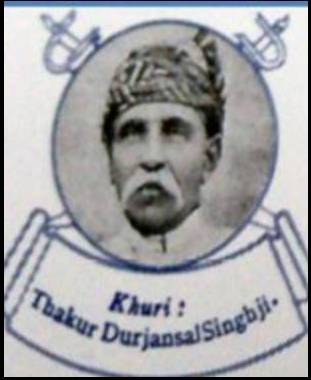
Present Head
History
Origin and Foundation of Khuri Thikana
The Thikana of Khuri holds an esteemed position within the historical fabric of the erstwhile princely state of Bikaner. The rulers of Khuri belong to the illustrious Bidawat clan of the Rathore dynasty. This clan traces its lineage back to Rao Bida, the younger brother of Rao Bika (the founder of Bikaner) and a son of Rao Jodha, the founder of Jodhpur. Rao Bida carved out his own territory in the region that came to be known as Bidawati.
The specific lineage of the Khuri house descends from Thakur Saheb Khangar Singhji, who was the son of Rao Sura of Sawantiya—a premier Bidawat estate. In 1638 AD, during the reign of the legendary Maharaja Karan Singhji of Bikaner, the estate of Khuri, comprising 12 strategic villages, was formally granted to Thakur Saheb Kishan Singhji. This grant solidified the branch's status as an independent and powerful feudal entity within the state of Bikaner.
Feudal Status and Honors in Bikaner Darbar
Within the highly structured court etiquette of Bikaner, the Thakur of Khuri was recognized as a premier noble. The chief of Khuri was granted the prestigious status of a Tazimi Sirdar, enjoying the rare double-honor of Dohri Tazim and Kurab Hath in the Bikaner Darbar:
- Dohri Tazim (Double Tazim): A rare ceremonial honor where the Maharaja of Bikaner would stand up both upon the arrival and the departure of the Thakur of Khuri in the royal court.
- Kurab Hath: A gesture of intimate royal favor where the Maharaja would place his hand on the shoulder of the noble as a mark of respect and familial bond.
These distinctions designated the Thakurs of Khuri as members of the highest echelon of the state nobility, placing them among the "Sirayats" (the top-tier chiefs) who played a pivotal role in the military and administrative affairs of the state.
The Colonial Period and Administrative Role
During the 18th and 19th centuries, as Bikaner State entered into treaty alliances with the British East India Company in 1818, the Bidawat nobles of Khuri continued to maintain local autonomy while assisting the state in maintaining law and order. The strategic position of the Bidawati region made the chiefs of Khuri crucial in protecting the trade routes passing through Churu and Sujangarh. To explore the administrative evolution of Bikaner's nobility during this period, scholars often refer to the comprehensive historical volumes archived in The House of Bikaner on Archive.org.
Post-Independence and Modern Era
Following India's independence in 1947, the princely state of Bikaner acceded to the Dominion of India, eventually merging into the unified state of Rajasthan. With the promulgation of the Rajasthan Land Reforms and Resumption of Jagirs Act in 1952, the traditional jagirdari system was formally abolished. Consequently, the feudal administrative and revenue-collection powers of the Khuri Thikana came to an end.
In the post-independence era, the descendants of the Khuri Thikana transitioned successfully into modern professions, agriculture, and public service, while continuing to preserve their rich cultural heritage, historical archives, and ancestral properties in the region.
Genealogy
- Thakur Saheb Khangar Singhji of Sawantiya, married and had issues.
- Kunwar Lakhan Singhji, granted Thikana of Loha.
- Kunwar Kishan Singhji (qv)
- Thakur Saheb Kishan Singhji, 1st Thakur of Khuri, married and had issues.
- Kunwar Kumbhkaran Singh (qv)
- Thakur Saheb Kumbhkaran Singhji, 2nd Thakur of Khuri, married and had issues.
- Kunwar Fateh Singh (qv)
- Thakur Saheb Fateh Singhji, 3rd Thakur of Khuri, married and had issues.
- Kunwar Zorawar Singh (qv)
- Thakur Saheb Zorawar Singhji, 4th Thakur of Khuri, married and had issues.
- Kunwar Inderbhan Singh (qv)
- Thakur Saheb Inderbhan Singhji, 5th Thakur of Khuri, married and had issues.
- Kunwar Vijay Singh (qv)
- Thakur Saheb Vijay Singhji, 6th Thakur of Khuri, married and had issues.
- Kunwar Guman Singh (qv)
- Thakur Saheb Guman Singhji, 7th Thakur of Khuri, married and had issues.
- Kunwar Hanut Singh (qv)
- Thakur Saheb Hanut Singhji, 8th Thakur of Khuri, married and had issues.
- Kunwar Shiv Singh (qv)
- Thakur Saheb Shiv Singhji, 9th Thakur of Khuri, married and had issue.
- Kunwar Chiman Singh (qv)
- Thakur Saheb Chiman Singhji, 10th Thakur of Khuri, he had provided services to Maharaja Sardar Singhji of Bikaner during 1857 AD Sepoy Mutiny, married and had adoptive issue.
- (A) Kunwar Durjan Singh, son of Thakur Ridmal Singhji uncle of Thakur Saheb Chiman Singhji of Khuri (qv)
- Thakur Saheb Durjan Singhji (see above)