Present Head
History
Origin and Lineage
The Thikana of Loha holds a highly distinguished position within the feudal hierarchy of the erstwhile Bikaner State. The rulers of Loha belong to the Bidawat clan of the Rathore dynasty, tracing their descent directly from Rao Sura, the grandson of Rao Bida. Rao Bida, the founder of Bidasar, was the brother of Rao Bika, who founded the kingdom of Bikaner. As premier nobles, the Bidawat Rathores of Loha played a critical role in the military campaigns and statecraft of the Bikaner region.
The Historic Valor of 1632 AD
The foundation of the Loha estate is rooted in a legendary act of chivalry and loyalty. In 1632 AD, during the reign of Maharaja Karan Singhji of Bikaner, the sacred Gangaur idol of Bikaner state was captured and taken away by Thakur Mehajal of Sirada, acting under the instructions of the Maharawal of Jaisalmer. The abduction of the Gangaur idol was considered a massive blow to the honor and religious sentiments of the Bikaner state.
In response, Thakur Lakhan Singhji, the son of Thakur Khangar Singhji of Sawantiya, initiated a bold and relentless pursuit into the hostile desert hinterlands. A bloody battle ensued near Jaisalmer, culminating in the death of Thakur Mehajal. Thakur Lakhan Singhji successfully retrieved the Gangaur idol and brought it back to Bikaner.
For this display of indomitable valor and devotion, Maharaja Karan Singhji granted Thakur Lakhan Singhji the estate of Loha, which originally consisted of 12 villages. Furthermore, the Chief of Loha was designated as a premiere noble of the Bikaner Darbar, enjoying the prestigious honors of Dohri Tazim (double ceremonial reception) and Kurab Hath (the privilege of the Maharaja placing his hand on the noble's shoulder as a mark of respect) in the royal court.
Feudal Administration and the British Period
Throughout the centuries, the rulers of Loha maintained their high standing at court. During the British Raj, when Bikaner entered into a treaty of subsidiary alliance with the British East India Company, Loha continued to function as a prominent Tazimi Thikana. The chiefs maintained local administrative control and contributed military support to the Bikaner state during times of regional conflicts.
Post-Independence and Modern Era
Following India's independence in 1947, Bikaner State acceded to the Union of India, eventually merging into the state of Rajasthan in 1949. With the passing of the Rajasthan Land Reforms and Resumption of Jagirs Act, the traditional feudal privileges and estates were formally integrated into the democratic administration. Today, the descendants of Loha preserve their historical heritage and the legacy of Thakur Lakhan Singhji's historic feat.
Genealogy
- Thakur Saheb Khangar Singhji of Sawantiya, married and had issue.
- Kunwar Lakhan Singh (qv)
- Thakur Saheb Lakhan Singhji, 1st Thakur of Loha, for his daring pursuit and bravery in retrieving the Gangaur of Bikaner, he was granted Loha Thikana, married and had issue.
- Kunwar Devidas (qv)
- Thakur Saheb Devidas, 2nd Thakur of Loha, married and had issue.
- Kunwar Fateh Singhji (qv)
- Thakur Saheb Fateh Singhji, 3rd Thakur of Loha, married and had issue.
- Kunwar Bakhat Singh (qv)
- Thakur Saheb Bakhat Singhji, 4th Thakur of Loha, married and had issue.
- Kunwar Bairishal Singh (qv)
- Thakur Saheb Bairishal Singhji, 5th Thakur of Loha, married and had issue.
- Kunwar Bhawani Singh (qv)
- Thakur Saheb Bhawani Singhji, 6th Thakur of Loha, married and had issue.
- Kunwar Prithvi Singh (qv)
- Thakur Saheb Prithvi Singhji, 7th Thakur of Loha, married and had issue.
- Kunwar Kirat Singh (qv)
- Thakur Saheb Kirat Singhji, 8th Thakur of Loha, he had provided services to Maharaja Sardar Singhji of Bikaner during 1857 AD Sepoy Mutiny, married and had issue.
- Kunwar Ishwari Singh (qv)
- Thakur Saheb Ishwari Singhji, 9th Thakur of Loha, married and had issue.
- Kunwar Bagh Singh (qv)
- Thakur Saheb Bagh Singhji, 10th Thakur of Loha, married and had issue.
- Kunwar Megh Singh (qv)
- Thakur Saheb Megh Singhji, 11th Thakur of Loha, married and had issue.
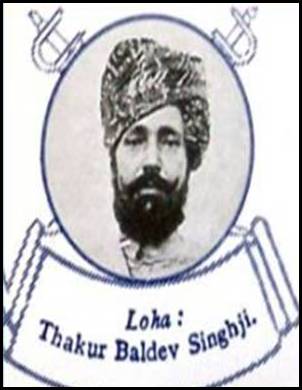
- Kunwar Baldev Singhji (qv)
- Thakur Saheb Baldev Singhji (see above)