Present Head
- Yuvraj Divyaraj Singh Deo, born .
History
Origin and Foundation of Kharsawan
The history of Kharsawan Princely State is deeply intertwined with the Rathore Rajput dynasty of the Porahat Raj. In the early 17th century, Kunwar Bikram Singh, the younger son of the Raja of Porahat, carved out the independent estate of Seraikella. Around the year 1650, his second son, Kunwar Padam Singh, established a separate fiefdom which came to be known as Kharsawan. Initially, Kharsawan was a feudal estate dependent on Porahat, and its ruler was styled as "Thakur," a title bestowed by the sovereign of Porahat to acknowledge their familial, political, and military ties.
The British Period and Treaty Relations
During the early 19th century, the expansion of the British East India Company into the Chota Nagpur and Singhbhum regions brought Kharsawan into the imperial sphere of influence. Following the Third Anglo-Maratha War and the subsequent pacification of the region, Kharsawan entered into direct treaty relations with the British authorities in 1818. Under the terms of the engagement, the state was recognized as a political entity exempt from paying tribute, although the British reserved the right to intervene in cases of severe misgovernance.
During the Indian Rebellion of 1857, the Thakur of Kharsawan, Hari Singh, chose to align with the British Administration. He provided military assistance to the British forces led by Commissioner E.T. Dalton, aiding in the suppression of local uprisings, particularly those led by the rebellious Raja Arjun Singh of Porahat. In recognition of this loyalty, the British Government confirmed the state's semi-independent status and granted a Sanad of adoption in 1892. The political status of the state was further elevated in 1917, when the hereditary title of Raja was officially conferred upon the ruler by the British Crown. More details of this political relationship can be found in the Imperial Gazetteer of India (Volume 15).
Administration and Key Reformers
In the late 19th and early 20th centuries, Kharsawan underwent significant modernization. Raja Ram Chandra Singh Deo (who ascended the gaddi in 1902) was a notable reformer who introduced systematic land revenue settlements, established primary and secondary educational institutions, and improved healthcare facilities within the state. Under his administration, the judicial system was reformed to align closely with British Indian civil and criminal codes, while preserving traditional tribal customary laws. His progressive governance helped the state transition from a feudal fief to a well-administered princely state, as documented in the Bengal District Gazetteers: Singhbhum, Saraikela and Kharsawan.
Heraldry and the State Flag
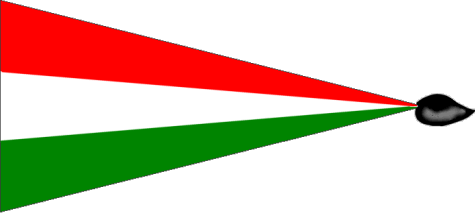
The rulers of Kharsawan adopted distinct heraldic symbols that reflected their Rajput heritage and military history. The State Flag was a rectangular banner displaying traditional Rajput colors, symbolizing courage, purity, and sovereignty. The Coat of Arms of Kharsawan featured:
- Shield: Depicting a fort situated amidst the rugged hills of Singhbhum, representing the defensive stronghold of the clan.
- Supporters: Two tigers rampart, symbolizing the dense forests of the region and the physical prowess of its rulers.
- Crest: A winged deity or a traditional Rajput dagger (Katar), representing divine protection and martial honor.
- Motto: A Sanskrit inscription emphasizing righteousness and victory ("Yato Dharmastato Jayah" - Where there is Righteousness, there is Victory).
Post-Independence Integration and the Kharsawan Massacre
With the departure of the British in August 1947, the princely states were given the option to accede to either India or Pakistan. Raja Sriram Chandra Singh Deo signed the Instrument of Accession, merging Kharsawan into the Dominion of India. On January 1, 1948, Kharsawan, alongside neighboring Seraikella, was temporarily integrated into the province of Orissa.
This integration sparked widespread dissatisfaction among the local Adivasi (tribal) population, who desired either a separate tribal-dominated state (Jharkhand) or integration with Bihar due to linguistic and cultural affinities. On January 1, 1948, a massive protest rally organized by the tribal leader Jaipal Singh Munda gathered at the Kharsawan market square. In the ensuing tension, the Orissa military police opened fire on the unarmed crowd, resulting in the tragic deaths of hundreds of protesters. This event, often referred to as the "Jallianwala Bagh of Jharkhand," remains a somber chapter in the region's modern history. For further reading on this political transition, see the historical records on the integration of Indian states available in V.P. Menon's "The Story of the Integration of the Indian States".
Modern Era
Following intense local agitation and political deliberation, the Government of India resolved the territorial dispute in May 1948 by transferring both Kharsawan and Seraikella from Orissa to the state of Bihar. In November 2000, with the reorganization of Bihar and the creation of a new state to fulfill long-standing tribal aspirations, Kharsawan became an integral part of the Seraikela Kharsawan district in the state of Jharkhand. Today, the royal family continues to be respected as keepers of the region's cultural heritage, participating in major local festivals like the Chhau dance celebrations and Rath Yatra.
Genealogy
- Thakur PADAM SINGH, Thakur of Kharsawan, married and had issue.
- Thakur Jaswant Singh (qv)
- Thakur JASWANT SINGH, Thakur of Kharsawan, married and had issue.
- Thakur Loknath Singh (qv)
- Thakur LOKNATH SINGH, Thakur of Kharsawan, married and had issue.
- Thakur Mohanlal Singh (qv)
- Thakur MOHANLAL SINGH, Thakur of Kharsawan, married and had issue.
- Thakur Chaitan Singh (qv)
- Thakur CHAITAN SINGH, Thakur of Kharsawan -/1839, married and had issue. He died .
- Thakur Upendra Singh (qv)
- Kunwar Ram Prasad Singh
- Thakur UPENDRA SINGH, Thakur of Kharsawan 1839/1844, married and had issue. He died .
- Thakur Ganga Ram Singh (qv)
- Thakur Raghunath Singh Deo (qv)
- Raja GANGA RAM SINGH Deo, Thakur of Kharsawan 1844/1863, born , he was granted the title of Raja in 1860 as a personal distinction only; married and had issue.
- Thakur Ram Narain Singh Deo (qv)
- Thakur RAM NARAIN SINGH Deo, Thakur of Kharsawan 1863/-
- Thakur RAGHUNATH SINGH Deo, Thakur of Kharsawan -/1884, born , married and had issue. He died ?.
- Thakur Mahendra Narayan Singh Deo (qv)
- Thakur MAHENDRA NARAYAN SINGH Deo, Thakur of Kharsawan 1884/1902, born , he succeeded to the gadi as a minor on 2nd March 1884, married and had issue.
- Raja Sri Sriram Chandra Singh Deo (qv)
- Sri Maharani Nalini Pattamaha Devi, married 1913, Capt. Maharaja Saheb Sri Sri Sri Krishna Chandra Gajapathi Narayana Deo of Parla Khimedi.
- Raja SRIRAM CHANDRA SINGH Deo, Raja of Kharsawan 1902/- , born and succeeded 6th February 1902, installed 4th July 1913, Raja [cr.1917], married Rani Giriraj Devi of Jharia, and had issue.
- Raja Sri Purnendu Narayan Singh Deo (qv)
- Rani Manoj Manjari Devi, married Raja Shri Balbhadra Narayan Bhanj Deo of Keonjhar, and had issue.
- Rajkumar Brajendra Narayan Singh Deo, married 1stly, in Bastar, married 2ndly, in Ratu.
- Rani Manjul Manjari Devi [later Rajmata Saheba of Kanika], married Raja Saheb Sailendra Narayan Bhanj Deo of Kanika, and had issue.
- Rajmata Prafulla Manjari, married Raja Brij Dev Narain Singh of Daltanganj (Chainpur), and had issue.
- Rajkumari Shyama Devi, married 14th July 1959, Rajkumar Shyam Chandra Pal of Bhajji, and has issue.
- Rajkumar Chandra Shekhar Singh Deo, married in Palkote, and has issue, three sons and one daughter.
- Raj Kunwar Pratap Chandra Singh Deo, married Kumari Kalpana Singh Deo, daughter of Lal Amresh Prasad Singh Deo, Zamindar of Lakhanpur in Surguja, and has issue, two sons and one daughter.
- Kunwar Kirti Narayan Singh Deo, presently (2008) working with MNC, married to Archana Singh Deo and has issue, one daughter.
- Akriti Singh Deo
- Kunwar Ripudaman Singh Deo, presently (2008) working with MNC, married to Rupa Singh Deo and has issue, one daughter.
- Anika Singh Deo
- Kunwarani Devyani Singh Deo, presently (2008) working with MNC, married to Samidra Gupta Deo of Jarada and has issues, two daughters.
- Anvesha Deo
- Ananya Deo
- Kunwar Kirti Narayan Singh Deo, presently (2008) working with MNC, married to Archana Singh Deo and has issue, one daughter.
- Raj Kunwar Narayan Chandra Singh Deo, married in Morhena, and has issue, two sons.
- Kunwar Anant Narayan Singh Deo, presently (2008) working with MNC; married Kunwarani Shivani Chauhan, daughter of the late Kanwar Jatinder Singh Chauhan, and his wife, Kanwarani Bimla Chauhan of Darkoti.
- Rajyavardhan Singh Deo, born in .
- Kunwar Bhishma Narayan Singh Deo, married to Kumari Viveka Yadvendra Gohil, daughter of Raja Yadvendra Singh Gohil of Rajpipla State (Gujarat) and Rani Madhu Singh of Jhalwar Zamindari, Churhat Family, Rewa MP.
- Maahiraj Narayan Singh Deo
- Kunwar Anant Narayan Singh Deo, presently (2008) working with MNC; married Kunwarani Shivani Chauhan, daughter of the late Kanwar Jatinder Singh Chauhan, and his wife, Kanwarani Bimla Chauhan of Darkoti.
- Raj Kunwar Ramanuj Pratap Singh Deo, married Kumari Indu Singh Deo, daughter of Lal Amresh Prasad Singh Deo, Zamindar of Lakhanpur in Surguja, and has issue, two sons.
- Kunwar Praduman Singh Deo, currently working in MNC and married to Shiveka Singh Deo.
- Kunwar Vishwa Vijay Singh Deo, married to Rajkumari Devina Singh, daughter of Kunwar Kiran Pratap Singh of Alipura State (MP) and his wife, Mamta Singh of Majhauli Raj (UP).
- Kunwarani Ratna Sahi, married Lokendra Pratap Sahi, Chief Editor of The Telegraph, and has issue, one daughter.
- Kumari Radhika Sahi
- Raj Kunwar Pratap Chandra Singh Deo, married Kumari Kalpana Singh Deo, daughter of Lal Amresh Prasad Singh Deo, Zamindar of Lakhanpur in Surguja, and has issue, two sons and one daughter.
- Rajkumar Dr. Amarendra Pratap Singh Deo, educated at Rajkumar Kumar College, Raipur, at Allahabad University, at Cuttack Medical College (M.B.B.S.), at Ophthalmic Institute, London, U.K., and was house surgeon at St. Asaims, North Wales; an accomplished College Tennis Player, in India he served as In India he served as a Reputed Doctor in Ispat General Hospital, Rourkela for 24 years; he married Rajkunwarani Indira Kumari Devi, and has issue. (Rourkela-769042, Orissa, India)
- Rani Rashmi Kumari, married 27th May 1979, Maharaj Manohar Singhji of Raoti in Jodhpur, and has issue, one son.
- Rajkumar Harshvardhan Singh Rathore, born , educated initially in Calcutta, then at Rajkumar College, Raipur; Graduation from Jodhpur and earned a Master's Degree in M.B.A. and M.B.L. from the National Law University (N.L.U.), Mandore, Jodhpur; presently (2009) working as a Manager for an esteemed company (MN). Married to Kunwarani Garima Kumari, daughter of Lal Vijay Singhji of Baikunthpur Thikana (Rewa), M.P. in December 2010.
- Raj Kunwar Chandra Chud Pratap Singh Deo, married Kunwarani Nandini Kumari, and has issue.
- Kunwar Anshuman Singh Deo
- Kuwarani Madhu Mayee Devi, married Sri Lal Kunwar Saheb Krishna Pratap Narayan Singh of Baluhipur (Arrah).
- Raj Kunwar Bhanu Pratap Singh Deo
- Rani Rashmi Kumari, married 27th May 1979, Maharaj Manohar Singhji of Raoti in Jodhpur, and has issue, one son.
- Lal Saheba Pramod Manjari Devi, married Lal Saheb Pramod Chandra Bhanj Deo of Mayurbhanj (Sankpeta), born , died .
- Raja Sri PURNENDU NARAYAN SINGH Deo, Raja of Kharsawan, born , married and had issue.
- Raja Pradeep Chandra Singh Deo (qv)
- Maharaj Kumar Shankar Pratap Singh Deo, married Maharajkumari Santosh Devi of Gabhana, and has issue.
- Kumari Padmavati Singh Deo
- Kunwar Shashank Pratap Singh Deo, married, Kunwarani Vartika Singh, daughter of Kunwar Atul Singh of Mankapur, and has issue.
- Kumar Pradyut Singh Deo
- Maharj Kumar Rudra Pratap Singh Deo, married Raj Kumari Tripura Kumari, daughter of Rana Raghunath Singh of Kotkhai, and his second wife, Rani Basantika Devi, and has issue.
- Kunwar Aditya Narayan Singh Deo
- Rani Vijay Laxmi Devi, married Maharajkumar Shri Ram Dev Singhji of Nagod, and has issue.
- Raja PRADEEP CHANDRA SINGH Deo, Raja Saheb of Kharsawan. Married Rani Vijaya Devi, daughter of Lt. Shri H. N. Singh, and has issue. He died in .
- Yuvraj Gopal Narayan Singh Deo (qv)
- Pat Jema Meenakshi Singh, married and has issue, two children.
- Shriya Singh
- Shreeraj Singh
- Raja GOPAL NARAYAN SINGH Deo, Raja of Kharsawan (see above)
- Pattayet Rani Padmini Devi, married Pattayet Bharatendra Shekhar Deo of Gangpur, and has issue.