Present Head

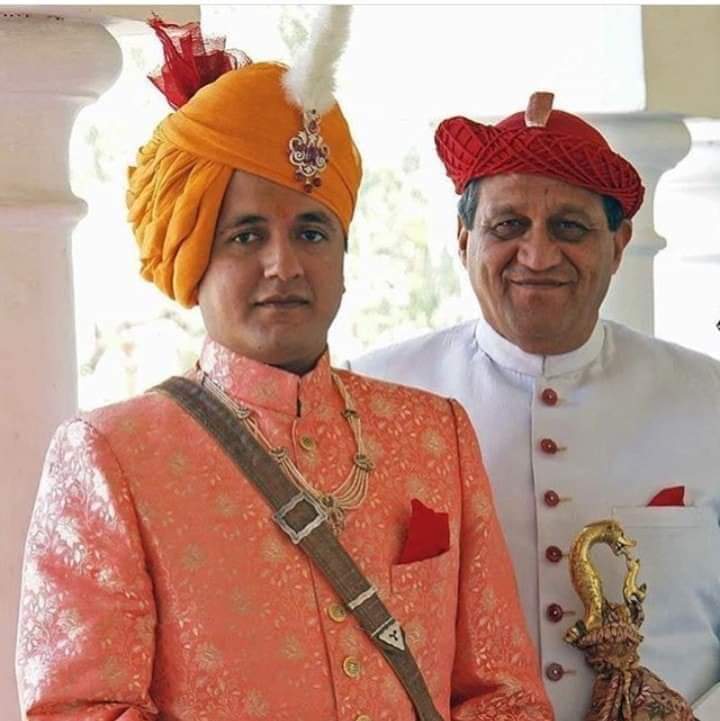
- Yuvraj Karmaveer Sinhji, married to Yuvrani Bhavna Devi (Indrapura, Churu).
- Bhanwar Anantvikram Sinhji
- Rajkumari Chandramohini Bapuraj, married in Kundanpur (Kota).
History
Introduction and Origins of Jambughoda (Narukot) State
The state of Jambughoda, historically known as Narukot, was a princely state in India during the era of the British Raj. Located in the rugged, forested hills of the Panchmahal region of Gujarat, it was classified under the Rewa Kantha Agency. The ruling dynasty of Jambughoda belonged to the Parmar Rajput clan, claiming legendary descent from the Parmars of Dharanagari. Historically, the rulers of this tract were intimately connected with the local tribal populations, establishing a unique socio-political hegemony that allowed them to maintain autonomy amidst the dense forests of eastern Gujarat.
The foundation of the state dates back to the late 14th century, when Parmar Rajputs migrated from Malwa and settled in the area. Over generations, they consolidated their power over the local tribes, establishing Narukot as their capital, which was later shifted to Jambughoda. The state was heavily fortified by natural barriers, which protected it from early external incursions. More detailed descriptions of its geographic and political limits can be found in the Gazetteer of the Bombay Presidency: Rewá Kántha, Nárukot, Cambay, and Sátára (1880).
The Maratha Influence and British Alliance
During the decline of the Mughal Empire in the 18th century, the Maratha Peshwas and subsequently the Gaekwads of Baroda extended their influence over the Rewa Kantha region. Narukot was forced to pay tribute (Ghasdana) to the Gaekwads. However, due to its difficult terrain and the fierce independence of its inhabitants, the Marathas rarely exercised direct administrative control over the state.
With the rise of the British East India Company and the signing of the Treaty of Bassein in 1802, the British began to mediate relations between the Gaekwad and the tributary states of Rewa Kantha. In 1826, the Thakore of Narukot entered into a formal treaty with the British, seeking protection against external aggression and internal rebellions. In return, the British secured administrative oversight, eventually placing the state under the political control of the Collector of Panch Mahals, acting as the Political Agent.
The Narukot Uprising of 1858
One of the most significant chapters in the history of Jambughoda was the Narukot Uprising of 1858. Spurred by the Indian Rebellion of 1857, the local Nayaka and Koli tribes, led by the charismatic leader Roop Singh Nayak (Rupsingh), rose in open rebellion against British hegemony and the local authorities. The rebels successfully captured the town of Jambughoda, plundered the treasury, and attacked the British military post at Rajgadh.
The British reacted swiftly, dispatching a joint military force under Captain Field and local corps to suppress the rebellion. After a series of fierce skirmishes in the dense jungles, Roop Singh Nayak and his close associates were captured. Roop Singh was executed in 1859, and the British assumed direct management of Narukot State to restore order, which lasted until 1894 when full administrative powers were restored to the ruling Thakore. For historical records of this revolt, researchers can refer to the archival compilations on the Indian Culture Portal operated by the Ministry of Culture, Government of India.
Reforms and Modernization under Later Rulers
Following the restoration of administrative powers, the rulers of Jambughoda turned their focus toward modernization and welfare. Thakore Gambhirsinhji (who ruled in the late 19th and early 20th centuries) and his successor, Thakore Ranjitsinhji Gambhirsinhji, initiated several progressive reforms:
- Educational Advancement: Primary schools were established in Jambughoda, and education was made accessible to the tribal populations.
- Agricultural Reforms: Development of irrigation facilities and encouragement of sustainable forest resource management.
- Infrastructure: Road networks were constructed to connect the remote forest tracts of Jambughoda with the commercial hubs of Baroda and Panchmahal.
Under these rulers, the state capital of Jambughoda was transformed into a well-planned town featuring administrative buildings, a state guest house, and judicial courts. The rulers managed to maintain a peaceful relationship with the British while preserving their internal autonomy. Detailed administrative reports of this era are archived in the Digital South Asia Library of the University of Chicago.
State Heraldry and Flag
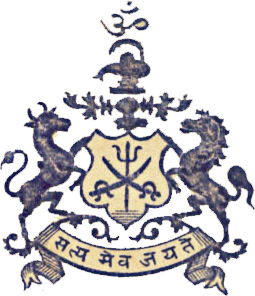
The princely state of Jambughoda possessed a distinct coat of arms that reflected its martial Parmar heritage and the natural environment of the state. The heraldic emblem featured:
- A shield depicting a fortress, symbolizing the historic strongholds of the Parmars.
- Two supporters, typically represented as leopards or tigers, indicating the rich wildlife of the surrounding forests.
- The state motto, emphasizing duty, honor, and protection of the subjects.
- A state flag, which was a rectangular bicolor or tricolor, often featuring saffron (representing Rajput courage) and green or white, flown over the Thakore's palace at Jambughoda.
Post-Independence, Integration, and the Modern Era
Following India's independence in August 1947, the last ruler of Jambughoda, Thakore Ranjitsinhji, signed the Instrument of Accession, merging the state into the Indian Union. On June 10, 1948, Jambughoda officially integrated into the Bombay State. Later, with the reorganization of states on linguistic lines in 1960, it became a part of the Panchmahal district in the newly formed state of Gujarat.
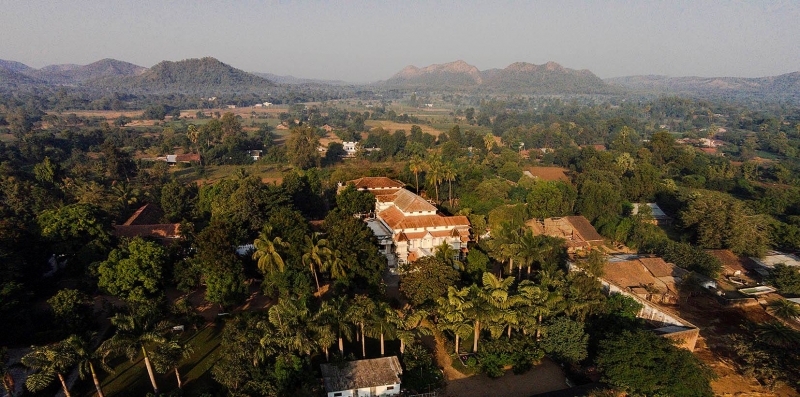
In the modern era, the erstwhile princely capital has emerged as a major ecological and tourist destination. In 1990, the government of Gujarat declared the surrounding forest tracts as the Jambughoda Wildlife Sanctuary, which is home to leopards, sloth bears, and diverse flora. The descendants of the royal family still reside in the majestic Jambughoda Palace, a portion of which has been converted into a heritage hotel, preserving the legacy and culture of this historic Rajput province.
Genealogy
- Thakore DIPSINHJI JAGATSINHJI, Chief of Narukot (Jambugodha), born .
- Meherban Rana Shri GAMBHIRSINHJI, Thakore Sahib of Jambugodha -/1917, married and had issue. He died .
- Meherban Rana Shri RANJITSINHJI GAMBHIRSINHJI, Thakore Sahib of Jambugodha 1917/1948 (abdicated), C.I.E., born and succeeded 27th September 1917, installed 2nd February 1918, educated at Rajkumar College, Rajkot; Patron of the All-India Kshatriya Mahasabha, Member of the Willingson Sports Club (Bombay), married and had issue. He died .
- HH Maharana Saheb Shri DIGVIJAI SINGHJI, Thakore Sahib of Jambugodha 1948/2003, born , married Rani Krishna Kumari, daughter of Late HH Maharaja Balbhadra Singhji of Datia, died , and had issue. He died .
- Rajkumari Sohini Devi, married Maharaj Shri Ranvir Singhji of Idar, and has issue.
- Meherban Rana VIKRAM SINGHJI, Thakore Sahib of Jambugodha (see above)
- Yuvaraj Saheb Harish Chandrasinhji of Jambugodha, married 29th January 1961, Baisa Durgesh Nandini, daughter of Maj. Rawal Raghubir Singhji of Bissau, and his wife, Rani Komal Kumari.
Notable Figures
Thakore Sahib Jagatsinhji (died )
Thakore Sahib Jagatsinhji was an early notable ruler of the state of Narukot (which was later renamed Jambughoda). Under his rule, the state maintained its traditional administrative structure but faced financial and political turbulence, leading to closer oversight by the British Rewa Kantha Agency. He passed away in 1870, leaving the gaddi to his successor.
More information about the state's early administration during this period can be found on the Jambughoda State Wikipedia Page.
Thakore Sahib Dipsinhji Jagatsinhji (1870 - 1917)
Born in , Thakore Sahib Dipsinhji succeeded to the gaddi on the death of his predecessor in 1870. Due to administrative challenges and unrest in the region, the British India government temporarily managed the state's affairs through the Political Agent of Rewa Kantha. Dipsinhji was eventually invested with full ruling powers as the state stabilized. His reign marked a transition from a volatile frontier principality to a more settled and organized state under British paramountcy.
Detailed historical accounts of the Rewa Kantha Agency administration during his tenure are detailed in the Imperial Gazetteer of India.
Thakore Sahib Ranjitsinhji Gambhirsinhji (1917 - 1948)
Succeeded to the throne on 27th September 1917, Thakore Sahib Ranjitsinhji was one of the most progressive and enlightened rulers of Jambughoda. Born in , he received a modern education which influenced his governance. Under his administration, Jambughoda witnessed significant development, including the establishment of free primary education, healthcare facilities, and infrastructural improvements such as roads and public buildings. He officially signed the Instrument of Accession to the Dominion of India on 15th August 1947, merging the state into the Bombay State in 1948.
You can read more about his accession and the integration of princely states on the Political Integration of India Wikipedia Page.
Thakore Sahib Vikramsinhji Ranjitsinhji (1962 - 2014)
Thakore Sahib Vikramsinhji Ranjitsinhji succeeded as the titular head of the Parmar dynasty of Jambughoda following the demise of his predecessor in 1962. A visionary entrepreneur, he played a crucial role in preserving the heritage of the region. He converted the ancestral Jambughoda Palace into an eco-friendly heritage hotel, pioneering heritage tourism in the Panchmahal district. His efforts helped put Jambughoda on the modern tourism map, preserving the local culture, wildlife, and royal legacy for future generations.
To learn more about the modern heritage of the palace, visit the Jambughoda Wikipedia Page.