Present Head
History
The Origin and Foundation of Dewas Senior
The princely state of Dewas Senior was founded in the early 18th century by the Puar (Pawar) dynasty of Marathas. The Puars of Dewas claim descent from the illustrious Paramara dynasty of Malwa, which boasted legendary rulers like Raja Vikramaditya and Raja Bhoja. Following the decline of the Paramara dynasty, a branch of the family migrated to the Deccan, settling near Pune and Satara, where they adopted the Marathi language and customs, becoming prominent military commanders under the Maratha Empire.
In the early 1700s, during the expansion of the Maratha confederacy under Peshwa Baji Rao I, two brothers, Kaloji Rao Puar's sons—Tukoji Rao I and Jivaji Rao I—distinguished themselves in military campaigns across Central India. In recognition of their services, they were granted the territory of Dewas in 1728. The brothers established a unique dual state, dividing the territory between them. The elder brother, Tukoji Rao I, founded the Dewas Senior Branch (Dewas Senior), while the younger brother, Jivaji Rao I, established the Dewas Junior Branch. Although they shared the same capital town of Dewas, lived in adjacent palaces, and ruled over intertwined territories, they maintained separate administrations, treasuries, and British political relationships.
The Maratha Expansion and the Mughal Era
During the mid-18th century, Dewas Senior played an active role in the Maratha expansion into Malwa and northern India. The Puars of Dewas Senior were loyal allies of the Peshwa and cooperated closely with other Maratha houses, such as the Scindias of Gwalior, the Holkars of Indore, and their cousins, the Puars of Dhar. The state successfully withstood the tumultuous transitions of power in Central India, balancing their sovereignty against the declining Mughal Empire and the rising influence of regional powers.
The British Period and Treaty of 1818
By the turn of the 19th century, Central India was ravaged by the Pindari raids and the conflicts of the Anglo-Maratha Wars. The stability of Dewas Senior was severely threatened. To secure his state, Maharaja Tukoji Rao II entered into a treaty of subsidiary alliance with the British East India Company on December 12, 1818. This treaty placed Dewas Senior under British protection, guaranteeing its internal sovereignty in exchange for British suzerainty and the stationing of a political agent.
The state was classified as a treaty state and was eventually placed under the Malwa Agency of the Central India Agency. The ruler of Dewas Senior was granted a permanent salute of 15 guns. Under British protection, the administrative boundaries of the state were stabilized, and the region slowly recovered from decades of economic devastation.
Key Reformers and Progressive Rule
Dewas Senior is highly regarded in Indian history for its progressive rulers who introduced major social, educational, and administrative reforms. Among them, two rulers stand out:
Maharaja Krishnaji Rao II "Baba Sahib" (r. 1860–1899)
Maharaja Krishnaji Rao II was a highly capable administrator who modernized the state's judicial and revenue systems. He established modern schools, built infrastructure, and encouraged trade and agriculture within the state, laying the foundation for modern civic administration.
Maharaja Tukoji Rao III "Chhatrapati Maharaj" (r. 1899–1937)
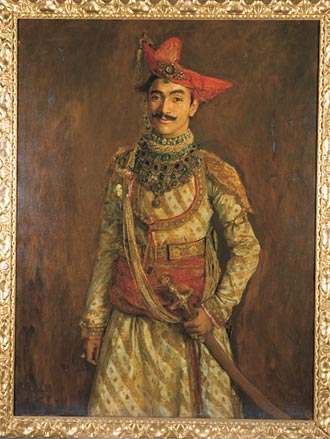
One of the most remarkable and intellectual rulers of modern India, Maharaja Tukoji Rao III was a visionary reformer. He was a great patron of arts, literature, and education. He initiated free primary education, set up cooperative banks, and established representative local bodies.
His court attracted scholars and writers from across the world. Notably, the famous English novelist E.M. Forster served as the Maharaja’s private secretary in 1921. Forster’s experiences at the court of Dewas Senior inspired his famous book, The Hill of Devi, which provides an intimate and vivid portrayal of the royal court and the eccentricities of state life during that era.
Heraldry and State Symbols
The heraldry of Dewas Senior represents its royal lineage and spiritual heritage:
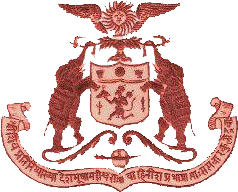
- The Coat of Arms: The shield features a sacred fire-altar (Havan Kund), symbolizing the Agnikula (fire-born ) origin of the Paramara dynasty.
- Supporters: The shield is supported by two tigers, symbolizing courage and royalty.
- Crest: The crest depicts Lord Hanuman holding the Dronagiri mountain, representing strength, devotion, and protection.
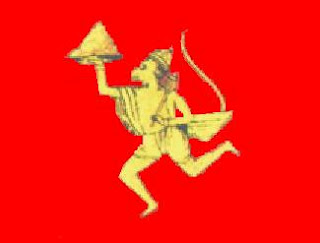
- State Flag: The state flag was a saffron (Bhagwa) rectangular banner, traditionally used by Maratha rulers, representing courage, sacrifice, and spiritual values.
Post-Independence and Modern Era
Following India's independence in 1947, Maharaja Vikramsinh Rao (Nanasaheb Maharaj), who had served with distinction in the Indian Army during World War II, signed the Instrument of Accession to the Dominion of India. In 1948, Dewas Senior merged with other princely states to form the newly created state of Madhya Bharat. Later, in 1956, Madhya Bharat was integrated into the state of Madhya Pradesh.
Today, the royal family of Dewas Senior continues to command immense respect in the region, actively participating in public service, local politics, and the preservation of the cultural heritage of Malwa.
References and External Links
- Read about the history and administration of Dewas State in the Imperial Gazetteer of India (Volume 11, Page 224-230) on the Digital South Asia Library.
- Explore E.M. Forster's account of his time at Dewas Senior in The Hill of Devi on the Internet Archive.
- Consult the historical details on Maratha states in James Grant Duff's classic work, A History of the Mahrattas on the Internet Archive.
Genealogy
- Raja Kaloji, married and had issue.
- Raja Tukojirao I Kaloji Puar, Raja of Dewas Senior (qv)
- Raja Jivajirao I Kaloji Puar, Raja of Dewas Junior (qv)
- Raja TUKOJIRAO I PUAR, 1st Raja of Dewas-Senior 1728/1753, he died
- Raja KRISHNAJIRAO I PUAR, 2nd Raja of Dewas-Senior 1753/1789
- Raja TUKOJIRAO II PUAR, 3rd Raja of Dewas-Senior 1789/1824, married and had adoptive issue.
- (A) Raja Rukmangadrao Tukojirao [Khasi Saheb] Puar (qv)
- Raja RUKMANGADRAO TUKOJIRAO [KHASI SAHEB] PUAR, 4th Raja of Dewas-Senior 1824/1860, he succeeded by adoption in 1824, married and had adoptive issue. He died .
- (A) HH Raja Krishnajirao II Rukmangadrao Puar (qv)
- HH Raja KRISHNAJIRAO II RUKMANGADRAO [BABA SAHEB] PUAR, 5th Raja of Dewas-Senior 1860/1899, born in , he succeeded to the gadi on 18th March 1861, married and had issue.
- HH Maharaja Sir Tukojirao III Krishnajirao Puar (qv)
- HH Maharaja Sir TUKOJIRAO III KRISHNAJIRAO PUAR, 6th Maharaja of Dewas-Senior 1899/1937, born , Maharaja [cr.1918], K.C.S.I. [cr.1911], educated at Daly College, Indore and at Mayo College, Ajmer; married 1908, HH Maharani Radhabai Akka Sahib of Kolhapur, and had issue. He died .
- HH Maharaja Vikramsinharao Tukojirao [Nana Saheb] Puar (qv)
- HH Maharaja VIKRAMSINHARAO TUKOJIRAO [NANA SAHEB] PUAR, 7th Maharaja of Dewas-Senior 1937/1948, born , Maharaja of Kolhapur 1948/1983 as HH Sir Maharajah Shahaji II Chhatrapati, married 1926, and had issue. He died
- HH Maharaja Puar Krishnajirao III Vikramsinhrao Puar (qv)
- Maharajkumari Shaliniraje Puar, married Shrimant Rajaramsinhrao Bhonsle of Nagpur, and had issue.
- HH Maharaja Shahu II Chhatrapati Rao of Kolhapur.
- HH Maharaja Puar KRISHNAJIRAO III VIKRAMSINHRAO PUAR, 8th Maharaja of Dewas-Senior 1948/1999, born , married and had issue. He died .
- HH Maharaja Puar Tukojirao IV Krishnajirao Puar (qv)
- HH Maharaja Puar TUKOJIRAO IV KRISHNAJIRAO PUAR, 9th Maharaja of Dewas-Senior.
- Maharaj Vikram Sinh Puar (qv)
- Yuvrani Kanika Raje Puar
- HH Maharaja Puar VIKRAM TUKOJIRAO PUAR, 10th Maharaja of Dewas-Senior.
- Maj. Sardar Shankarrao [Appasaheb] Gambhirrao Puar, great grandson of Bhagwantrao fl.1792, Home Member of Council of State in Dewas-Snr, Premier Jagirdar of Dewas-Snr.
Notable Figures
Shrimant Tukoji Rao I Puar (1728–1754)
Shrimant Tukoji Rao I Puar was the co-founder of the Dewas State alongside his younger brother Jivaji Rao I. Belonging to the Maratha Puar (Parmar) clan, they were granted territory in the Malwa region by the Peshwa Baji Rao I in 1728 as a reward for their military services. This unique joint administration split the territory into two distinct branches: Dewas Senior (ruled by Tukoji Rao) and Dewas Junior (ruled by Jivaji Rao).
Tukoji Rao I established his capital at Dewas, sharing the administration of the city with his brother while maintaining separate state revenues and courts. His reign successfully established Maratha dominance in the region, carving out a sovereign territory from the declining Mughal Empire. More information on the foundation of the state can be found on the Dewas State Wikipedia Page.
Shrimant Krishnaji Rao I Puar (1754–1789)
Shrimant Krishnaji Rao I Puar succeeded his adoptive father Tukoji Rao I. During his reign, the Maratha Empire faced one of its greatest challenges at the Third Battle of Panipat in 1761. Krishnaji Rao I actively participated in this historic battle alongside other Maratha chieftains against the forces of Ahmad Shah Durrani.
He managed the state through turbulent decades of Maratha history, maintaining the integrity of the Senior branch despite the rising influence of neighboring powers like the Holkars of Indore and the Scindias of Gwalior. Historical records of this period are documented on the History of Dewas on Wikipedia.
Shrimant Tukoji Rao II Puar (1789–1827)
He succeeded Krishnaji Rao I and ruled during a period of significant geopolitical transition in central India. As the Maratha Confederacy weakened due to internal conflicts and successive wars with the British East India Company, Tukoji Rao II navigated the survival of his state through diplomatic channels.
In 1818, he signed a treaty of subsidiary alliance with the British, which guaranteed British protection in exchange for local autonomy. Under his rule, Dewas Senior was officially recognized as a treaty state under the Central India Agency, securing the dynastic succession and stability of the Parmar dynasty's Senior line. Details regarding these treaties can be viewed on the Dewas State Treaty Page on Wikipedia.
Shrimant Rukmangad Rao Puar (1827–1860)
Popularly known as Babasaheb Puar, he was the adopted son and successor of Tukoji Rao II. His reign spanned the critical period of the Indian Rebellion of 1857. He maintained steady administration and diplomatic loyalty to the British Crown, ensuring that his state remained protected from annexation under the Doctrine of Lapse.
Rukmangad Rao was highly regarded as an able administrator who took an active interest in the welfare of his subjects. He focused on agricultural improvements, revenue reforms, and maintaining civil order during a highly volatile period in central India.
Shrimant Krishnaji Rao II Puar (1860–1899)
Also known as Alasaheb Puar, he succeeded his adoptive father Rukmangad Rao. His long reign was marked by severe financial difficulties due to his lavish spending, generous patronage of arts, and elaborate public works, which eventually led the British administration to intervene in the state’s financial management.
Despite these financial struggles, his reign saw the introduction of early modern infrastructure in Dewas, including modern schools, roads, and basic medical facilities, laying the groundwork for subsequent modernizing reforms in the state.
Maharaja Sir Tukoji Rao III Puar (1899–1937)
One of the most prominent, progressive, and highly educated rulers of Dewas Senior, Tukoji Rao III was adopted from the Shashtri branch of the family. He was educated at Daly College, Indore, and Mayo College, Ajmer. He was granted the title of Maharaja as a personal distinction in 1918 and was appointed a Knight Commander of the Order of the Star of India (KCSI).
His court is famously associated with the English novelist E.M. Forster, who served as his private secretary in 1921. Forster's experiences in Dewas inspired his famous book The Hill of Devi. In his later years, due to financial distress and administrative disputes with the British government, Tukoji Rao III left Dewas and went into voluntary exile in Pondicherry, where he passed away in 1937. Read more about his life on the Tukojirao III Wikipedia Page.
Maharaja Vikramsinh Rao Puar (Shahu II Maharaj of Kolhapur) (1937–1947)
The son of Tukoji Rao III, Vikramsinh Rao succeeded his father during a turbulent era. He was a highly decorated military officer who served in the British Indian Army during World War II, seeing active service in North Africa and the Middle East. He was later adopted into the historic royal house of Kolhapur in 1947, ascending that historic gadi as Chhatrapati Shahaji II Bhonsle.
Before his departure to Kolhapur, he signed the Instrument of Accession, merging Dewas Senior into the Union of India, which later became part of the Madhya Bharat state. For more on his military career and dual succession, visit the Shahaji II Wikipedia Page.
Maharaja Krishnaji Rao III Puar (Titular Head 1983–1997)
Following the integration of princely states and the eventual abolition of privy purses and royal titles in India, Krishnaji Rao III succeeded as the titular head of the Dewas Senior branch in 1983. He maintained the family's deep cultural and religious traditions, remaining a highly respected figure among the local population of Dewas.
He engaged in various philanthropic activities and oversaw the maintenance of ancestral temples and heritage sites, ensuring the preservation of the Parmar dynasty's legacy in modern India.
Maharaja Tukoji Rao IV Puar (Titular Head 1997–2015)
He was the titular Maharaja of Dewas Senior and successfully transitioned from royal heritage to democratic politics. He was a prominent leader of the Bharatiya Janata Party (BJP) and was elected as a Member of the Legislative Assembly (MLA) from the Dewas constituency multiple times. He also served as a cabinet minister in the Government of Madhya Pradesh.
His leadership bridged the gap between historic respect for the royal family and modern democratic representation, making him an incredibly influential public figure in the Malwa region until his demise in 2015. Read more about his political career on the Tukoji Rao Puar Wikipedia Page.
Maharaja Vikram Singh Rao II Puar (Titular Head 2015–Present)
He succeeded his father, Tukoji Rao IV, as the titular head of the Dewas Senior royal house in 2015. He continues to manage the family's ancestral estates, religious trusts, and local community outreach programs in Dewas.
Under his stewardship, the family maintains its traditional role during major cultural festivals, particularly the annual Dussehra celebrations at the historic Dewas Tekri temple complex, preserving the living heritage of the Parmar dynasty.