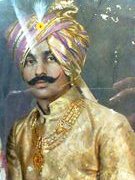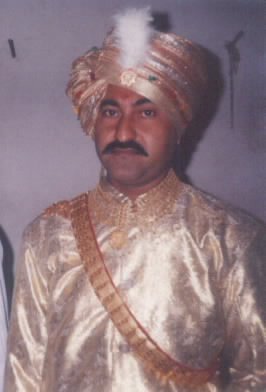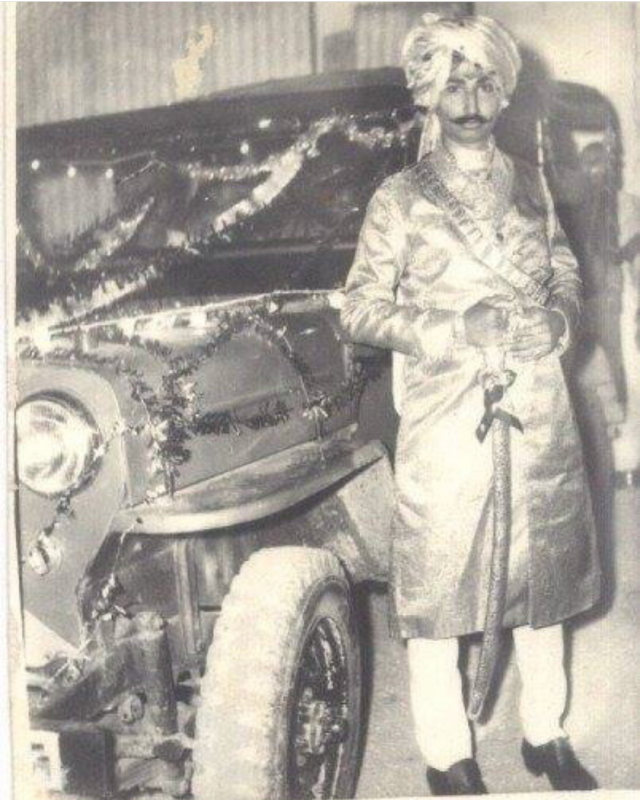

Present Head
- Rajkumar Harpalwala Bhupendrawala Saheb of Sanala, married to Jaishree Kumari Dhadhal and had issue, one son.
- Rajkumar Devendrawala Harpralwala, born .
- Rajkumari Lekharaj Kumari Bhupendrawala, maried Kumar Shri Kuldeepsinh Basia of Galath and has issues, two sons.
- Kumar Shri Manveersinh Basia of Galath
- Kumar Shri Samarjeetsinh Basia of Galath
- Rajkumari Shriraj Kumari Bhupendrawala, married Kumar Shri Mahaveersinh Basia of Khijadia.
- Rajkumar Virendrawala Bhupendrawala, born , at Sanala Darbargadh, educated at Pathak School Rajkot and Hospitality Management in Vihtm Rajkot. He started career in Real estate market as a investor since 2017 in Ahmedabad and founded 3 Companies SANALA INVESTMENT PVT LTD. & SANALA SHARE SOLUTION PVT LTD. & SANALA SOLAR ENERGY PVT LTD.
History
Origin and Foundation
The estate of Sanala was a historic princely state, categorized as a petty state or taluka, located in the historic Saurashtra (Kathiawar) peninsula of Gujarat, India. The origin of the state is deeply connected to the waves of Rajput and Kathi migrations that swept across Saurashtra during the medieval period. Like many smaller principalities in the region, Sanala emerged as a distinct administrative entity through the subdivision of larger parental estates, established by clans who sought to secure sovereign territorial pockets amidst the declining authority of regional empires.
Mughal and Maratha Periods
During the height of the Mughal Empire, the territory of Kathiawar was placed under the administrative control of the Subahdar (Governor) of Gujarat, who ruled from Ahmedabad, with local tribute collection managed through the Faujdar of Junagadh. With the gradual collapse of Mughal authority in the early 18th century, the Maratha Empire, led by the Peshwa and the Gaekwad dynasty of Baroda, asserted dominance over the peninsula.
During this period of transition, Sanala, like its neighboring states, was subjected to the aggressive Maratha tributary expeditions known as Mulkgiri. Every year, Maratha forces marched through Kathiawar to collect tribute (peshkash). The rulers of Sanala managed to preserve their internal autonomy by paying regular tributes to the Gaekwad of Baroda and acknowledging the nominal suzerainty of the Nawab of Junagadh, to whom certain peripheral taxes, such as Zortalbi, were occasionally due.
British Raj and Jurisdictional Classification
The chaotic era of military expeditions came to an end with the British East India Company's intervention. In 1807–1808, Colonel Alexander Walker, the British Resident at Baroda, instituted the historic Walker's Settlement. This landmark settlement stabilized the Kathiawar peninsula by fixing the tribute of each state and guaranteeing the territorial integrity of the chiefs against external encroachment. Sanala entered into treaty relations with the British, bringing peace and security to the estate.
Under the British Raj, Sanala was placed under the political supervision of the Kathiawar Agency, which was later integrated into the Western India States Agency. To manage the hundreds of tiny estates in Saurashtra, the British classified them into seven distinct classes based on their size, population, revenue, and geopolitical importance. Sanala was recognized as a Fourth Class State.
As a Fourth Class State, the jurisdictional powers of Sanala's ruling Talukdar were limited to maintain local order while leaving serious offenses to the British political agents. The state’s judicial powers were defined as follows:
- Criminal Jurisdiction: Power to award up to three months of rigorous imprisonment and levy fines of up to 200 Rupees.
- Civil Jurisdiction: Power to decide civil suits and dispute settlements up to a financial value of 500 Rupees.
Cases that exceeded these parameters were referred to the court of the British Political Agent or the regional Thana circle, ensuring a dual system of governance where local customs were respected under imperial oversight.
The System of Equal Division (Bhagvand)
Unlike the larger princely states of India that practiced primogeniture (where the eldest son inherits the entire state), succession in Sanala was governed by the custom of equal division, locally known as the Bhagvand or Bhagdari system.
Under this customary law, upon the death of a ruling Talukdar, the land, revenue, and sovereign rights of the estate were divided equally among all surviving sons. While this system ensured that all male descendants maintained their noble status and received a livelihood, it also led to the continuous fragmentation of the state's territory and resources over generations. This custom explained why many Kathi and Rajput estates in Kathiawar remained relatively small in terms of geographical area and revenue.
Administrative and Judicial Reforms
Despite its modest size, the administration of Sanala made concerted efforts to modernise under the influence of British advisors. The primary source of state revenue was agriculture, with cotton, millet, and wheat being the major crops.
Land revenue reforms were introduced to replace the older crop-sharing systems with fixed cash assessments, which provided stability to the local peasantry. The rulers also patronized elementary education and primary healthcare, establishing basic infrastructure to serve the local population. Law and order were maintained by a small body of state police and village watchmen, who worked closely with the colonial administrative machinery.
Post-Independence Era and Merger
When India achieved independence from British rule on August 15, 1947, the rulers of Kathiawar faced the monumental task of consolidating their territories. Under the diplomatic leadership of Sardar Vallabhbhai Patel, the integration of the princely states was initiated.
The Talukdar of Sanala, along with other rulers of the region, signed the Instrument of Accession, merging the estate into the newly formed United State of Kathiawar (later known as Saurashtra State) in February 1948. Through this merger, the administrative identity of Sanala as an independent princely estate officially ended.
In 1956, Saurashtra was merged into the larger Bombay State, and subsequently, with the linguistic reorganization of states on May 1, 1960, Sanala became an integral part of the state of Gujarat. The royal privileges and privy purses of the erstwhile ruling family were officially abolished by the 26th Amendment to the Constitution of India in 1971 under the Privy Purse Abolition Act. Today, Sanala exists as a peaceful village and tract, preserving its rich heritage of Kathiawari culture, royal history, and traditional customs.
Genealogy
- Darbar Shri NATHUVALA CHAMPRAJVALA, Talukdar of Sanala, son of the Talukdar of Thana Devli, married and had issue.
- Darbar Shri Hipa Nathu Vala (qv)
- Darbar Shri Bhaya Nathu Vala, Talukdar of Bhayavadar (Bhaya Nathu Estate).
- Darbar Shri HIPAVALA NATHUVALA, Talukdar of Sanala -/1920, married and had issue.
- Darbar Shri Gigavala Hipavala (qv)
- Darbar Shri GIGAVALA HIPAVALA, Talukdar of Sanala 1920/-, born , succeeded 19th January 1920, educated at Rajkumar College, Rajkot, married and had issue.
- Darbar Shri Nathuvala Gigavala (qv)
- Darbar Shri Muluvala Gigavala, educated at Rajkumar College, Rajkot; married and had issue, four sons. He died .
- Darbar Shri Bhupendravala Muluvala, married and had issue, two sons.
- Kumar Shri Harpalvala Bhupendravala
- Kumar Shri Virendravala Bhupendravala, born , presently (2011) studying in 10th Standard at Pathak Schools, Rajkot, Gujarat.
- Darbar Shri Shivraj Muluvala, married and had issue, two sons.
- Kumar Shri Rajendravala Shivrajvala
- Kumar Shri Gajendravala Shivrajvala
- Darbar Shri Mahipal Muluvala, married and had issue, two sons.
- Kumar Shri Digvijayvala Mahipalvala
- Kumar Shri Satyajitsinh Mahipalvala
- Darbar Shri Dharmendravala Muluvala, married and has issue, two daughters.
- Kumari Shri Rajviba Dharmendravala
- Kumari Shri Virajba Dharmendravala
- Darbar Shri Bhupendravala Muluvala, married and had issue, two sons.
- Darbar Shri NATHUVALA GIGAVALA, Talukdar of Sanala -/2001, educated at Rajkumar College, Rajkot; married and had issue. He died .
- Darbar Shri Meramvala Nathuvala (qv)
- Darbar Shri MERAMVALA NATHUVALA, Talukdar of Sanala since 27th May 2001. married and has issue, two sons. He died on .
- Kumar Shri Gigavala Meramvala
- Kumar Shri Vishvajitvala Meramvala