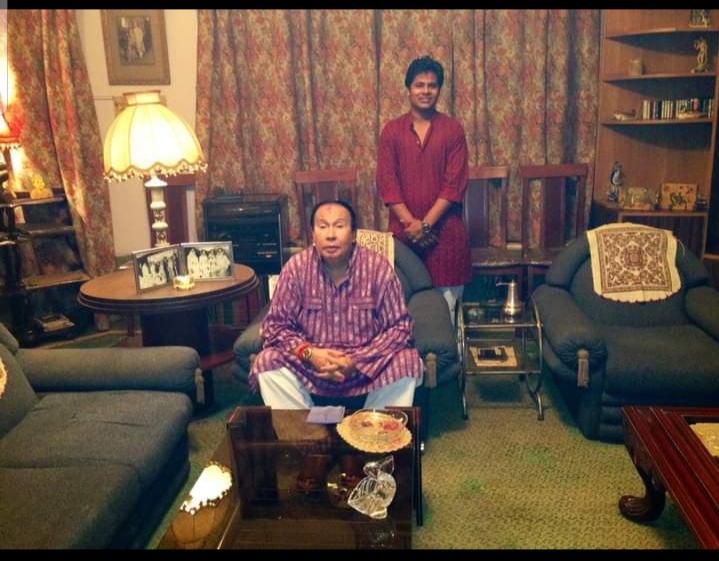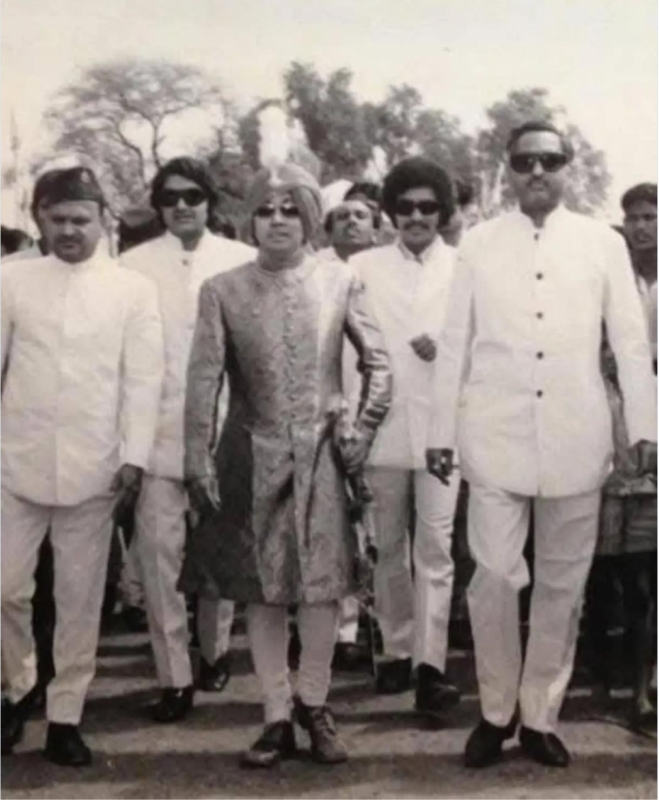
Present Head
History
Origin and Legendary Foundation of Sakti State
The princely state of Sakti, situated in the eastern plains of Chhattisgarh, possesses a unique historical legacy rooted in the traditions of the Raj Gond dynasty. Historically, the Raj Gonds represented a ruling aristocracy within the Gond tribe who adopted classical Kshatriya traditions while retaining their deep indigenous roots in the Gondwana region.
According to regional folklore and historical records, the state was founded by two twin brothers, Hari and Gujar. The brothers served as soldiers under the Raja of Sambalpur. Suspicious of their growing power and martial prowess, the Raja sought to test them by presenting them with swords made entirely of wood. Despite the handicap, during a royal demonstration or conflict, the brothers miraculously decapitated a massive wild buffalo with a single blow of their wooden swords. Impressed by this extraordinary feat and recognizing their supernatural favor, the Raja of Sambalpur granted them the independent estate of Sakti. These legendary wooden swords were preserved as sacred relics in the state treasury and worshipped during festive occasions like Dussehra for centuries.
The Maratha Hegemony and Transition to British Suzerainty
In the 18th century, the expansion of the Maratha Empire under the Bhonsles of Nagpur brought Sakti, along with other Chhattisgarh feudatory states, under Maratha suzerainty. The Raj Gond rulers of Sakti managed to preserve their internal autonomy by paying an annual tribute (takoli) to the Maratha governors based in Raipur and Nagpur.
With the defeat of the Marathas in the Third Anglo-Maratha War, control over the region passed to the British East India Company. In 1818, Sakti entered into tributary relations with the British. The state was formally recognized as a feudatory state of the Central Provinces under the Chhattisgarh States Agency. In 1867, the British Crown granted a Sanad (charter) to the ruler of Sakti, guaranteeing the succession and sovereignty of the Raj Gond dynasty within their territory, subject to British paramountcy.
Key Rulers and Administrative Reforms
Sakti was one of the smaller princely states of the Chhattisgarh Agency, but its rulers made progressive strides in administration, particularly during the late 19th and early 20th centuries. The rulers bore the hereditary title of Rana, which was later upgraded to Raja.
- Raja Rup Narayan Singh: During his reign in the late 19th century, the state experienced financial instability, leading to temporary administrative intervention by the British government. This period of joint administration introduced modern land settlement practices and stabilized the state’s agrarian economy.
- Raja Liladhar Singh: Born in , he succeeded to the gaddi in 1914 and was the last ruling chief of Sakti. Raja Liladhar Singh was a highly educated and reformist ruler. Under his administration, Sakti witnessed substantial modernization, including the establishment of primary schools, healthcare dispensaries, well-planned roads, and agricultural credit societies to assist local Gond farmers.
Post-Independence Integration and the Modern Era
Following India's independence in August 1947, Raja Liladhar Singh signed the Instrument of Accession, merging the state of Sakti into the Dominion of India on 1 January 1948. The territory was initially integrated into the Bilaspur district of the Central Provinces and Berar (later Madhya Pradesh).
When the tribal-dominated state of Chhattisgarh was carved out of Madhya Pradesh in November 2000, Sakti became part of the Janjgir-Champa district. Recognizing its historical prominence and administrative needs, the Government of Chhattisgarh officially declared Sakti as the 33rd district of the state in September 2021. Today, the town of Sakti continues to flourish as a district headquarters, preserving its rich Raj Gond heritage while embracing modern democratic governance.
References and External Links
- To explore more about the historical records of the Chhattisgarh princely states, visit the Internet Archive.
- For current administrative developments and historical profiles, visit the official portal of the Sakti District, Government of Chhattisgarh.
- For details on the territorial status and treaties of the Central Provinces states, consult the Sakti State Wikipedia Page.
Genealogy
- Rana RUDRA SINGH, Rana of Sakti
- Rana UDAI SINGH, Rana of Sakti
- Rana KIWAT SINGH, Rana of Sakti
- Rana KAGAN SINGH, Rana of Sakti
- Rana KALANDAR SINGH, Rana of Sakti -/1837
- Rana RANJIT SINGH, Rana of Sakti (1837)1850/1875, born , succeeded 19th June 1850, married and had issue.
- Rana Rup Narayan Singh (qv)
- Nanki Tal Chhatarbhan Singh, [?married and had issue.
- Rana Bahadur Leeladhar Singh (qv)]
INTERREGNUM 1875/1892
- Rana RUP NARAYAN SINGH, Rana of Sakti 1892/1914
- Rana Bahadur LEELADHAR SINGH, Rana of Sakti 1914/-, born and succeeded 4th July 1914, educated at Rajkumar College, Raipur; M.L.A. (Madhya Pradesh) for two terms, married Rani Indumati Devi, and had issue.
- Yuvaraj Jivendra Bahadur Singh, married Rani Sahiba Tank Rajeshwari Devi Singh and had issue.
- Rana Shri Surendra Bahadur Singh (qv)
- Rajkumar Pushpendra Bahadur Singh, born , educated at Rajkumar College, Raipur; M.L.A. (Madhya Pradesh) for two terms. Married Kumarani Ranjana Singh, daughter of Nukul Shamsher Rana of Nepal royal family and has issues, one son and two daughters.
- Bir Bikram Singh, born .
- Kumari Devika Singh, born on , currently (2023) studying in Rajkumar College.
- Yogeshwari Singh, born .
- Siddheshwari Singh, born .
- Bir Bikram Singh, born .
- Yuvaraj Jivendra Bahadur Singh, married Rani Sahiba Tank Rajeshwari Devi Singh and had issue.
- Rana SURENDRA BAHADUR SINGH, Rana of Sakti; born ; educated at Rajkumar College, Raipur; Minister in the Government of Madhya Pradesh for two terms, in 1961 he represented India in hockey, against the New Zealand Hockey Touring Team. Married Rani Geeta Devi Rana of Nepal and had adopted Dharmendra Singh in 1997 because the had no issues. He Died .
- Rajkumar Dharmendra Singh (qv)
- Rana Shri DHARMENDRA SINGH, Rana of Sakti (see above)
- Rajmata Sahiba Shrimant Tank Rajeshwari Devi