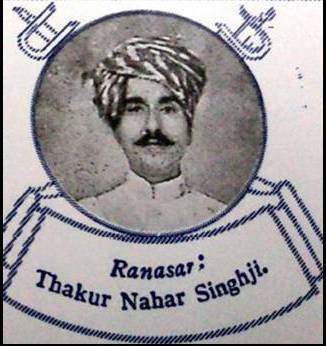
Present Head
History
Origin and Ancestry of the Panwar Rajputs of Ranasar
The rulers of Ranasar Thikana belong to the illustrious Panwar (Parmar) clan of Rajputs, which traces its lineage back to the legendary imperial Paramara dynasty of Dhar and Malwa. The immediate ancestors of the Ranasar house were established at Srinagar, an important Istamrari (fiefdom) in the Ajmer Pargana. Rao Saheb Sultan Singhji of Srinagar was a prominent noble of this line. His grandson, Thakur Saheb Kesri Singhji, established himself at the seat of Jaitsisar.
Following the establishment of high-profile matrimonial alliances between the Panwar nobles of Srinagar/Jaitsisar and the ruling Rathore house of Bikaner, the family migrated to Bikaner State. Due to these close marital ties, they were designated as Parsangis (noble kinsmen by marriage) to the Bikaner royalty, cementing their position within the inner circle of the state's aristocracy.
Establishment of Ranasar Thikana (1831 AD)
The Thikana of Ranasar was formally carved out and granted in 1831 AD by Maharaja Ratan Singhji of Bikaner. The beneficiary of this grant was his maternal uncle (Mamaji), Thakur Saheb Bhom Singhji. Along with the estate, Maharaja Ratan Singhji bestowed the prestigious honor of Tazim (a formal court reception where the Maharaja rises to receive the noble) upon Thakur Bhom Singhji.
In the administrative and ceremonial hierarchy of the Bikaner Durbar, the Thikana of Ranasar held an elevated status. The Thakur of Ranasar was seated at the prominent number 7 position in the "Misl Davi Mahli" (the Left-Wing Seat of the Nobles), demonstrating the proximity of the family to the Bikaner throne.
Feudal Obligations and Military Service
As was customary in the Rajput feudal system, the grant of the estate came with hereditary military obligations (Chakri) to the parent state of Bikaner. The Thikana of Ranasar was obligated to provide a contingent of 12 armed horsemen (Chakari Asvar) to the state army during times of military campaigns or state emergencies. The Panwar cavalry from Ranasar served honorably in various defensive and administrative campaigns undertaken by the rulers of Bikaner during the 19th and early 20th centuries.
Post-Independence and Modern Era
With the independence of India in 1947 and the subsequent integration of princely states, the Bikaner State merged into the United State of Greater Rajasthan. Under the Rajasthan Land Reforms and Resumption of Jagirs Act of 1952, the feudal privileges, jagirdari rights, and administrative powers of Ranasar Thikana were formally abolished.
Despite the loss of their traditional feudal authority, the descendants of the Ranasar family have continued to preserve their rich cultural heritage and ancestral legacy. Today, the members of the family are engaged in modern professions, agriculture, and public service while maintaining their historical identity as proud representatives of the Panwar dynasty in Rajasthan.
Genealogy
- Rao Sultan Singhji, of Srinagar (previously an Istamrari in Ajmer Pargana).
- Thakur Saheb Jaitsiji, 1st Thakur of Jaitsisar.
- Thakur Saheb Kesri Singhji, 2nd Thakur of Jaitsisar.
- Thakur Saheb Madho Singhji, 3rd Thakur of Jaitsisar, married and had issues.
- Kunwar Chand Singh, heir apparent to Jaitsisar.
- Kunwar Bhom Singh(qv), granted Tazim of Ranasar.
- Thakur Saheb Bhom Singhji, 1st Thakur of Ranasar, married and had issue.
- Kunwar Gulab Singh (qv)
- Thakur Saheb Gulab Singhji, 2nd Thakur of Ranasar, married and had issue.
- Kunwar Lakshman Singh (qv)
- Thakur Saheb Lakshman Singhji, 3rd Thakur of Ranasar, married and had issue.
- Kunwar Nahar Singh (qv)
- Thakur Saheb Nahar Singhji (see above)