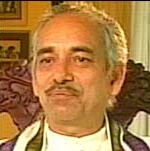
Present Head
- H.H Maharani Shree Divyajyoti Kumari Saheba of Danta (educated at Mayo College, Ajmer (Postgraduate in Psychology); briefly worked as a teacher at a public school in Bhubaneswar; married 6th/9th March 2007, H.H Maharaja Shree Riddhiraj Singh, Maharaja of Danta.
- Maharajkumari Devyani Devi, educated at Mayo College, Ajmer (Graduate)
- Maharajkumari Devika Devi, educated at Mayo College, Ajmer (Graduate)
- Maharajkumari Devesi Devi, presently attending public school in Bhubaneshwar.
History
Origin and Foundation: The Legacy of the Gajapatis
The historical lineage of the Puri Zamindari is deeply intertwined with the imperial heritage of Odisha's medieval rulers. Following the fall of the Gajapati Empire in 1568 CE due to internal instability and invasions from the Bengal Sultanate, the region plunged into political chaos. In 1572, Ramachandra Deva I, a prominent local chieftain of the Bhoi dynasty, established a new sovereign capital at Khurda.
Recognizing his strategic influence, the Mughal general Raja Man Singh of Amber formally acknowledged Ramachandra Deva I as the legitimate heir to the Gajapatis and the traditional custodian of the Jagannath Temple in Puri. This sacred guardianship bestowed upon the Rajas of Khurda the spiritual title of Gajapati Maharaja, confirming their status as the "Thakura Raja" (God-King) of Odisha.
Mughal, Maratha, and British Alignments
Throughout the 17th and 18th centuries, the kingdom of Khurda constantly defended its territorial integrity and the sanctity of the Jagannath Temple from Mughal subahdars and later from the Marathas. When the Maratha Empire assumed control of Odisha in 1751, they took over the direct revenue administration of the temple but left the ritualistic authority entirely in the hands of the Khurda rulers.
In 1803, the British East India Company defeated the Marathas and took control of Odisha. Hoping to regain full sovereignty, Raja Mukunda Deva II initially cooperated with the British. However, realizing that the British intended to annex his territories directly, the Raja, guided by his chief minister and commander Jayi Rajaguru, rose in rebellion in 1804. The British forces swiftly suppressed the rebellion. Jayi Rajaguru was executed, the Raja was imprisoned, and the territory of Khurda was confiscated by the British Crown.
The Establishment of the Puri Zamindari (1809)
Recognizing that stripping the Raja of all authority caused widespread resentment among the local population and the Paiks (the traditional landed militia), the British administration adopted a policy of pacification. In 1809, the British passed a regulation that formally entrusted the management of the Jagannath Temple to the Raja of Khurda, who was subsequently relocated to Puri.
The family was stripped of its sovereign political powers but was granted the Zamindari of Puri (often referred to as the Purusottam Khetra or the Gajapati Estate of Puri). The Rajas of Puri, while technically zamindars under the British Raj, continued to hold immense socio-religious influence across the region due to their hereditary role as the Adhyasevaka (first servitor) of Lord Jagannath.
Post-Independence and the Modern Era
Following India's independence in 1947, the princely states and estates were integrated into the Indian Union. Under the Orissa Estates Abolition Act of 1951, the temporal zamindari rights of the Puri estate were formally abolished. However, to safeguard the ancient religious traditions of Odisha, the state government enacted the Sri Jagannath Temple Act, 1955, which legally preserved the unique spiritual and ritualistic status of the Gajapati Maharaja.
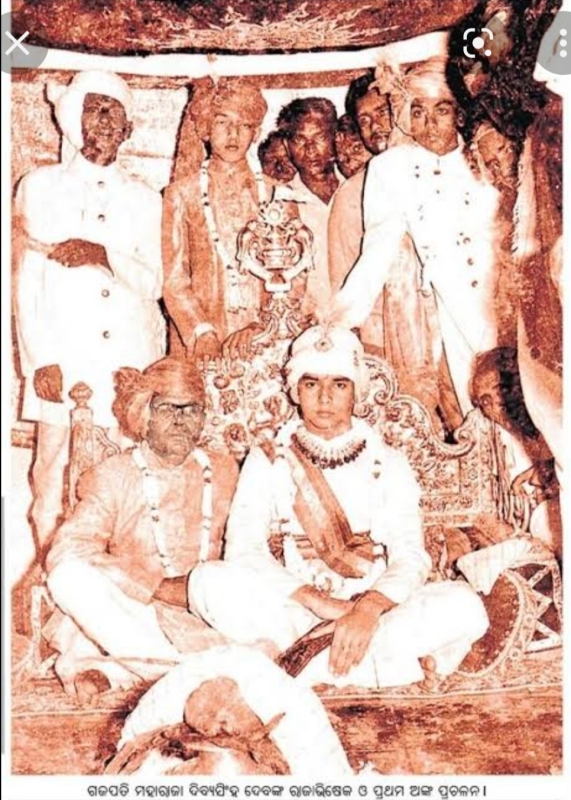
Today, the titular head of the dynasty, Gajapati Maharaja Dibyasingha Deb, continues to reside in Puri. He performs vital ritual duties, most notably the Chhera Pahanra (the ritual sweeping of the chariots) during the world-famous annual Ratha Yatra, serving as a living link to Odisha's royal and spiritual heritage.
References and Further Reading
- Learn more about the history of the region on Encyclopaedia Britannica.
- Read about the transition of the dynasty in the Khurda Kingdom Wikipedia Article.
- Explore the administrative records of the Jagannath Temple on the official website of the Shree Jagannatha Temple Administration.
Genealogy
- Sri Gajapati Raja RAMCHANDRA DEVA III, Raja of Puri 1808/1857 (1817/1856), son of Raja Mukunda Deva II, the last Raja of Khurda, who rebelled against the British authorities in 1808, and the state was abolished, with the zamindari of Puri, being granted to the family for their maintenance.
- Sri Gajapati Raja BIRAKISHORE DEVA II, Raja of Puri 1856/1862
- Sri Gajapati Raja DIBYASINGHA DEVA III, Raja of Puri 1862/1878 (1857/1871), tried for murder, convicted and sentenced to transportation for life.
- Sri Gajapati Raja MUKUNDA DEVA III, Raja of Puri 1878/1926, attained his majority in 1897, granted the title of Raja for personal use only on the 29th March 1884, being a representative of the Gangavansa Dynasty of the ancient Kings of Orissa, he adopted 1stly on 2nd March 1916, Jagadananda Deb, younger son of the Zamindar of Bada Khemidi, he adopted 2ndly, 2nd October 1918, Lal Mohini Mohan Deb, third son of Raja Satchidananda Tribhuban Deb of Bamra, married and had adoptive issue. He died .
- (A) Sri Jagannath Jenomi, he succeded as Sri Gajapati Raja Ramchandra Deb IV of Puri (qv)
- (A) Sri Jagadananda Deb, born , died .
- Sri Gajapati Raja RAMCHANDRA DEB IV, Raja of Puri 1926/1957, born , as Lal Mohini Mohan Deb, third son of Raja Satchidananda Tribhuban Deb of Bamra, he married Rani Chandramani Pattamahadei, and had issue, two sons and one daughter. He died .
- Sri Gajapathi Maharaj Bira Kishore Deb (qv)
- HH Maharani Kasturika Mohini Devi, married HH Maharaja Pratap Kesari Deo of Kalahandi, and had issue, two sons and two daughters. She died .
- Thatraj Raj Raj Deb B.A., born , educated at Rajkumar College, Raipur; prior to joining politics he was Captain of the Puri District Football team; he served as Manager, Shri Jaganath Temple 1956/1961; M.L.A. (Orissa) 1961/1967; married Thatrani Purneshwari Devi, daughter of Thakur Saheb Surendra Nath Shah Deo of Gingo Thakurgaon, and had issue, one son and three daughters. He died . (Srinahar, P.O. - Puri, Dist. - Puri, Orissa, India)
- Yuvrani Mohini Devi [now Rajmata Mohini Devi of Jashpur], married Yuvraj Uppendra Singh Ju Deo of Jashpur, and has issue, two sons and one daughter.
- Rani Rajshree Devi, married Raja Jitamitra Singh Deo of Khariar, and has issue, two sons and one daughter.
- Kumar Anang Bhaskar Deb, married Kumari Jaishree Devi of Chhota Udaipur in Gujarat, and has issue, one son and one daughter.
- Kumar Uday Raj Singha Deb, pursuing training to be a Pilot, in Florida, USA.
- Kumari Kriti Devi
- Kunwrani Utkala Singh, married on 16th May 1985 to Kunwar Col. Aklesh Kumar Singh, son of Thakur Lt-Col(retd.) Avdesh Kumar Singh, grandson of late Thakur Ramnath Bux Singh of Parsendi, Dist. Sitapur, U.P., and has issue, one son and a daughter.
- Bhanwar Lt. Akshay Kumar Singh, born , presently serving in Indian Army, got commissioned from Officer Training Academy, Chennai.
- Kumari Akanksha Singh, born .
- Sri Gajapathi Maharaj BIRA KISHORE DEB, Raja of Puri 1957/1970, born , educated at Rajkumar College, Raipur where he was Wrestling Champion, All-round Athlete for 1944-45 and 1946 consecutively; he represented Orissa in Sontosh Trophy 1947/1948; entered politics in 1967; M.L.A. (Orissa) 1967/1971; interests and pastimes were Reading, Music and Painting, Riding, Swimming and Football; married Maharani Suryamani Pattamahadei [n�e Rajkumari Snehalata Manjari Devi], born , died , daughter of Raja Kishor Chandra Mardraj Harichandan of Nilgiri, and his second wife, Rani Giriraj Kumari, and had issue, two sons and one daughter. He died .
- Gajapathi Maharaj Dibyasingha Deb IV (qv)
- Pattayet Rani Nayanshree Devi, married Pattayet Bikram Kesari Deo of Kalahandi, and has issue, one son and two daughters.
- Thatraj Ranarnab Deb, married Thatrani Soma Devi, daughter of Kumar Jagadananda Singh Deo of Panchkot, and has issue, one son.
- Kumar Deb Raj Deb, an accomplished sportsman in Equesterian sports.
- Sri Gajapathi Maharaj DIBYASINGHA DEB IV (see above)