Present Head
History
Origin and Foundation of Pugal
The historical region of Pugal (historically known as Poogal or Puggal) holds a prominent place in the history of the Thar Desert. Its foundation as an independent Bhati Rajput principality arose from the internal political conflicts within the royal family of Jaisalmer.
The lineage of Pugal begins with Rawal Keher, the ruler of Jaisalmer. His eldest son, Rao Kelan, defied family wishes by marrying into the Mahecha Rathore clan of the Barmer-Jasol region. Consequently, Kelan was banished from Jaisalmer, and his younger brother, Laxman, was declared heir to the throne. Driven by determination and military skill, Rao Kelan conquered the frontier lands and founded the principality of Bikampur. His son, Rao Chacha, pushed further northwest to establish dominance over Pugal, making it a powerful seat of Bhati power. Chacha was succeeded by Bairisal, who was in turn succeeded by his son, Rao Sheikha.
The Reign of Rao Sheikha and Alliance with Bikaner
Pugal's geographic position on the margins of the desert made it a frequent target for raids from Sindh. During the reign of Rao Sheikha, the Langah Sultanate of Multan and local Sindhi Muslim clans sought to crush Pugal's power. They conspired with Sheikha’s envious brothers, Tiloksi and Jagmal, leading to Sheikha's capture and the fall of Pugal.
During this critical juncture, Rao Bika (the founder of the Rathore kingdom of Bikaner) was consolidating his power over Jangladesh. Recognizing the strategic value of a friendly Bhati state on his frontier, Rao Bika launched a military expedition, defeated the Langah forces, and reinstated Rao Sheikha on the throne of Pugal.
To seal this political alliance, Rao Bika married Sheikha's daughter, Princess Rangkunwari. This union played a pivotal role in regional history, as she gave birth to Rao Lunkaran, who would later expand Bikaner's territories. The loyalty of Pugal to Bikaner was demonstrated in 1478 A.D. (B.S. 1535). When the Bhatis of Jaisalmer actively opposed Rao Bika’s construction of the Kodamdesar Fort and pressured Rao Sheikha to join their coalition, Sheikha resolutely refused, cementing the permanent alliance between Bikaner and Pugal.
Mughal and Medieval Periods
During the medieval period, as Bikaner established strong diplomatic ties with the Mughal Empire under Emperors Akbar and Jahangir, Pugal enjoyed elevated status as a premier frontier fiefdom (Thikana). The Raos of Pugal were classified among the highest nobles (Sirayat) at the Bikaner royal court.
The warriors of Pugal served with distinction in the military campaigns of the Maharajas of Bikaner. Because of their familiarity with the harsh desert terrain, they acted as a formidable defense line protecting the state's western borders from Sindhi and Baluchi raiders.
British Raj and Treaty Relations
Following the treaty of 1818 between Maharaja Surat Singh of Bikaner and the British East India Company, the borders of Bikaner were formalized under British protection. Pugal was recognized as one of the elite "Patta" (fiefs) of Bikaner.
The Raos of Pugal retained significant local administrative, judicial, and revenue-collection authorities within their estate, while paying regular tribute (Rekh) to the Bikaner state. Throughout the British era, the Thikana of Pugal remained an important pillar of Bikaner's noble administration.
Heraldry, Flag, and Culture
As descendants of the Yaduvanshi Bhati Rajputs, the rulers of Pugal claimed descent from Lord Krishna. Their heraldry featured the traditional Bhati symbols: the sacred royal umbrella (Chhatra) and the double-edged sword (Khanda).
Pugal is also deeply woven into the romantic folklore of Rajasthan. The famous oral epic of Dhola-Maru, which is celebrated across the desert, identifies Maruvi (the heroine) as a princess of Pugal. Her beauty, fidelity, and the landscapes of Pugal continue to be celebrated in the traditional songs of the Manganiyar and Langa folk musicians.
Post-Independence and Modern Era
Following the independence of India in 1947, Bikaner State merged into the United State of Rajasthan, and the princely system was formally integrated. With the subsequent passage of the Rajasthan Land Reforms and Resumption of Jagirs Act, the feudal privileges of the Rao of Pugal were dissolved.
In the modern era, Pugal (often spelled Poogal) is a thriving administrative block and Tehsil within the Bikaner district. The construction of the Indira Gandhi Canal revolutionized life in this historically dry region, converting vast tracts of sand dunes into highly productive agricultural land, and turning Pugal into a key agricultural hub in western Rajasthan.
References and Bibliography
- Tod, James. Annals and Antiquities of Rajasthan. London: Smith, Elder, 1829. Digitized copy available on the Internet Archive.
- Ojha, Gauri Shankar Hirachand. The History of the Bikaner State (Bikaner State ka Itihas). Vedic Yantralaya, 1939. Accessible on the Indian Culture & Internet Archive.
- Powlett, P. W. Gazetteer of the Bikaner State. Bikaner: Government Press, 1874. Archived on Digital South Asia Library.
Genealogy
- Rao Chacha, 1st Rao of Pugal.
- Rao Bairsal, 2nd Rao of Pugal.
- Rao Sheikha, 3rd Rao of Pugal.
- Rao Haraa, 4th Rao of Pugal.
- Rao Barsingh, 5th Rao of Pugal.
- Rao Jaisa, 6th Rao of Pugal.
- Rao Kanhsingh, 7th Rao of Pugal.
- Rao Askarn, 8th Rao of Pugal.
- Rao Jagdev, 9th Rao of Pugal.
- Rao Sudarshan, 10th Rao of Pugal, as per records, Sudarshan, the Rao of Pugal, rebelled and after a siege lasting a month, Pugal was taken by Karan Singh. It had been a place of note and importance as it lay between the city of Bikaner and Multan. The Bhatis had acquired it from the Panwars. At that time it had 200 villages and in Karan Singh's time this number had increased to 561. Now, the descendants of Shekha, Bikas father-in-law, claimed division of the estate. It was accordingly divided amongst the descendants of the three sons of Shekha. The eldest son's descendant, obtained Pugal and 252 villages. The two descendants of the second son obtained Bikampur with 84 villages and the other Varsalpur with 41 villages respectively. The descendant of the third son received Raimalwali with 184 villages.
- Rao Ganeshdas, 11th Rao of Pugal.
- Rao Vijaysingh, 12th Rao of Pugal.
- Rao Dalkarn, 13th Rao of Pugal.
- Rao Amarsingh, 14th Rao of Pugal.
- Rao Abhaysingh (Anoopsingh), 15th Rao of Pugal.
- Rao Ram Singh, 16th Rao of Pugal.
- Rao Ranjit Singh, 17th Rao of Pugal.
- Rao Karnisingh, 18th Rao of Pugal.
- Rao Raghunathsingh, 19th Rao of Pugal.
- Rao Mahtavsingh, 20th Rao of Pugal.
- Rao Jivrajsingh, 21st Rao of Pugal.
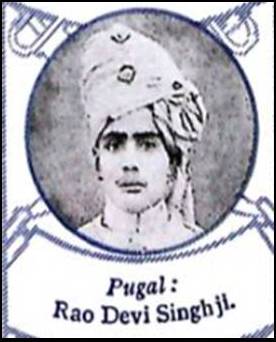
- Rao Devisingh, 22nd Rao of Pugal, married a daughter of the Rawat of Piploda and had issues.
- Rao Sagat Singh (qv)
- Kumari (name unknown), married and had issue.
- Rao Sagat Singh, 23rd Rao of Pugal, born in , died in , married to daughter of Thakur Jeoraj Singh Ji of Harasar.
- Rao Rahul Singh, 24th Rao of Pugal (see above)