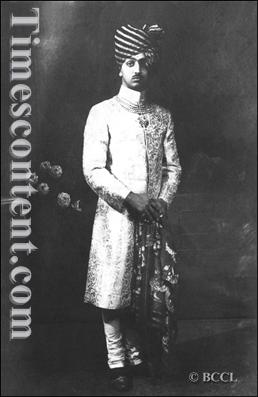
Present Head
History
Origin and Gond Foundation
The history of Nagpur began significantly in 1702 when it was founded by the Gond King, Raja Bakht Buland Shah of Deogarh, on the banks of the Nag River, from which the city derived its name. He established this urban center by combining twelve small agricultural hamlets collectively known as "Rajapur Baraasa" or "Barasa." His successor, Raja Chand Sultan, continued to develop the infrastructure of the city, fostering trade and commerce. However, following Chand Sultan's death in 1739, intense succession disputes broke out within the Gond royal family. Seeking to restore order and secure her sons' rights, Chand Sultan's widow appealed to the Maratha military commander, Raghoji I Bhonsle, who was then governing Berar on behalf of the Maratha Peshwa.
Raghoji I Bhonsle intervened in 1743, successfully resolving the civil conflict. Recognizing the strategic and economic value of the region, he decided to establish his direct authority over Nagpur, making it the sovereign capital of the Bhonsle Maratha kingdom. The Bhonsle family originally traced their lineage as traditional village headmen (Patils) from Deora, located in the Satara District of Maharashtra. Raghoji's grandfather and his grand-uncles had served with distinction in the military forces of Chhatrapati Shivaji Maharaj. In recognition of their valor, Chhatrapati Shahu I of Satara later conferred high military commands upon the family, along with the hereditary right to collect chauth (a one-fourth revenue tribute) in the territories of Berar and Gondwana.
The Golden Era of the Bhonsle Dynasty
Under the leadership of Raghoji I Bhonsle (who ruled until 1755), the Nagpur Kingdom expanded rapidly. He launched several ambitious military campaigns, most notably into the Bengal Presidency. Between 1741 and 1751, Raghoji’s forces, led by his capable general Bhaskar Pandit, carried out repeated expeditions into Bengal, Bihar, and Odisha, which severely challenged the authority of Alivardi Khan, the Nawab of Bengal. These campaigns culminated in the Treaty of 1751, under which the Nawab ceded the province of Odisha to the Marathas and agreed to pay an annual tribute of twelve lakhs of rupees as chauth.
To learn more about the extensive expansion of this Maratha confederacy branch, see the detailed profile of the Bhonsle Dynasty on Wikipedia.
Anglo-Maratha Conflicts and Decline
The prosperous reign of the Bhonsles faced a critical turning point during the rule of Raghoji II Bhonsle (1788–1816). As the British East India Company sought to expand its hegemony across central India, Nagpur was drawn into the Second Anglo-Maratha War (1803). Raghoji II allied with Maharaja Daulat Rao Scindia of Gwalior against the British, but the coalition suffered defeats at the Battles of Assaye and Argaon. Consequently, Raghoji II was forced to sign the humiliating Treaty of Deogaon in 1803, by which he ceded Odisha, southern Berar, and Cuttack to the British, vastly reducing the kingdom's territory and economic power.
Following the death of Raghoji II, Mudhoji II Bhonsle, popularly known as Appa Sahib, assumed power in 1816. During the Third Anglo-Maratha War (1817–1818), Appa Sahib made a desperate attempt to break free from British control by aligning with Peshwa Baji Rao II. His forces engaged the British in the hard-fought Battle of Sitabuldi in November 1817, but were ultimately defeated. Appa Sahib was subsequently deposed and sent into exile, marking the end of the independent military power of the Nagpur State.
British Regency and the Doctrine of Lapse
In 1818, the British East India Company placed a minor prince, Raghoji III, on the throne under a British regency administered by the resident, Richard Jenkins. During this period, the administration was heavily reorganized along British lines, though local traditions were preserved. Raghoji III was granted full ruling powers in 1830, but his reign remained closely supervised by British political agents.
Raghoji III died in without leaving a direct male heir or a formally adopted successor. Consequently, the Governor-General of India, Lord Dalhousie, applied the controversial Doctrine of Lapse, annexing the Nagpur Princely State into British India in 1854. The territory was initially administered as the Nagpur Province, which was later integrated into the Central Provinces in 1861. Following the annexation, the Bhonsle royal family was pensioned off, receiving an annual sum of 203,000 Rupees, and their private estates were largely managed under British supervision.
Post-Independence and the Modern Era
Following India's independence in 1947, the Nagpur territory was merged into the new Indian Union. Nagpur was designated as the capital of the newly created Madhya Pradesh state. However, following the States Reorganisation Act of 1956, the administrative boundaries of Indian states were redrawn on a linguistic basis. The Marathi-speaking Vidarbha region, including Nagpur, was subsequently merged into Bombay State, which later became the state of Maharashtra in 1960.
Under the historic Nagpur Pact of 1953, Nagpur was designated as the official auxiliary or "second capital" of Maharashtra. Today, the city hosts the winter session of the Maharashtra State Legislative Assembly (Vidhan Sabha). The descendants of the Bhonsle dynasty continue to reside in Nagpur, maintaining the Senior Bhonsle Palace and actively participating in the cultural, social, and political life of the region.
References and Further Reading
- For an overview of the geographic and historical development of the region, visit the Encyclopædia Britannica Entry on Nagpur.
- For comprehensive archival details on the administrative transition of the Central Provinces, consult the Nagpur Kingdom Historical Overview on Wikipedia.
Genealogy
- Maharaja Chhatrapati RAGHUJI BHONSLE I, 1st Maharaja of Nagpur 1734/1755, he was bold and decisive in action, twice his armies invaded Bengal, and he obtained the cession of Cuttack. In addition, Chanda, Chhattisgarh, and Sambalpur were added to his dominions between 1745 and 1755, the year of his death; he married and had issue. He died at Nagpur.
- Maharaja Chhatrapati Janoji Bhonsle (qv)
- Maharaja Chhatrapati Madhoji Raghunathrao Bhonsle I (qv)
- Maharajkumar Bimbaji Bhonsle
- Maharajkumar Sabhaji Bhonsle, died in battle, 26th January 1775.
- Maharaja Chhatrapati JANOJI BHONSLE, 2nd Maharaja of Nagpur 1755/1773, he took part in the wars between the Peshwa and the Nizam of Hyderabad, and after he had in turn betrayed both of them, they united against him and sacked and burnt Nagpur in 1765; married Maharani Darya Bai, and had adoptive issue. He died sp on 21st May 1773.
- (A) Maharaja Chhatrapati Raghoji Bhonsle II (qv)
- Maharaja Chhatrapati MADHOJI RAGHUNATHRAO BHONSLE I, 3rd Maharaja of Nagpur 1773/1788 (Regent), Senadhurandhar, fought for the succession with his brother, until the battlefield of Panchgaon, and succeeded to the regency on behalf of his infant son Raghoji II who was Janoji's adopted heir. In 1785 Mandla and the upper Narmada valley were added to the Nagpur dominions by treaty with the Peshwa; married and had issue. He died at Nagpur.
- Maharaja Chhatrapati Raghoji Bhonsle II (qv)
- Maharajkumar Vyankoji Bhonsle [Manyabapu], Senadhurandhar, married and had issue. He died at Kasi.
- Maharaja Chhatrapati Madhoji Appasaheb Bhonsle II (qv)
- Maharajkumar Chimnaji Bhonsle, died .
- Maharajkumar Lachman Dada
- Maharaja Senasaheb Subha Chhatrapati RAGHOJI BHONSLE II, 4th Maharaja of Nagpur 1788/1816, Senasaheb Subha [cr.1775], his predecessor had courted the favor of the British East India Company, and this policy was continued for some time by Raghoji II, who acquired Hoshangabad and the lower Narmada valley, in 1803 he united with Daulatrao Scindia of Gwalior against the British, but the two leaders were decisively defeated at the battles of Assaye and Argaon, and, by the Treaty of Deogaon of that year, Raghoji ceded Cuttack, southern Berar, and Sambalpur to the British, although Sambalpur was not relinquished until 1806; he married (amongst others), Maharani Baka Bai, died at Nagpur, aged 77 years, having received a pension of 120,000Rs, and had issue, as well as further issue. He died .
- Maharaja Chhatrapati Parsoji Raghoji Bhonsle (qv)
- Maharajkumari Banu Bai, married and had issue.
- Maharaja Chhatrapati Raghoji Bapusaheb Bhonsle III (qv)
- Maharajkumar Dharmaji Bhonsle (natural son), murdered 5th May 1816.
- Maharaja Senasaheb Subha Chhatrapati PARSOJI BHONSLE, 5th Maharaja of Nagpur 1816/1817, born , killed by Madhoji II on 2nd February 1817.
- Maharaja Senasaheb Subha Chhatrapati MADHOJI APPASAHEB BHONSLE II, 6th Maharaja of Nagpur 1816/1818, born , in 1817, on the outbreak of war between the British and the Peshwa, Appa Sahib threw off his cloak of friendship, and accepted an embassy and title from the Peshwa. His troops attacked the British, and were defeated in the action at Sitabaldi, and a second time near Nagpur city. As a result of these battles, the remaining portion of Berar and the territories in the Narmada valley were ceded to the British. Appa Sahib was reinstated to the throne, but shortly afterwards was discovered to be again conspiring, and was deposed and moved to Allahabad in custody. On the way, however, he bribed his guards and escaped, first to the Mahadeo Hills and subsequently to the Punjab; he married (a), Maharani Savitri Bai, received a pension of 10,000Rs, married (b), Maharani Uma Bai, died in Jodhpur.
- Maharaja Senasaheb Subha Chhatrapati RAGHOJI BAPUSAHEB BHONSLE III, 7th Maharaja of Nagpur 1818/1853, born (1806), due to his young age, the territories were administered by the resident from 1818 to 1830, when he was allowed to assume ruling powers; he married (a), Maharani Annapurna Bai, received a pension of 50,000Rs, married (b), Maharani Dariya Bai, received a pension of 25,000Rs. He died spm on 11th December 1853. The state lapsed with his death (annexed by the British under the Doctrine of Lapse due to failure of Heirs).
- Maharajkumar (name unknown), died .
- Maharajkumar Bhimbaji Bhonsle, born .
- Maharajkumari Bannu Bai, died .
- Maharaja Senasaheb Subha Chhatrapati JANOJI II YASHWANTRAO BHONSLE, 8th Maharaja of Nagpur, son of Nana Ahirarao (a nephew of Raghuji III) 1853/1881, adopted by Maharani Dariya Bai after 1853, Raja Bahadur of Devur or Deor [cr.1861](Hereditary title), received a pension of 120,000Rs, (subject to revision after his death), married and had issue. He died .
- Raja Bahadur Raghoji Deo Janoji Bhonsle (qv)
- Raja Bahadur RAGHOJI DEO JANOJI BHONSLE, 9th Raja of Deor, born . Title confirmed as hereditary.
- Rajaramsinhrao Bhonsle, married Shaliniraje Puar, daughter of HH Maharaja Chhatrapati Shahaji II Puar of Kolhapur and Dewas-Snr, and had issue.
- HH Maharaja Chhatrapati Shahu II Bhonsle of Kolhapur.
- Raja Laxmanrao Bhonsle, married and had issue.
- Shri Tejsingrao Bhonsle, born in Nagpur, Maharashtra; married 25th December 1959, Shrimant Rani Chitralekha Raje Bhonsle (n�e Chitralekha Kadam), born in Baroda, daughter of Shri Sharas Chandra Kadam, educated at Sayajirao Gaekwad College and M.S. University, Baroda (B.A.), Member of the 12th Lok Sabha 1998/-, Member, Committee on Energy and its Sub-Committee-II on Coal 1998/1999, Member, Consultative Committee, Ministry of Coal Social and Cultural Activities, Chairperson, Mahalaxmi Jagdamba Trust, Koradi, Nagpur (Maharashtra), Chairperson, Distt. Volleyball Association, Nagpur, interests are Painting and reading; and has issue, two sons and three daughters. (Junior Bhosla Palace Mahal, Nagpur - 440002, Maharashtra, India)