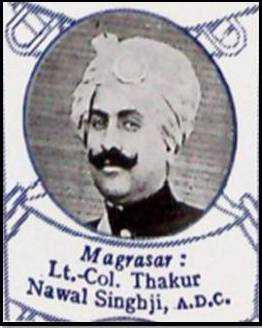
Present Head
History
Origin and Genealogy
The Thikana of Maghrasar holds a distinguished place in the feudal hierarchy of the erstwhile Bikaner State. The ruling family of Maghrasar belongs to the Narnot (also spelled Narnaut) clan, a prominent sub-branch of the Bika Rathores. The lineage of Maghrasar traces back to Rajkumar Narang (Naranji), who was the grandson of Rao Lunkaran, the third ruler of Bikaner (reigned 1505–1526 AD). Rao Lunkaran was himself the son of Rao Bika, the illustrious founder of the Bikaner State and a scion of the Rathore dynasty of Marwar.
The Narnot clan carved out a reputation for bravery and administrative capability in the desert region of Rajputana. Over generations, the descendants of Rajkumar Narang established several estates, with Maghrasar emerging as their primary ancestral seat.
Establishment of the Thikana and Court Honors
The estate of Maghrasar was formally granted as a hereditary jagir by Maharaja Sur Singhji of Bikaner, who ruled the state from 1613 to 1631 AD. Prior to this formalization, the family had already consolidated substantial territorial influence in the region; historical records indicate that by 1552 AD, the estate already comprised 12 flourishing villages.
Within the courtly hierarchy of the Bikaner Darbar, the Thakur of Maghrasar was recognized as an elite Umrao (noble) of the state, ranking 29th among the premier nobles. The chief of Maghrasar was accorded highly coveted ceremonial privileges, reflecting their close kinship with the ruling house of Bikaner and their military significance:
- Dohri Tazim (Double Tazim): A rare honor where the Maharaja of Bikaner would rise from his throne both upon the arrival and the departure of the Maghrasar chief in the royal court.
- Kurab Hath: A ceremonial gesture of intimacy and respect where the Maharaja would place his hand on the noble's shoulder or chest during formal audiences.
The British Era and Military Service
Following the treaty of 1818 between the British East India Company and Maharaja Surat Singh of Bikaner, the administrative and military dynamics of the region shifted. Like other Tazimi Sirdars of Bikaner, the chiefs of Maghrasar maintained internal autonomy over their estates while contributing feudal levies (cavalry and infantry) to the state army for regional defense and imperial services. The administrative details of such estates are preserved in the historical Imperial Gazetteer of India and state administrative reports of the Bikaner Regency.
Post-Independence and Modern Era
With India's independence in 1947 and the subsequent integration of the princely states, Bikaner formally merged into the United State of Greater Rajasthan in 1949. The feudal privileges, jagirdari land revenues, and judicial powers of the Maghrasar Thikana were phased out following the passage of the Rajasthan Land Reforms and Resumption of Jagirs Act, 1952.
Despite the dissolution of their constitutional feudal powers, the family of Maghrasar has successfully transitioned into the modern era. Today, the descendants of the Narnot clan preserve their rich cultural heritage, historical archives, and traditional weapons, while actively contributing to modern professions, agriculture, and local communities in Rajasthan.
Genealogy
- Thakur Saheb Bhopat, 1st Thakur of Maghrasar, married and had issue.
- Kunwar Sunderdas (qv)
- Thakur Saheb Sunderdas, 2nd Thakur of Maghrasar, married and had issue.
- Kunwar Hardramdas Singh (qv)
- Thakur Saheb Hardramdas Singhji, 3rd Thakur of Maghrasar, married and had issue.
- Kunwar Kesri Singh (qv)
- Thakur Saheb Kesri Singhji, 4th Thakur of Maghrasar, married and had issue.
- Kunwar Sahab Singhji (qv)
- Thakur Saheb Sahab Singhji, 5th Thakur of Maghrasar, married and had issue.
- Kunwar Bakhtawar Singh (qv)
- Thakur Saheb Bakhtawar Singhji, 6th Thakur of Maghrasar, married and had issue.
- Kunwar Harnath Singh (qv)
- Thakur Saheb Harnath Singhji, 7th Thakur of Maghrasar, was a brave and dynamic General of Bikaner State Forces and in 1830 AD, he led a victorious campaign against notorious dacoits Pema and Jora Bawari, who had assimilated 4,000 dacoits to plunder villages and towns of Bikaner State. He led the State forces in numerous campaigns against Rebel Thakurs of Churu, Mahajan and Bhadra, and eventually died in a battle at Churu, in 1855 AD, for his sacrifice and bravery Mahraja Sardar Singhji exempted the Thikana from paying any ‘Rekh’ (Tax) to the State, married and had issue.
- Kunwar Dalel Singh (qv)
- Thakur Saheb Dalel Singhji, 8th Thakur of Maghrasar, married and had issue.
- Kunwar Pratap Singhji (qv)
- Thakur Saheb Pratap Singhji, 9th Thakur of Maghrasar, married and had issue, he died on AD.
- Kunwar Bije Singh (qv)
- Thakur Saheb Bije Singhji, 10th Thakur of Maghrasar, married and had issue.
- Kunwar Nawal Singh (qv)
- Lt. Col. Thakur Saheb Nawal Singhji (see above)