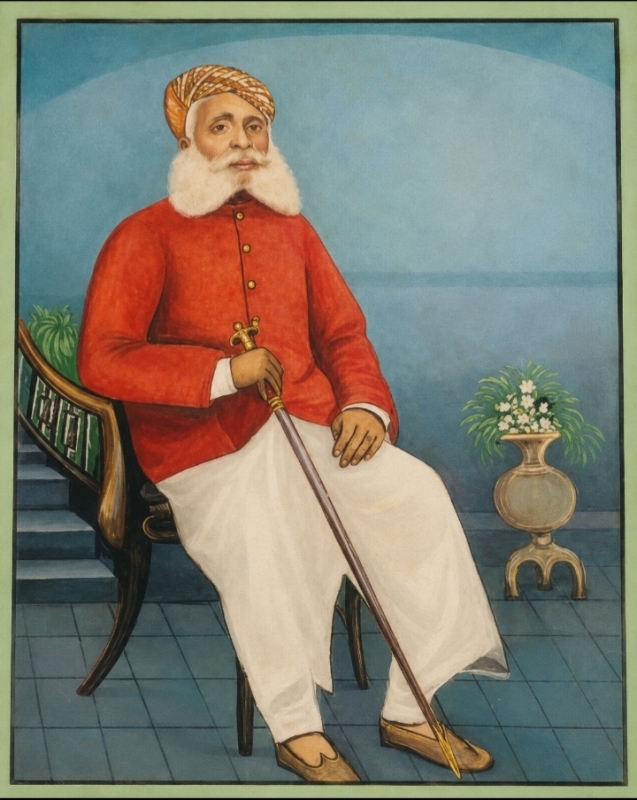
Present Head
- Kunwar Yayanarayan Singh.
- Kunwar Sarveshwar Singh.
- Kunwar Madhusudan Singh.
History
Origin and Lineage
The Jagirdars of the Kuncholi Thikana are descendants of Maharana Udai Singh II, the illustrious founder of Udaipur, and his second wife, Maharani Solankini Sehja Bai Ji, who was the daughter of Rao Prithvi Singh Ji Solanki of Toda (present-day Todaraisingh in Tonk). Their son, Maharaj Veeramdev Ji, established the Veeramdevot branch of the Ranawat clan.
The descendants of Maharana Udai Singh Ji formed the first branch of the Sisodia dynasty of Mewar to bear the patronymic title "Ranawat." In the traditional hierarchy of the Mewar state, the Baba Ranawat clan held immense prestige. From these thikanas, male children were often adopted into the ruling house of Mewar in the absence of a direct male heir to the throne of Udaipur.
The Martial Legacy and Kumbhalgarh Kiledari
The Veeramdevot lineage was honored with the highly prestigious responsibility of holding the post of Kiledar (fort commander) of the strategic Kumbhalgarh Fort, one of Mewar’s most vital defensive bastions.
During the volatile 18th century, Mewar was frequently embroiled in conflicts with Maratha forces and raiding Pindaris. The family distinguished itself through exemplary military service and supreme sacrifice:
- Thakur Sahib Sultan Singh Ji: The younger son of Maharaj Shambhu Singh Ji of Sanwar, he distinguished himself in the Battle of Shipra River in 1769 CE. On the auspicious day of Paush Shukla Navami, Vikram Samvat 1825, he attained martyrdom while valiantly fighting against the Maratha forces near Satiya.
- Thakur Sawroop Singh Ji and Thakur Sher Singh Ji: The elder and third sons of Sultan Singh Ji, respectively, upheld the family's martial legacy. They participated in a fierce engagement against Pindari raiders in Vikram Samvat 1809, where both brothers attained martyrdom in the line of duty.
- Thakur Govardhan (Gauvardhan) Singh Ji: The second son of Sultan Singh Ji, he was appointed to the distinguished position of Kiledar of Kumbhalgarh. He too embraced martyrdom while fighting bravely against adversaries near Chor Bavri in Gogunda.
Establishment of Kuncholi Thikana
In recognition of generations of blood sacrifice on the battlefield—traditionally honored in Rajputana through the grant of Mund-Katai (land granted as compensation for supreme sacrifice and loss of life)—Maharana Jawan Singh Ji of Udaipur granted the estate of Kuncholi as a jagir in 1832 CE to Thakur Gulab Singh Ji, the grandson of Sultan Singh Ji and son of the martyred Sawroop Singh Ji.
British Era and Modern Transition
Following the treaty of 1818 between the Mewar State and the British East India Company, the region transitioned into an era of relative peace. The rulers of Kuncholi administrative functioned as feudal lords under the suzerainty of the Mewar Durbar, maintaining local law, order, and revenue collection.
With India's independence in 1947 and the subsequent integration of the princely states of Rajasthan, the jagirdari system was formally abolished under the Rajasthan Land Reforms and Resumption of Jagirs Act, 1952. Despite the loss of feudal privileges, the descendants of the Kuncholi Thikana continue to preserve their rich historical heritage, cultural traditions, and ancestral ties to the royal house of Udaipur.
Genealogy
- Maharana Udai Singh II, (August 4, 1522 – February 28, 1572), was the Maharana of Mewar and the founder of the city of Udaipur in the present-day Rajasthan state of India. He was the 53rd ruler of the Mewar Dynasty. He was the fourth son of Maharana Sangram Singh (Rana Sanga) and Rani Karnavati, a princess of Bundi.
- Maharaj Veeramdev Ji, 1st Baba Saheb of Gosunda.
- Maharaj Ishwardas Ji, 2nd Baba Saheb of Gosunda.
- Maharaj Sabal Singh Ji, 3rd Baba Saheb of Gosunda.
- Maharaj Sangram Singh Ji, (1705–1720 CE), 1st Baba Saheb of Sanwar. He fought on the side of Maharana Sangram Singh II of Mewar (1710–1734), defeating the Mughal Ranbai Khan in the Battle of Badanwada in 1711 CE (sent by the Mughal Emperor Bahadur Shah I).
- Maharaj Fateh Singh Ji, 2nd Baba Saheb of Sanwar.
- Maharaj Shambhu Singh Ji, (1742–1773 CE), 3rd Baba Saheb of Sanwar. He fought with the forces of Maharana Raj Singh II in 1748 CE against the combined forces of Maharaja Ishwari Singh of Jaipur and Maharaja Surajmal of Bharatpur to ascertain the rights of his nephew Maharaja Madho Singh I for the Gaddi of Jaipur. He married four times: 1stly, Narukiji Ratan Kanwar, daughter of Thakur Sawai Singhji; 2ndly, Chauhanji Raj Kanwar, daughter of Thakur Sobhag Singhji; 3rdly, Panwarji Maya Kanwar, daughter of Thakur Padam Singhji; and 4thly, Kachchawiji Maya Kanwar, daughter of Thakur Durjan Singhji Khangarot, and had issues.
- Kunwar Jait Singh Ji (son of Ratan Kanwar), later became 4th Baba Saheb of Sanwar.
- Kunwar Surtan Singh Ji (son of Ratan Kanwar).
- Thakur Saheb Surtan Singh Ji, he received the village Dabar as a jagir from Sanwar but remained in Sanwar. He distinguished himself in the Battle of Shipra in 1769 CE. On the auspicious day of Paush Shukla Navami, Vikram Samvat 1825, he attained martyrdom while valiantly fighting against the Maratha forces near Satiya.
- Kunwar Sawroop Singh Ji.
- Kunwar Gaurdhan Singh Ji. The Veeramdevot lineage was honored with the prestigious responsibility of holding the post of Kiledar (fort commander) of Kumbhalgarh; Gaurdhan Singh Ji was appointed to this distinguished position. He too embraced martyrdom while fighting bravely near Chor Bavri in Gogunda.
- Kunwar Sher Singh Ji. He also upheld the family's martial legacy by participating in a battle against the Pindaris in Vikram Samvat 1809, where he attained martyrdom in the line of duty.
- Thakur Saheb Sawroop Singh Ji. He also upheld the family's martial legacy by participating in a battle against the Pindaris in Vikram Samvat 1809, where he attained martyrdom in the line of duty. He married and had issue, one son.
- Kunwar Gulab Singh Ji.
- Thakur Saheb Gulab Singh Ji, 1st Thakur Saheb of Kuncholi. In the year 1832 CE, Maharana Jawan Singh Ji granted the estate of Kuncholi as a jagir in recognition of mund-katai (supreme sacrifice on the battlefield) to Thakur Gulab Singh Ji. In the year 1816 A.D. (Vikram Samvat 1873), the notorious Nawab Diler Khan, along with his band of marauders, devastated the villages around Chittor and advanced towards Udaipur. Upon receiving this alarming news, Maharana Bhim Singh Ji of Mewar ordered immediate action. Under his command, Kunwar Amar Singh Ji, Rawat Dulh Singh Ji of Asind with his Faujdar Ranawat Gulab Singh Ji, Shaktiwat Uday Singh Ji of Ochdi, and other chieftains marched to confront the enemy. A fierce battle followed, and the invaders were successfully driven away from the land of Mewar. In this conflict, Mahant Sakharam Giri Ji and Hamir Singh Bhati Ji attained martyrdom. Rawat Dulh Singh Ji, Shaktiwat Uday Singh Ji, Chaturbhuj Chundawat Ji, Khum Singh Ji, Jodh Singh Ji, and Ranawat Gulab Singh Ji were injured, bearing marks of their bravery. Among them, Ranawat Gulab Singh Ji stood out for his exceptional courage and skill in battle. Impressed by his service, Maharana Bhim Singh Ji took him into his personal service in 1827 A.D. (Vikram Samvat 1884). At that time, the Meenas of the Sera Nala region were causing great disturbance by looting villages. The Maharana entrusted Ranawat Gulab Singh Ji with the task of restoring peace. He successfully suppressed them and brought stability back to the region. He married and had issue, four sons.
- Kunwar Bhim Singh Ji.
- Kunwar Gamer Singh Ji, received jagir and havli in Sanwar.
- Mod Singh Ji.
- Jodh Singh Ji.
- Kunwar Girvar Singh Ji, received the jagir of Kheda Jaitpura Kila.
- Bhopal Singh Ji.
- Kishan Singh Ji.
- Ragunath Singh Ji.
- Kasari Singh Ji.
- Amar Singh Ji.
- Bhopal Singh Ji.
- Kunwar Arjun Singh Ji, married to Bhatiyani Ji of Thikana Hingwaniya.
- Kasari Singh Ji (adopted).
- Sajjan Singh Ji.
- Uday Singh Ji.
- Bhagvan Singh Ji.
- Dula Singh Ji.
- Kasari Singh Ji (adopted).
- Thakur Saheb Bhim Singh Ji, 2nd Thakur Saheb of Kuncholi. During the reign of Maharana Shambhu Singh II, the region of Mavli Pargana faced serious disturbances. Robbers, Pindaris, and Meena groups created chaos, and their frequent looting caused great trouble for the villagers, disturbing their daily lives. To bring back peace and proper administration, Mavli Pargana was given to Thakur Bhim Singh Ji. He was a brave and capable noble who had already done notable service in the court of Mewar. He took charge with responsibility and worked with courage and dedication to maintain law and order. On the 5th of June, 1862, a grave sacrilege occurred when the sacred cows of Shreenathji of Nathdwara were seized by marauding Meena raiders. Rising to the call of dharma, Thakur Bhim Singh Ji launched a fierce campaign against the miscreants to rescue the holy cattle. In the ensuing battle, he fought with unparalleled bravery and ultimately attained martyrdom, laying down his life in the noble cause of protection and righteousness. In reverent memory of his supreme sacrifice, he is venerated to this day as Sagas Ji Bavji in Mavli, where his legacy continues to inspire devotion and pride among the people. He also commissioned the construction of a Rawla in Mavli, a testament to his enduring presence and noble stature. He married and had issue, three sons and one daughter.
- Kunwar Inder Singh Ji.
- Kunwar Prathvi Singh Ji.
- Kunwar Man Singh Ji (Graha Hakim of Mewar), built Kamleshwar Mahadev temple in Kuncholi and baori in Mogana.
- Dhokal Singh Ji.
- Baktawar Singh Ji.
- Harnath Singh Ji.
- Madan Singh Ji.
- Mitu Singh Ji.
- Shambu Singh Ji.
- Narayan Singh Ji.
- Baktawar Singh Ji.
- Dhokal Singh Ji.
- Thakur Saheb Inder Singh Ji, 3rd Thakur Saheb of Kuncholi. He built the Ram Lakshman Ji temple in Kuncholi and Indersagar lake. On 20 August 1880, Maharana Sajjan Singh Ji created the Council of Mahendraj Sabha (Ijalis Khas) (an 18-member Judicial Council similar to a Supreme Court); he was a member in it. He received the bathak of Badi Oal, batak of Nav, and a vacant seat of Pava in Bada Batisa. He married and had no issue.
- Thakur Saheb Prathvi Singh Ji, 4th Thakur Saheb of Kuncholi. In the year 1834, a band of notorious robbers from Odwadiya in Marwar descended upon the villages of Khemli and Gudli, spreading fear and plundering wealth. Demonstrating exceptional courage and unwavering resolve, Thakur Prathvi Singh Ji pursued the marauders relentlessly, tracking them to Khokri Nal near Bej Nal. There, he successfully apprehended the culprits and recovered the stolen goods. Upon receiving news of this valiant act, the Maharana expressed great admiration for his bravery and loyalty. In recognition of his distinguished service, he graciously bestowed upon him the villages of Margada and Sakhela Kheda as a mark of royal favor. He married Thakurani Sahiba Rathore Ji of Thikana Lordi and had issue, two sons and two daughters.
- Kunwar Chaman Singh Ji.
- Kunwar Ukar Singh Ji (Janglat Hakim).
- Jalam Singh Ji.
- Pratap Singh Ji.
- Mahetab Singh Ji.
- Kishan Singh Ji.
- Lal Singh Ji.
- Govind Singh Ji.
- Fathe Singh Ji.
- Prem Singh Ji.
- Lakshman Singh Ji.
- Kalayan Singh Ji.
- Jai Singh Ji.
- Hari Singh Ji.
- Dalal Singh Ji.
- Manohar Singh Ji.
- Ram Singh Ji.
- Ratan Singh Ji.
- Daulat Singh Ji.
- Ishwar Singh Ji.
- Kishor Singh Ji.
- Virendra Singh Ji.
- Jalam Singh Ji.
- Baisa, married to Thakur Saheb Gulab Singh Ji of Thikana Dabla.
- Baisa, married to Thakur Saheb of Thikana Aagriya.
- Thakur Saheb Chaman Singh Ji, 5th Thakur Saheb of Kuncholi. He married Thakurani Sahiba Bhatiyani Ji of Thikana Hingwaniya and had issue, one son.
- Kunwar Nathu Singh Ji.
- Thakur Saheb Nathu Singh Ji, 6th Thakur Saheb of Kuncholi. He married Thakurani Sahiba Rathore Ji Lad Kunwar of Thikana Dholi and had issue, five sons and one daughter.
- Kunwar Sawroop Singh Ji.
- Kunwar Mohan Singh Ji.
- Kunwar Jivan Singh Ji.
- Kunwar Lakshman Singh Ji.
- Kunwar Roop Singh Ji.
- Baisa, married to Thakur Saheb Ummed Singh Ji of Thikana Kundiya.
- Thakur Saheb Sawroop Singh Ji, 7th Thakur Saheb of Kuncholi. He was the first chairman of the Nagar Palika of Fathanagar-Sanwar. He married Thakurani Chouhan Ji Sahiba Hukum Kunwar, daughter of Thakur Saheb Dula Singh Ji of Thikana Chouhano ki Kuncholi, and had issue, three sons and four daughters.
- Kunwar Sher Singh Ji.
- Kunwar Chatar Singh Ji.
- Kunwar Virvrat Singh Ji.
- Baisa Anand Kunwar, married to Thakur Saheb Vijay Singh Ji of Thikana Murayala.
- Baisa Krishna Kunwar, married to Thakur Saheb Man Singh Ji of Thikana Gorana.
- Baisa Leela Kunwar, married to Thakur Saheb Narendra Singh Ji of Thikana Baldarkha.
- Baisa Geeta Kunwar, married to Thakur Saheb Nagandra Singh Ji of Thikana Nathidyas.
- Thakur Saheb Sher Singh Ji, 8th Thakur Saheb of Kuncholi. He married Thakurani Sahiba Jagmalot Ji Shankar Kunwar, daughter of Thakur Saheb Roop Singh Ji of Thikana Kund ka Lamba (Masuda), and had issue, one son and two daughters.
- Baisa Bhagwati Ranawat, married to Thakur Saheb Bhupendra Singh Ji Chouhan of Thikana Garnawat (Banswara).
- Kunwar Devendra Singh Ji.
- Baisa Urmila Ranawat, married to Thakur Saheb Vishnunarayan Singh Ji Rathore of Thikana Khod.
- Thakur Saheb Devendra Singh Ji, 9th Thakur Saheb of Kuncholi (see above)