Present Head
- Baisa Vinita Kumari Rathore, married Commander (Retd.) Sunil Chauhan of Tankri, and has issue.
- Kunwar Adhiraj Singh Chauhan
History
Origin and Foundation
The Thikana of Kumbhana holds a highly distinguished position in the historical hierarchy of the erstwhile princely state of Bikaner. Belonging to the illustrious Ratansinghot branch of the Bika Rathore clan, Kumbhana is recognized as one of the premier noble estates, second only to the estate of Mahajan. The lineage of this estate traces its origin back to Rao Lunkaran, the ruler of Bikaner (reigned 1505–1526 AD), who was the son of Rao Bika, the founder of the Bikaner state.
The progenitor of the Kumbhana branch was Thakur Kesri Singh, who was sixth in descent from Rao Lunkaran. The Ratansinghot Bikas are descendants of Maharajkumar Ratan Singh, a prince of Bikaner whose lineage established some of the most powerful and loyal feudal estates (Thikanas) in the region, acting as major pillars of military and administrative strength for the ruling Maharaja of Bikaner.
Feudal Status and Privileges in Bikaner Darbar
Due to their close blood relations with the ruling house of Bikaner and their exceptional military services to the state, the Chiefs of Kumbhana enjoyed exemplary honors in the Bikaner court (Darbar). The Thakur of Kumbhana was a noble of the highest order, entitled to the rare privileges of Double Tazim and Kurab Hath:
- Double Tazim: A prestigious ceremonial honor where the Maharaja of Bikaner would stand up to receive the noble upon his arrival in the court and would stand again to see him off upon his departure.
- Kurab Hath: A mark of intimate respect and royal favor wherein the Maharaja would place his hand on the shoulder of the noble during formal receptions, symbolizing equality, trust, and kinship.
These distinctions placed the Kumbhana family among the topmost aristocracy of Bikaner State, ensuring their influential voice in state affairs, succession councils, and military campaigns.
Role in State Administration and Military Campaigns
Throughout the Mughal and British periods, the rulers of Bikaner were heavily involved in external military campaigns, from the Deccan expeditions under the Mughal Emperors to the wars of the British Empire. The nobles of Kumbhana actively led their feudal levies under the Bikaner state banner. As part of their feudal obligations (Chakri), the Thikana maintained a dedicated force of cavalry and infantry for the defense of the state's borders and represented the crown in various regional administrative duties.
Post-Independence and Modern Era
Following India's independence in 1947, the princely state of Bikaner acceded to the Dominion of India. Under the leadership of Maharaja Sadul Singh, Bikaner was integrated into the United State of Greater Rajasthan in 1949. Subsequently, with the passing of the Rajasthan Land Reforms and Resumption of Jagirs Act in 1952, the feudal privileges, jagirdari rights, and administrative powers of Kumbhana Thikana were formally abolished.
Today, the descendants of the Kumbhana royal family reside in Rajasthan and other parts of India, preserving their rich cultural heritage, historical archives, and traditional customs as proud representatives of the Rathore dynasty's legacy in Bikaner.
Genealogy
- Thakur KESRI SINGH RATHORE, Thikanedar of Kumbhana, received independent jagir of Kumbhana and Double Tazim from Maharaja Anup Singh of Bikaner. He is ancestor of Ratansinghot Bika Rathore clan (second important Thikana after Mahajan).
- Thakur Jorawar Singh (qv)
- Thakur JORAWAR SINGH, Pattedar of Kumbhana, married and had issue, two sons.
- Thakur Ajit Singh (qv)
- Thakur Kishan Singh (qv)
- Thakur CHAIN SINGH [MAN SINGH or AJIT SINGH], Ruler of Kumbhana and Mahajan, he became the Pattedar (Pattayat) of Kumbhana & Mahajan. Maharaja Ratan Singh Bikaner offered him Mahajan if he killed his enemy Thakur Bairisal of Mahajan. He and his nephew Ram Singh got Bairisal killed (when he came out of Bikaner Fort), by Lal Singh of Kumbhana in 1883 AD near Sursagar Lake. Later Mahajan was granted to a son of the deceased ruler and the three murderers returned to Kumbhana and engaged in anti-legal activities, robbery and dacoity. So Maharaja Ratan Singh granted Kumbhana to his brother Kishan Singh.
- Thakur KISHAN SINGH, Pattedar of Kumbhana, married and had issue.
- Thakur Lal Singh (qv)
- Thakur Ram Singh
- Thakur LAL SINGH, Pattedar of Kumbhana, he killed Thakur Bairisal of Mahajan in BS 1890 (1833 AD) and his estate was briefly confiscated by Bikaner Ruler and he engaged in robbing villages, married and had issue.
- Thakur Girdhari Singh (qv)
- Thakur GIRDHARI SINGH [GANGA SINGH or GEEG SINGH], Pattedar of Kumbhana, his widow adopted Megh Singh ignoring his elder brother Nawal Singh and his children, and Regency Council approved this adoption on recommendation of Sodhi Hukum Singh (Vice-President of Regency Council), but Thakur Lal Singh Churu (Member of Regency Council) gave dissenting opinion that this would lead to an endless series of murders. He died sp. and had adoptive issue.
- (A) Thakur Megh Singh (qv)
- Thakur MEGH SINGH, Pattedar of Kumbhana, he was killed by Um Singh and Karnidan Singh in BS 1953-54 (1896-97 AD), and they were in turn killed in June-July 1898 AD. Kumbhana went under Court of Wards after Maharaja Ganga Singh's complete Succession as ruler of Bikaner State in 1898 AD. Till 1922 both the parties received maintenance money (Gujara) from the Thikana during that period. He died .
- Rao Bahadur Thakur Daulat Singh (qv)
COURT OF WARDS
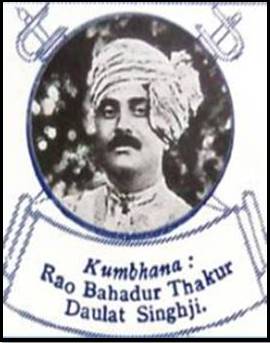
- Rao Bahadur Thakur DAULAT SINGH [Daulat Singhji or DALL SINGH], Pattedar of Kumbhana, son of Megh Singh, succeeded to the gadi in 1922, till then the issue of succession of Kumbhana was unresolved; he was educated at the Mayo College, Ajmer, and was appointed as the Comptroller of the House-Hold of Maharaja Ganga Singh Bikaner in BS 1972 (1915 AD) and went on to become the Master of the House-Hold of the Maharaja and retired in 1937 AD. He was granted additional jagir of Takhtpura and Bairawas. He received the title of Rao Bahadur from the British Government on 3rd June 1927.
- Rajkumar Amar Singh Rathore, he was appointed as R.A.S. Officer (Tehsildar) in Bikaner State, married Rajkumari Umaid Kanwar, daughter of Aapjisa Thakur Pane Singhji Khangarot, Thakur Sahib of Jadawata, and his wife, Princess Kesar Kanwar of Dobri, and had issue, one son and two daughters.
- Thakur Raj Singh (qv)
- Bai Indra Kanwar, married (as his first wife) Rao Kalyan Singh Chandrawat (Sisodia) of Sheopur in Jaipur (Sanganer), she died sp.
- Bai Chandra Kanwar, married (as his second wife) Rao Kalyan Singh of Sheopur, and has issue, one son and one daughter.
- Col. Thakur Virendra Singh, currently serving in Indian Army.
- Baisa Shanu Kumari, married Rajkumar Rajendra Singh, younger son of Maharaj Shri Dalip Singh of Raoti, and his wife of Nimbaj in Sirohi, and has issue, one son.
- Bhanwar Bana Bharat Singh
- Rajkumar Amar Singh Rathore, he was appointed as R.A.S. Officer (Tehsildar) in Bikaner State, married Rajkumari Umaid Kanwar, daughter of Aapjisa Thakur Pane Singhji Khangarot, Thakur Sahib of Jadawata, and his wife, Princess Kesar Kanwar of Dobri, and had issue, one son and two daughters.
- Thakur RAJ SINGH RATHORE, Pattedar of Kumbhana (see above)