History
Origin and Foundation
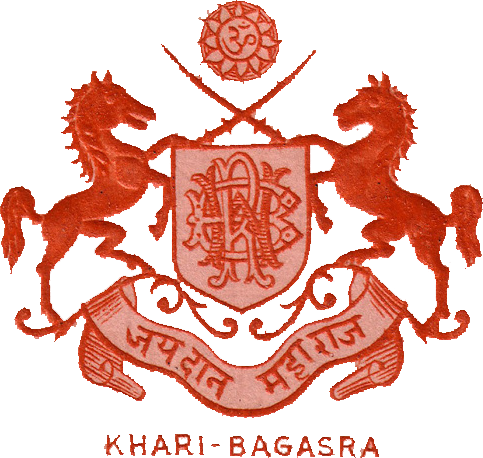
The estate of Khari-Bagasara (often historically referenced within the wider Bagasra region in the Kathiawar peninsula of Gujarat) was established in 1525. The region was historically dominated and ruled by the Kathi Darbars belonging to the Vala (Wala) clan. The Vala Kathis acquired Bagasra and its surrounding territories in the early 16th century, establishing themselves as the ruling elite. Over the generations, the estate grew as an influential local chiefdom, serving as a hub for local trade, crafts, and agricultural administration in Saurashtra.
The Rule of Vala Kathis and the Bhagdari System
Unlike many Rajput states in India that followed the law of primogeniture (where the eldest son inherits the entire state), Khari-Bagasara was governed by the customary law of equal division, known locally as the Bhagdari or Bhayati system. Under this tradition, the territory of the estate was partitioned equally among all surviving male heirs upon the death of a ruler.
While this system prevented long-term centralized autocracy and ensured financial security for all descendants, it also led to the fragmentation of the state into numerous smaller, distinct jurisdictions. Khari-Bagasara emerged as one such divided taluka (share) of the greater Bagasra estate. Despite the subdivision, the Vala Kathis maintained close cultural, marital, and defensive alliances amongst themselves to guard their ancestral territories against external threats.
British Raj and Jurisdictional Classification
During the British colonial administration, the Kathiawar region was placed under the political supervision of the Kathiawar Agency (later part of the Western India States Agency). Due to the fragmented nature of the Kathi holdings, the British classified the regional estates into various "classes" based on their size, revenue, and local influence to streamline judicial and administrative governance.
Khari-Bagasara was classified as a Sixth Class State. As a Sixth Class entity, the jurisdictional powers of the ruling talukdar were restricted. The state's judicial powers were defined as follows:
- Criminal Jurisdiction: Power to award up to two years of rigorous imprisonment and levy fines of up to 2,000 Rupees.
- Civil Jurisdiction: Power to hear and decide cases involving values of up to 5,000 Rupees.
Cases exceeding these limits, or involving capital punishment, were referred to the court of the British Political Agent stationed at Rajkot or the local Thana officer.
Administration and Economic Life
Despite its small size, the rulers of Khari-Bagasara worked toward the welfare of their subjects. The economy of the estate was primarily agrarian, relying heavily on cotton cultivation, millet, and oilseeds. Bagasra was historically famous for its local artisans, particularly those skilled in weaving, brassware, and gold-plated jewelry (often referred to locally as "Bagasra Gold"). The rulers patronized these local craftsmen, which helped sustain the estate's economy despite the heavy tribute demands imposed by the Gaekwads of Baroda and later the British East India Company under the Walker's Settlement of 1807-08.
Post-Independence and Modern Era
Following India's independence in August 1947, the ruler of Khari-Bagasara, along with other Kathi chiefs, signed the Instrument of Accession to merge with the Dominion of India. In 1948, the estate formally integrated into the United State of Kathiawar (later known as Saurashtra State).
With the reorganization of states in 1956, the territory became part of the bilingual Bombay State, and eventually, in 1960, it was incorporated into the newly formed state of Gujarat. Today, the historical territory of Khari-Bagasara lies in the Amreli district of Gujarat, where the legacy of the Vala Kathis is still preserved in local folklore, ancestral fortresses, and community traditions.
References and External Links
- To read more about the administrative classification of Kathiawar states, visit the Imperial Gazetteer of India on the Digital South Asia Library.
- For detailed historical documentation of the Kathi estates, refer to the digital copy of the Gazetteer of the Bombay Presidency: Kathiawar (Volume VIII).
Genealogy
- Darbar Shri SAMAT DESA WALA, Darbar Saheb of Khari-Bagasra, of the Senior branch of the Wala clan, married and had issue.
- Darbar Shri Harsur Samat Wala (qv)
- Darbar Shri Godad Samat Wala, Darbar Saheb of Bagasra (Ram and Vira Mulu Wala Estate).
- Darbar Shri Vajsur Samat Wala, Darbar Saheb of Bagasra (Hadala Estate)
- Darbar Shri HARSUR SAMAT WALA, Darbar Saheb of Khari-Bagasra, married and had issue.
- Darbar Shri Laxman Harsur Wala (qv)
- Darbar Shri LAXMAN HARSUR WALA, Darbar Saheb of Khari-Bagasra, married and had issue.
- Darbar Shri Harsur Laxman Wala (qv)
- Kumar Shri Jaga Laxman Wala
- Darbar Shri HARSUR LAXMAN WALA, Darbar Saheb of Khari-Bagasra, married and had issue.
- Darbar Shri Ram Harsur Wala (qv)
- Darbar Shri RAM HARSUR WALA, Darbar Saheb of Khari-Bagasra 1914/1933, born , succeeded 1914, educated at Rajkumar College, Rajkot. He died .