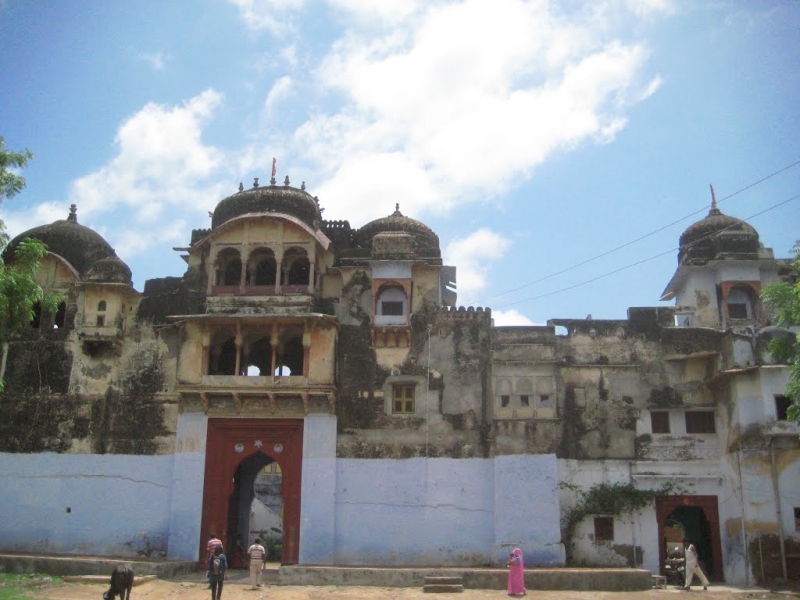
Present Head
- Rajkumari Mridula Kumari, married Rajkumar Prabal Pratap Singhji of Banswara, and has issue, one son.
- Rajkumari Kaushika Kumari, married Kunwar Shakti Singh of Dungarpur, son of Maharaj Anirudh Singh of Dungarpur, and his wife, Baiji Lal Veena Kumari of Diggi.
- Rajkumari Kritika Kumari, educated at Daly College, Indore, M.P., and did her Masters degree in Economics from Bangalore University, she is a keen squash player and has represented her state at the national level.
- Rajkumar Vanshvardhan Singh, educated at Daly College, Indore, M.P., and did his graduation from De Montfort University in Leicester, U.K., he represented his school in cricket, football and Rifle Shooting, and won a gold medal in the state championship and represented the Madhya Pradesh team in the Shooting Nationals, three times, he also represented his University for cricket in Leicester, U.K; married on 12th February 2016 to Mayurakshi Singh of Dhanani (Marwar).
History
Origin and Foundation
The Jagir of Kapren was established in the mid-18th century as an appanage for the younger branch of the ruling Hada Chauhan dynasty of Bundi. In 1760, the estate was formally granted to Kunwar Dip Singh (also spelled Deep Singh), the younger son of the illustrious Maharao Raja Budh Singh of Bundi. This grant was made by his elder brother, HH Maharao Raja Umaid Singh, who had successfully reclaimed the throne of Bundi after a prolonged and legendary struggle against the expansionist designs of Maharaja Sawai Jai Singh of Jaipur and subsequent Maratha interventions.
The creation of the Kapren Jagir served a dual purpose: it provided an honorable estate for the immediate kinsman (Bhai-Beta) of the Bundi ruler and strengthened the defensive network of the Bundi state by placing a loyal Hada Rajput noble at a strategically important location in the eastern plains of the principality.
The Turbulent 18th Century and Maratha Incursions
During the latter half of the 18th century, the Haraoti region (comprising Bundi and Kotah) was frequently subjected to raids and tribute demands by Maratha forces, particularly the Holkars and Scindias. The nobles of Kapren, as premier vassals of the Bundi Durbar, played an active role in the military mobilization of the state. They contributed forces to defend the frontiers of Bundi and maintained local law and order during a period characterized by weak central Mughal authority and rising regional powers.
British Period and Treaty of 1818
Following decades of devastating Maratha raids, the Bundi State entered into a treaty of subsidiary alliance with the British East India Company in 1818, during the reign of Maharao Raja Bishen Singh. Under this treaty, Bundi's territories were protected from external aggression. To understand the wider administrative and political framework of this era, historical records such as the Bundi State historical archives detail the relationship between the central Durbar and its principal thikanas.
As a prominent thikana (fiefdom) under Bundi, Kapren enjoyed internal revenue autonomy. The Thakurs of Kapren were responsible for land revenue collection, dispensing local justice, and providing military levies to the Maharao Raja of Bundi during state emergencies or ceremonial occasions. The estate maintained its status and prestige within the courtly hierarchy of Bundi throughout the 19th and early 20th centuries.
Post-Independence and Modern Era
With the dawn of Indian independence in 1947, the princely state of Bundi, along with its constituent jagirs like Kapren, acceded to the Dominion of India. In 1948, Bundi merged into the United State of Rajasthan, which later became the modern state of Rajasthan in 1949.
The traditional feudal privileges of the Jagirdars were formally ended with the passage of the Rajasthan Land Reforms and Resumption of Jagirs Act in 1952. Following the resumption of estates, the descendants of the Kapren ruling family transitioned into private citizens, with many retaining local respect as community leaders and custodians of their ancestral heritage. Today, Kapren has evolved into a thriving municipal town located in the Bundi District of Rajasthan, known for its agrarian economy and historical connections to the Hada Chauhan dynasty.
Genealogy
- Maharajdhiraj Dip Singh Sa Hada of Kapren, 1st Maharaj of Kapren.
- ......
- Maharaj Sahib Dhanurdhar Singh of Kapren, married and had issue.
- Rajkumar Bahadur Singh, adopted by Major HH Maharao Raja Shri Sir Ishwari Singhji Bahadur of Bundi in 1933, and succeeded there as Col. HH Maharao Raja Shri Bahadur Singhji Bahadur of Bundi.
- Capt. Maharaj Kesri Singh of Kapren, adopted by Major HH Maharao Raja Shri Sir Ishwari Singhji Bahadur of Bundi in 1933, educated at Mayo College, Ajmer; married 1946, Rani Devendra Kanwar, born , elder daughter of Rawat Himmat Singhji of Bhainsrorgarh, and his first wife, Rani Suraj Kanwar, and had issue.
- Maharaj Balbhadra Singhji of Kapren (qv)
- Thakurani Shrimati Narendra Kumari, married Thakur Narendra Singhji of Bidwal, and has issue.
- Maharaj Balbhadra Singhji of Kapren (see above)