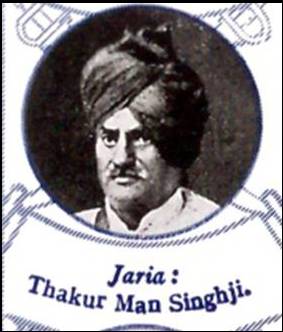
Present Head
History
Origin and Lineage
The rulers of Jhariya Thikana belong to the illustrious Kandhalot branch of the Rathore dynasty. This lineage traces its descent back to Rao Kandhal, the valiant son of Rao Rinmal (of Marwar) and brother of Rao Jodha, the founder of Jodhpur. Rao Kandhal was an influential warrior-statesman who played a pivotal role in assisting his nephew, Rao Bika, in carving out the sovereign kingdom of Bikaner in the late 15th century. For more on the broader Rathore history, you can refer to the Rathore Dynasty History.
As reward for their exceptional military service, the descendants of Rao Kandhal, known as the Kandhalots, were granted premier fiefdoms within the newly established Bikaner State. The principal seat of the Kandhalots was established at Rawatsar, which stood as one of the most influential and politically significant noble houses in the region.
Establishment of Jhariya Thikana (1764 AD)
The branch of Jhariya was founded during the 18th century as an offshoot of the Rawatsar Thikana. The estate was formally granted to Thakur Saheb Dhirat Singhji, the son of Thakur Sangram Singhji of Rawatsar, by the then ruler of Bikaner, Maharaja Gaj Singhji (who ruled from 1746 to 1787 AD). This grant was conferred in the year 1764 AD and initially comprised 12 strategic villages.
The grant was a recognition of the unwavering loyalty and administrative capability demonstrated by Thakur Dhirat Singhji and his ancestors during a turbulent period in Rajputana's history, when Bikaner was defending its borders against neighboring principalities and internal rebellions. Detailed accounts of these administrative grants can be explored in the Bikaner State History on Archive.org.
Privileges and Status in Bikaner Darbar
As representatives of one of the senior-most lineages of the state, the Chiefs of Jhariya enjoyed a highly elevated status in the formal hierarchy of the Bikaner Darbar. They were recognized as premiere nobles, possessing several hereditary distinctions:
- Dohri Tazim (Double Tazim): A prestigious courtly honor wherein the Maharaja of Bikaner would stand to receive the Thakur of Jhariya upon his arrival in the court, and would rise again to honor him upon his departure.
- Kurab Hath: A ceremonial gesture of close intimacy and respect where the sovereign would place his hand on the noble's shoulder or chest as a mark of special favor.
These honors marked Jhariya as a first-class noble estate (Tazimi Thikana), placing its rulers in the inner circle of the Bikaner State's decision-making and military councils.
Post-Independence and Modern Era
Following India's independence in 1947 and the signing of the Instrument of Accession by Maharaja Sadul Singhji of Bikaner, the princely state integrated into the United State of Greater Rajasthan. With the subsequent passing of the Rajasthan Land Reforms and Resumption of Jagirs Act in the 1950s, the territorial administrative and tax-collecting powers of the Jhariya Thikana were officially dissolved.
Despite the end of feudal governance, the royal descendants of Jhariya have successfully transitioned into modern democratic India, continuing to preserve their rich cultural heritage, historical archives, and traditional family customs in the Rajasthan region.
Genealogy
- Rao Kandhalji of Rawatsar, ancestor of Kandhalot Rathores and uncle of Rao Bikaji of Bikaner.
- Rao Banir, ancestors of Kandhal Banirot Rathores.
- Thakur Kushal Singhji, married and had issue.
- Kunwar Sangram Singh
- Thakur Sangram Singhji, married and had issue.
- Kunwar Dhirat Singh (qv)
- Thakur Saheb Dhirat Singhji, 1st Thakur of Jharia, married and had issue.
- Kunwar Surajmal Singh (qv)
- Thakur Saheb Surajmal Singhji, 2nd Thakur of Jharia, married and had issue.
- Kunwar Mukan Singhji (qv)
- Thakur Saheb Mukan Singhji, 3rd Thakur of Jharia, married and had issue.
- Kunwar Jetsiji Singh (qv)
- Thakur Saheb Jetsiji, 4th Thakur of Jharia, married and had issue.
- Kunwar Dalel Singh (qv)
- Thakur Saheb Dalel Singhji, 5th Thakur of Jharia, married and had issue.
- Kunwar Man Singh (qv)
- Thakur Saheb Man Singhji (see above)