Present Head
History
Origin and Lineage
The rulers of the Jasana Thikana belong to the illustrious Sringot clan of the Rathore dynasty, tracing their direct ancestry to Maharaj Srirangji (also known as Sarangji), a prominent son of Rao Jetsiji (Rao Jaitsi), the ruler of Bikaner State who reigned from 1526 to 1542 AD. As descendants of this royal line, the House of Jasana held a position of paramount prestige within the hierarchy of the Bikaner state nobility. The chiefs of this estate were recognized as Umrao nobles, placing them in the highest echelon of the Bikaner aristocracy.
Foundation of the Thikana (1694 AD)
The Thikana of Jasana was established in the late 17th century under heroic circumstances. During the reign of Maharaja Anup Singhji of Bikaner, the northern frontiers of the state were constantly threatened by regional powers. Bhatti Hayat Khan of Bhatner (modern-day Hanumangarh) launched a formidable military campaign against Sirsa, a vital province under the jurisdiction of Bikaner.
Thakur Saheb Khadagsen of Bhukarka, a senior Sarangot noble and warrior, marched with his forces to counter the Bhatti invasion. In the fierce battle that ensued, the Bikaner forces successfully defended the town and repelled the invaders, but Thakur Khadagsen made the ultimate sacrifice on the battlefield. To honor this heroic defense and commemorate the supreme sacrifice of the commander, Maharaja Anup Singhji in 1694 AD granted a new Jagir consisting of 15 villages to Thakur Khadagsen’s second son, Thakur Saheb Amar Singhji. This new seat of power was established at Jasana.
Court Privileges and Ceremonial Honors
As premier nobles of the state, the Thakurs of Jasana enjoyed exclusive ceremonial privileges in the Bikaner Royal Court (Darbar). These included the double-honor of Dohri Tazim (where the Maharaja would stand to receive and see off the noble) and the prestigious Kurab Hath (the privilege where the Maharaja would affectionately place his hand on the shoulder of the noble as a sign of respect and familial bond). These privileges solidified Jasana's status as a top-tier vassal state under the Bikaner crown.
British Era and Feudal Administration
Following the treaty of 1818 between the British East India Company and Maharaja Surat Singh of Bikaner, the region transitioned into a period of relative administrative stability. The chiefs of Jasana continued to play an active role in the governance, military administration, and court affairs of Bikaner State. They maintained local law and order, collected revenue across their 15 villages, and contributed contingents to the state's military forces during imperial requirements.
Post-Independence and Modern Era
Following India's independence in 1947, Bikaner State formally integrated into the United State of Rajasthan in 1949. With the passage of the Rajasthan Land Reforms and Resumption of Jagirs Act in 1952, the administrative and revenue-collecting powers of the Thikana were abolished. Despite the end of the formal feudal structure, the descendants of the Jasana family continue to reside in the region, actively preserving their historical archives, ancestral heritage, and their historic role in the annals of Rajput history.
Genealogy
- Thakur Khadagsen, 5th Thakur of Bhukarka, married and had issues.
- Kunwar Prithviraj Singh, heir apparent to Bhukarka.
- Kunwar Amar Singh, granted Thikana of Jasana (Dohri Tazim Kurab Hath) in 1694 A.D. by Maharaja Anup Singhji of Bikaner.
- Thakur Saheb Amar Singhji, 1st Thakur of Jasana, married and had issue.
- Kunwar Saheb Singh (qv)
- Thakur Saheb Saheb Singhji, 2nd Thakur of Jasana, married and had issue.
- Kunwar Bhawani Singh (qv)
- Thakur Saheb Bhawani Singhji, 3rd Thakur of Jasana, married and had issue.
- Kunwar Sangram Singh (qv)
- Thakur Saheb Sangram Singhji, 4th Thakur of Jasana, married and had issue.
- Kunwar Anup Singh (qv)
- Thakur Saheb Anup Singhji, 5th Thakur of Jasana, married and had issue.
- Kunwar Lal Singh (qv)
- Thakur Saheb Lal Singhji, 6th Thakur of Jasana, married and had issue.
- Kunwar Megh Singh (qv)
- Thakur Saheb Megh Singhji, 7th Thakur of Jasana, married and had issue.
- Kunwar Sakat Singh (qv)
- Kunwar Shardul Singh, later succeeded his elder brother on 30th March 1895 AD.
- Thakur Saheb Sakat Singhji, 8th Thakur of Jasana, died without issue on 12th February 1895 AD.
- Thakur Saheb Shardul Singhji, 9th Thakur of Jasana, married and had issue.
- Kunwar Jai Singh (qv)
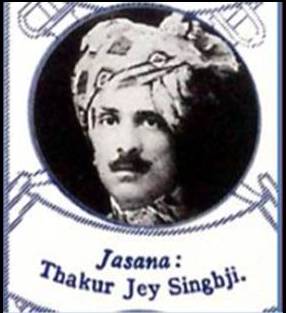
- Thakur Saheb Jai Singhji, 10th Thakur of Jasana, married and had issue.
- Kunwar Birender Singh (qv)
- Thakur Saheb Birender Singhji (see above)