Present Head
History
Origin and Chauhan Heritage of Dadrewa
Dadrewa, located in the present-day Churu district of Rajasthan, holds deep historical, military, and spiritual significance. Long before the establishment of the Rathore hegemony, Dadrewa was a flourishing principality ruled by the Chauhan Rajputs. It is most famous as the birthplace of the legendary 11th-century warrior-deity Gogaji (also known as Jahar Veer Gogaji), who was born to the Chauhan ruler Rao Jewar. The ancient fort of Dadrewa and its sacred soil remain a revered pilgrimage site for millions of devotees across northern India who revere Gogaji as a protector and folk deity.
The Rathore Conquest and Siege of Dadrewa
The Chauhan Rajput rule over Dadrewa continued until the mid-16th century. The expansionist policies of the growing Bikaner State eventually brought them into conflict with the rulers of Dadrewa. Rao Lunkaran of Bikaner initiated a massive military campaign and laid siege to the formidable fort of Dadrewa.
The siege lasted for seven grueling months, during which the Chauhan garrison put up a fierce resistance. Thakur Man Singh Chauhan, the then ruler of Dadrewa, fought heroically but eventually succumbed in the battlefield along with 500 of his loyal retainers. The Bikaner forces were led by Rajkumar Gahrsi Ji, the younger brother of the Bikaner ruler. Following this decisive battle in 1566 AD, the Pargana of Dadrewa became a strategic bastion of the Rathores of Bikaner.
Establishment of the Dadrewa Thikana
The Thikana of Dadrewa was formally established as a prominent Rathore fief in 1617 AD. Raja Sur Singh of Bikaner granted the estate, consisting of 12 villages, to Thakur Saheb Sundersen. Thakur Sundersen was the son of Maharaj Prithviraj Singhji, the legendary prince, diplomat, and poet of Bikaner (famed for composing the Rajasthani masterpiece Veli Krisan Rukmani ri at the court of Emperor Akbar), and grandson of Rao Kalyanmal of Bikaner.
Due to this illustrious lineage, the Thakurs of Dadrewa were recognized as the premiere nobles of Bikaner State. In the royal Bikaner Darbar, they enjoyed the highest privileges, including Dohri Tazim (double ceremonial reception by the Maharaja) and Kurab Hath (the privilege of the Maharaja placing his hand on the noble's shoulder as a mark of close kinship and respect).
Post-Independence and Modern Era
With the independence of India and the subsequent accession of the Bikaner State into the United State of Rajasthan in 1949, the feudal privileges and jagir system of Dadrewa were abolished under the Rajasthan Land Reforms and Resumption of Jagirs Act.
In the modern era, Dadrewa has transitioned from a feudal seat of power to a cultural and spiritual hub. The descendants of the Thikana preserve their ancestral heritage, while the town itself attracts thousands of tourists and pilgrims annually, particularly during the Goga Navami festival. For further historical and administrative details of the region, resources are maintained on the official Churu District Website.
Genealogy
- Maharaj Shri Prithviraj Singh Ji Rathore, son of Rao Kalyanmal (4th Ruler of Bikaner), ancestor of Prithvirajot clan of Bika Rathores. He was born on AD and he was a man of numerous talents, he possessed incredible wisdom, was a renowned scholar and a poet, a great devotee of Vishnu and a great warrior. His prowess as a brave Rajput and a poet has been amply justified by Lt Col James Tod, who had written that "Prithviraj in his time was epitome of rare blend of bravery and mesmerizing poetry which he used with tantalising effect and could fulfill whatever he desired by mere use of words ". Mughal Emperor Akbar held him in very high esteem and he had led Imperial Army on two occasions i.e. 1581 AD against Kabul and 1596 AD against Ahmednagar. Akbar had conferred on him the Gagron (Kota State) Fort in recognition of his bravery and which formed part of his Jagir for a long period. He was a very patriotic and inspite of being part of Mughal court he had famously lend his moral support to Maharana Pratap of Mewar and his famous poem "Pathal Peethal" is testimony to his relentless patriotism which motivated Maharana to continue his resilience against the invaders, married and had issue.
- Kunwar Sundersen (qv)
- Thakur Saheb Sundersen, 1st Thakur of Dadrewa.
- Kunwar Kesri Singhji (qv)
- Thakur Saheb Kesri Singhji, 2nd Thakur of Dadrewa.
- Kunwar Vijay Singhji (qv)
- Thakur Saheb Vijay Singhji, 3rd Thakur of Dadrewa.
- Kunwar Chattar Singh (qv)
- Thakur Saheb Chattar Singhji, 4th Thakur of Dadrewa.
- Kunwar Jodh Singhji (qv)
- Thakur Saheb Jodh Singhji, 5th Thakur of Dadrewa.
- Kunwar Mukund Singh (qv)
- Thakur Saheb Mukund Singhji, 6th Thakur of Dadrewa.
- Kunwar Kushal Singh (qv)
- Thakur Saheb Kushal Singhji, 7th Thakur of Dadrewa.
- Kunwar Lunkaran Singhji (qv)
- Thakur Saheb Lunkaran Singhji, 8th Thakur of Dadrewa
- Kunwar Surajmal (qv)
- Thakur Sheb Surajmal, 9th Thakur of Dadrewa. In 1818 AD he rebelled against Maharaja Surat Singhji of Bikaner which led to conflict with British and state forces under command of General Elner and which eventually led to siege of Dadrewa for 12 days and resultant escape of the Thakur to Sikar, married and had issue.
- Kunwar Hir Singh (qv)
- Thakur Saheb Hir Singhji, 10th Thakur of Dadrewa, he had provided services to Maharaja Sardar Singhji of Bikaner during 1857 AD Sepoy Mutiny, married and had issue.
- Kunwar Ganpat Singh (qv)
- Thakur Saheb Ganpat Singhji, 11th Thakur of Dadrewa.
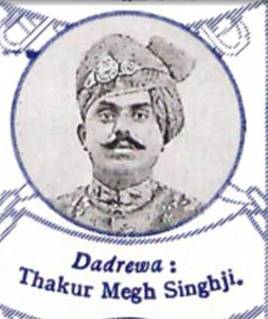
- Kunwar Megh Singhji (qv)
- Thaku Saheb Megh Singhji (see above)