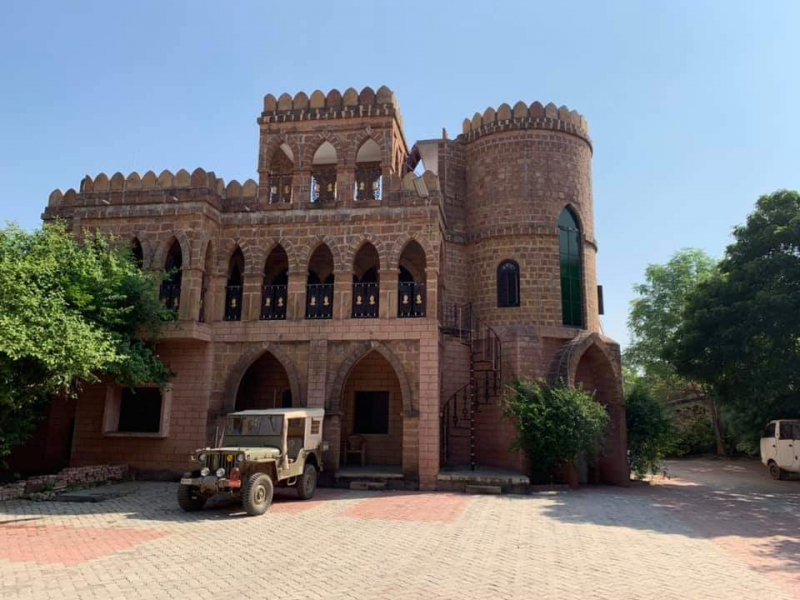
Present Head
- Yuvaraj Dhruvraj Jayvir Khachar
History
Origin and Foundation of the Khachar Dynasty
The history of the Chotila Princely State is closely intertwined with the migration, social evolution, and rise of the Kathi community in the Saurashtra peninsula of Gujarat. According to regional historical traditions, the ruling lineage of Chotila traces its lineage back to the historic town of Dhank, which was then ruled by a Rajput chieftain of the Wala clan. A significant alliance occurred when the son of this Rajput chief married a Kathi woman belonging to the Patgir branch. Following this union, he was formally elected as a Chief of the Kathis.
The descendants of this chief by his Kathi wife eventually split into three primary noble ruling branches of the Kathis: the Walas, the Khachars, and the Khumans. These three groups represent the "Shakhayat" (noble) division of the Kathis. To this day, members of these three clans do not intermarry due to their shared fraternal ancestry. Devout by tradition, all Kathis are worshippers of the Sun God (Surya), historically invoking his blessings in their state seals, flags, and daily prayers. For more details on the socio-cultural history of the community, see the Kathi People History.
The Conquest of Chotila
Historically, the hilly tract of Chotila and its surrounding areas were under the dominion of the Parmar Rajputs (associated with the rulers of nearby Muli). In Samvat 1600 (circa 1544 CE), the ambitious Kathi chieftain, Ram Khachar, launched a military campaign and successfully conquered Chotila from the Parmars. Following this conquest, Ram Khachar's descendants established a firm hold over the territory, establishing the Chotila Thana and securing possession of the surrounding villages where they continued to dwell as the dominant local chieftains.
British Period and Judicial Administration
During the British Raj, Chotila was managed as a minor state under the Jhalawad Prant of the Eastern Kathiawar Agency. The territory was divided among various Kathi shareholders (known as Bhayats or Bhagdars). Under the British administrative arrangements, the local rulers were granted limited judicial powers corresponding to their estate's size and revenue.
During the late colonial era, Khachar Shri Surag Sadul was granted personal civil and criminal jurisdictional powers by the British administration for his lifetime. His judicial authority included:
- Criminal Jurisdiction: Power to award up to three months of rigorous imprisonment and impose fines of up to 200 Rupees.
- Civil Jurisdiction: Power to adjudicate civil disputes involving financial claims of up to 500 Rupees.
This period was also marked by territorial and administrative partitions. A prolonged estate dispute arose between Khachar Shri Surag Sadul and Nana Sadul Khachar. Following a formal division of the estate, the descendants of Surag Sadul received the Jinjuda estate, while Nana Sadul’s descendants retained the original ancestral villages of Chotila. Despite this division, boundary and shares disputes lingered between the two branches, remaining unresolved well into the mid-20th century.
Post-Independence and Modern Era
Following India's independence in 1947, the rulers of Chotila signed the Instrument of Accession, integrating their state into the United State of Kathiawar (later known as the Saurashtra State) in 1948. This territory was subsequently merged into the bilingual Bombay State and eventually became a part of the Surendranagar district in the newly created state of Gujarat in 1960. You can explore modern regional administration details on the official Surendranagar District Portal.
Today, Chotila is widely celebrated not only for its historical legacy of the Khachar dynasty but also as a prominent spiritual destination. The famous Chotila Hill, featuring the ancient temple dedicated to Goddess Chamunda (Chamunda Mataji), remains a vital cultural and religious landmark in Gujarat, drawing millions of pilgrims and tourists annually.
Genealogy
- Darbar Shri MULU KHACHAR, married and had issue.
- Darbar Shri NAGJAN MULU KHACHAR (qv)
- Darbar Shri NAGJAN MULU KHACHAR, married and had issue.
- Darbar Shri SADUL NAGJAN KHACHAR (qv)
- Darbar Shri SADUL NAGJAN KHACHAR, married and had issue.
- Darbar Shri JAITA SADUL KHACHAR (qv)
- Darbar Shri JAITA SADUL KHACHAR, married and had issue.
- Darbar Shri DADA JAITA KHACHAR (qv)
- Darbar Shri DADA JAITA KHACHAR, married and had issue.
- Darbar Shri SADUL DADA KHACHAR (qv)
- Darbar Shri SADUL DADA KHACHAR, married and had issue.
- Darbar Shri SURAG SADUL KHACHAR of Jinjuda, married and had issue.
- Darbar Shri AMRA SURAG KHACHAR of Jinjuda, married and had issue.
- Darbar Shri JETHSUR AMRA KHACHAR of Jinjuda
- Kumar Shri SANTU JETHSUR KHACHAR of Jinjuda, married and had issue.
- Kumar Shri Rajendra Khachar
- Kumar Shri Dharmendra Khachar
- Kumar Shri Bharat Amra Khachar, married and had issue.
- Kumar Shri Umesh Khachar
- Kumar Shri Pradeep Khachar
- Darbar Shri AMRA SURAG KHACHAR of Jinjuda, married and had issue.
- Darbar Shri NANA SADUL KHACHAR (qv)
- Darbar Shri SURAG SADUL KHACHAR of Jinjuda, married and had issue.
- Darbar Shri NANA SADUL KHACHAR, married and had issue.
- Darbar Shri DADA NANA KHACHAR (qv)
- Darbar Shri DADA NANA KHACHAR, born , married and had issue. He died .
- Darbar Shri JAYVIR DADA KHACHAR (qv)
- Kumar Shri Mahavir Dada Khachar, married and had issue.
- Kumar Shri Kuljit Mahavir Khachar
- Kumar Shri Samarjit Mahavir Khachar
- Kumar Shri Chhatrajit Dada Khachar
- Rudraveer Chhatrajit Khachar
- Darbar Shri JAYVIR DADA KHACHAR (see above)