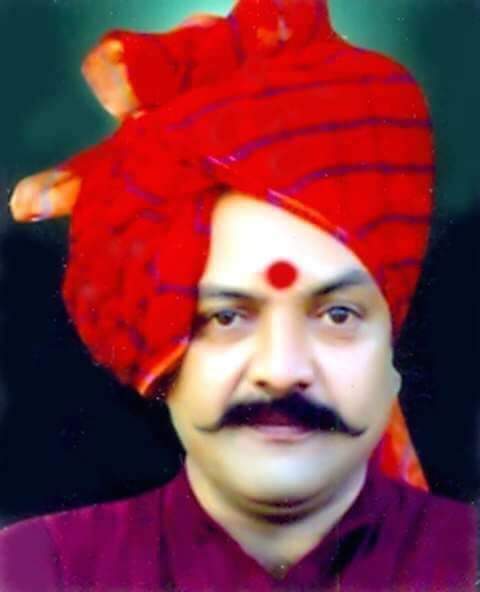
Present Head

History
Origin and Foundation
The princely state of Chhatarpur was founded in 1785 by Kunwar Sone Singh Ponwar (Parmar), a military adventurer and descendant of the Parmar Rajput dynasty. Originally, the region of Chhatarpur was part of the territory ruled by the Bundela Rajputs under the legendary Maharaja Chhatrasal. Sone Singh Ponwar served as a trusted commander and retainer under Raja Hindupat of Panna. During the political instability and factionalism that plagued the Bundela kingdoms in the late 18th century, Sone Singh carved out his own independent principality. He seized control of Chhatarpur, which was named in honor of Maharaja Chhatrasal, and established the Parmar dynasty's rule over the region.
The British Alliance and Consolidation
Following the expansion of the British East India Company into Central India, Sone Singh Ponwar sought to secure his newly founded state. In 1806, the British government granted him a sanad (charter of recognition), confirming his possession of Chhatarpur in exchange for his allegiance. This political settlement brought peace to the region after decades of Maratha incursions and local Bundela conflicts.
Upon the death of Sone Singh in 1816, he was succeeded by his son, Raja Pratap Singh. Pratap Singh was an able administrator who actively assisted the British during the regional pacification campaigns. In recognition of his loyalty, the British government bestowed upon him the title of Raja Bahadur in 1827. Since the rulers had no direct male heirs on multiple occasions, succession in Chhatarpur was often secured through the Hindu custom of adoption, which was subsequently recognized by the British Paramountcy under the Doctrine of Lapse exemptions.
The 1857 Uprising and Later Rulers
During the Indian Rebellion of 1857, Chhatarpur was ruled by Raja Jagat Singh (who had been adopted by Raja Pratap Singh). Despite the widespread anti-British rebellions in neighbouring Bundelkhand states like Jhansi, Chhatarpur remained loyal to the British Crown. The state forces provided sanctuary to European refugees and helped maintain order in the region. For his loyalty, Jagat Singh was rewarded and his state was granted a permanent salute of 11 guns.
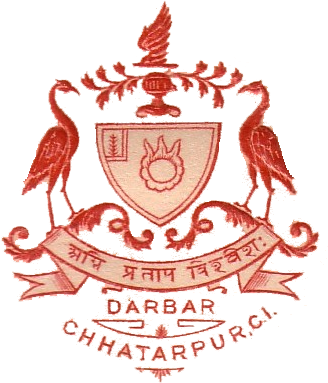
One of the most notable rulers of Chhatarpur was Maharaja Vishwanath Singh, who ascended the gaddi (throne) in 1867. A great patron of education, arts, and public works, he modernized the state's administration. He built schools, hospitals, and improved irrigation systems across the province. In 1895, the hereditary title of Maharaja was conferred upon him by the British Empire. Under his rule, the state's military strength was maintained as a well-disciplined force, comprising cavalry, infantry, and artillery guns, which proudly marched under the state's motto, "Agni pratap Vishweshah" ("As fire resplendent, Lord of the World").
Post-Independence and Modern Era
The last ruling chief of the state, Maharaja Bhawani Singh, acceded his state to the Dominion of India on April 4, 1948, following India's independence in 1947. Chhatarpur was initially integrated into the newly formed union of Vindhya Pradesh. Later, in 1956, during the states' reorganization on a linguistic basis, Vindhya Pradesh was merged, and Chhatarpur became a prominent district within the state of Madhya Pradesh.
Today, Chhatarpur is widely recognized as a major cultural and historical hub in Central India. The district is world-renowned for housing the UNESCO World Heritage Site of the Khajuraho Group of Monuments, which attracts tourists from across the globe, preserving the rich artistic and architectural legacy of medieval Bundelkhand.
References and External Links
- Learn more about the history of the region on the Chhatarpur State Wikipedia Page.
- For detailed geographical and historical gazetteers, refer to the Imperial Gazetteer of India.
- Explore the cultural heritage of Chhatarpur district via the Official Website of Chhatarpur District, Government of Madhya Pradesh.
Genealogy
- Raja SONE SHAH, 1st Raja of Chhatarpur 1785/1816, a Sardar of the Panna Raj, who was in military possession of the Chhatarpur jagir when the British acquired Bundelkhand, he was granted a sanad by the British Government in 1806, married and had issue, five sons. He died .
- Raja Pratap Singh Bahadur (eldest son) (qv)
- Kunwar Bakht Singh (fifth son), made over his jagir to his brother and received a cash allowance of 2,250Rs monthly, married and had issue.
- Kunwar (name unknown) Singh, married and had issue.
- Raja Jagat Raj Singh Bahadur (qv)
- Kunwar (name unknown) Singh, married and had issue.
- Raja PRATAP SINGH Bahadur, 2nd Raja of Chhatarpur 1816/1854, granted the title of Raja Bahadur in 1827. He died sp in 1854.
- Raja JAGAT RAJ SINGH Bahadur, 3rd Raja of Chhatarpur 1854/1867, born , he was granted a sanad of adoption in 1862, married and had issue. He died .
- HH Maharaja Sir Vishwanath Singh Bahadur (qv)
- HH Maharaja Sir VISHWANATH SINGH Judeo Bahadur, 4th Maharaja of Chhatarpur 1867/1932, born , succeeded 14th November 1866, commenced to administer his state in 1887 and received enhanced criminal powers in 1894, educated at Rajkumar College, Nowgong and subsequently under the tutorship of Sir Theodore Morison, K.C.S.I. , K.C.I.E.; Maharaja (Personal)[cr. 1895], (Hereditary) [cr.1919], married 1stly, 1884, a daughter of HH Maharaja Pratap Singh of Orchha, died sp in 1920, married 2ndly, a lady from Paigram, and had issue. He died .
- HH Maharaja Bhawani Singh Bahadur (by 2nd marriage) (qv)
- HH Maharaja BHAWANI SINGH Bahadur, 5th Maharaja of Chhatarpur 1932/2006, born , educated at Daly College, Indore; Head of the Bundelkhand Ponwars or Pamars, a local section of the great Agnikula clan which separated from the parent branch in the 13th century, married a daughter of Thakur Shankar Pratap Singh Karaiya, a noble of Charkhari State, and had issue. He died .
- Yuvaraj Balwant Singh, married Yuvrani Kumkum Kumari, daughter of HH Maharaja Mahendra Narendra Singh Ju Deo Bahadur of Panna, and his wife, HH Maharani Durga Rajya Laxmi Devi, and had issue, one son. He died .
- HH Maharaja Vikram Singh Bahadur (qv)
- Yuvaraj Balwant Singh, married Yuvrani Kumkum Kumari, daughter of HH Maharaja Mahendra Narendra Singh Ju Deo Bahadur of Panna, and his wife, HH Maharani Durga Rajya Laxmi Devi, and had issue, one son. He died .
- HH Maharaja VIKRAM SINGH Bahadur, 6th Maharaja of Chhatarpur (see above)
Notable Figures
Raja Soni Singh Ponwar (1785–1816)
Raja Soni Singh (also known as Sune Singh or Sone Shah) was the founder of the Chhatarpur State. Originally a Ponwar Rajput adventurer and a military commander under Raja Hindupat of Panna, Soni Singh took advantage of the internal discord and weakness of the Bundela rulers following Hindupat's death. He seized control of Chhatarpur and established it as an independent state in 1785. Soni Singh successfully defended his newly formed territory against local rivals and Maratha incursions.
In 1806, recognizing his de facto control over the region, the British East India Company granted him a sanad (charter), officially recognizing his sovereignty over Chhatarpur. Soni Singh is remembered as a shrewd diplomat and capable military leader who laid the foundations of the state. He ruled until his death in 1816. More information can be found in the Chhatarpur State Wikipedia Page and the historical records of the Imperial Gazetteer of India.
Raja Pratap Singh (1816–1854)
Raja Pratap Singh succeeded his father Soni Singh in 1816. His reign was marked by efforts to consolidate the administrative setup of Chhatarpur and foster economic growth. He maintained cordial relations with the British East India Company, which assured stability and protection from external aggression. Pratap Singh was a patron of art, culture, and architecture, contributing significantly to the development of the town of Chhatarpur.
As he died without a direct male heir in 1854, the British authorities initially contemplated annexing the state under the Doctrine of Lapse. However, recognizing the family's long-standing loyalty, they ultimately permitted the succession of his adopted son, Jagat Singh, ensuring the continuation of the dynasty. Historical details of his tenure are recorded in the 1911 Encyclopædia Britannica.
Raja Jagat Singh (1854–1867)
Raja Jagat Singh (also referred to as Jagat Raj) succeeded to the gaddi of Chhatarpur in 1854 as an adopted minor. Because of his youth, the administration of the state was initially supervised by a regency council under the guidance of his mother and British political agents. His reign coincided with the turbulent events of the Indian Rebellion of 1857. Under the regency, Chhatarpur remained loyal to the British Crown, assisting in maintaining order in the Bundelkhand region.
In recognition of this loyalty, the British government granted the rulers of Chhatarpur the right of adoption (sanad of adoption) in 1862, guaranteeing that the state would not lapse to the British Crown in the absence of direct heirs. Jagat Singh assumed full ruling powers upon reaching majority but died relatively young in 1867. His reign is chronicled in the Chhatarpur State History.
Maharaja Vishwanath Singh (1867–1932)
Maharaja Vishwanath Singh succeeded Jagat Singh in 1867 when he was just an infant. During his long minority, Chhatarpur was administered efficiently by British administrators, who introduced modern administrative reforms, revenue surveys, and educational institutions. Vishwanath Singh was formally invested with ruling powers in 1887. In 1895, the hereditary title of 'Maharaja' was conferred upon him by the British Empire as a personal distinction, which was later made hereditary.
Vishwanath Singh was an enlightened ruler who took a keen interest in the welfare of his subjects. He built schools, hospitals, and infrastructure, and was an active member of the Chamber of Princes (Narendra Mandal). His reign of over six decades brought unprecedented modernization and stability to Chhatarpur. His life and titles are documented in The Golden Book of India.
Maharaja Bhawani Singh (1932–1947)
Maharaja Bhawani Singh succeeded to the gaddi in 1932 following the demise of Maharaja Vishwanath Singh. He was the last ruling chief of the Chhatarpur Princely State. Bhawani Singh ruled during a highly transformative period of Indian history, marked by the escalating struggle for Indian independence and the eventual partition.
Following India's independence in August 1947, Maharaja Bhawani Singh signed the Instrument of Accession, merging Chhatarpur State into the Dominion of India. The state officially became part of the newly formed Vindhya Pradesh province in 1948, which was later integrated into the state of Madhya Pradesh in 1956. For further details on the accession, see the Chhatarpur State Wikipedia Page.