
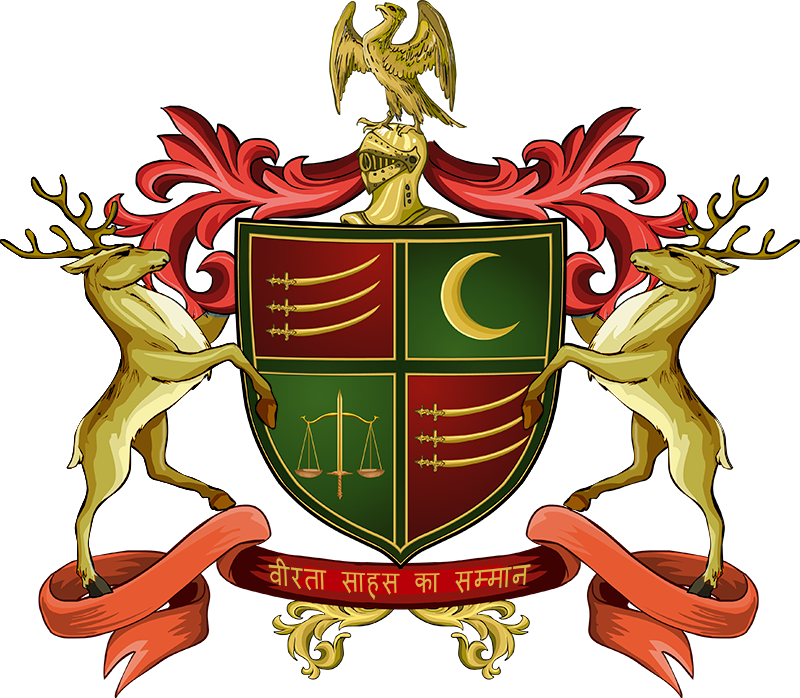
History
Origin and Foundation of Bijapur Jagir
The Bijapur Jagir, situated in the Kangra region of present-day Himachal Pradesh, represents a prominent cadet branch of the historic Katoch dynasty of Kangra. The Katoch clan is renowned as one of the oldest surviving royal lineages in the world, traditionally tracing their ancestry back to the ancient Trigarta Kingdom. The Bijapur estate emerged through the partition of ancestral lands among the descendants of Mian Narpat Chand, a nobleman of the royal clan. Initially, the four sons of Mian Narpat Chand inherited equal shares of their father's estate. However, after one of the sons died without issue, his share was resumed by the state, while the remaining three lines continued to hold their respective estates in the valley.
Sikh Annexation and the British Era
The turn of the 19th century brought significant geopolitical upheaval to the Punjab Hill States. As Maharaja Ranjit Singh consolidated and expanded the Sikh Empire, his forces overran the Kangra Valley. By the late 1820s, the sovereign authority of the Katoch rulers was dismantled, and the Sikh administration confiscated the estates of the Bijapur jagir along with other regional territories. Following the defeat of the Sikh Empire in the Anglo-Sikh Wars, the British East India Company assumed control of the region. Under the British Raj, various cadet branches of the Kangra royal family, including the lineages of Lambagraon and Bijapur, were recognized as local gentry and granted revised land rights or pensions to maintain their historical status, as documented in the records of the Kangra State.
Post-Independence and Modern Era
Following India's independence in 1947 and the subsequent integration of the hill states into the Indian Union, the formal system of jagirdari and princely privileges was phased out. This transition was finalized through legislative measures such as the Himachal Pradesh Abolition of Big Landed Estates and Land Reforms Act. Today, the descendants of the Bijapur Katoch branch continue to reside in Himachal Pradesh, actively preserving their ancestral heritage, regional fort remnants, and the cultural legacy of the Katoch dynasty.
Genealogy
- Mian NARPAT CHAND, a nephew or uncle of Raja Bhim Chand of Kangra, ruled 1690/1697; he was granted the jagir of Bijapur worth 20,000Rs; married and had issue, four sons.
- Mian Prag Chand (qv)
- Mian PRAG CHAND, married and had issue.
- Mian Agar Chand (qv)
- Mian AGAR CHAND, married and had issue. He died .
- Mian Nigahi Chand (qv)
- Mian NIGAHI CHAND, married and had issue. He died .
- generation or two
- Mian Molak Chand (qv)
- generation or two
- Mian MOLAK CHAND, born , he was restored only to a part of his jagir, worth 2,000Rs; he took no part in the rebellion raised by Raja Pramodh Chand, and was rewarded with a confirmation of his possession of the jagir in perpetuity; married and had issue. He died .
- Mian Mordhaj Chand (qv)
- Mian MORDHAJ CHAND, born , he served as a Provincial Darbari; married and had issue. He died .
- Mian Devi Chand (qv)
- Mian DEVI CHAND, born , he represents the Junior line of this branch of the Katoch family.