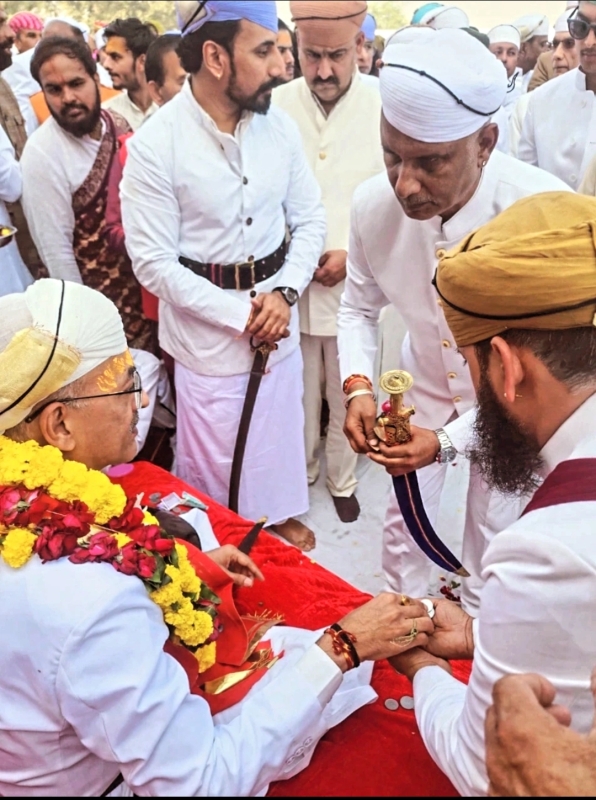
Present Head
- Kunwar Yudhveer Singh
- Kunwar Haranveer Singh
- Baisa Himakshi Kumari
History
Origin and Foundation
The foundation of the Bhunas Thikana is deeply intertwined with the royal house of Mewar during a period of intense geopolitical conflict. Maharana Raj Singh I, celebrated for his defiant stance against the religious and imperialist policies of Mughal Emperor Aurangzeb, granted the estate of Bhunas to his eighth son, Maharaja Bahadur Singh, in 1680. As direct descendants of the Maharana, the chiefs of Bhunas belonged to the prestigious Ranawat sub-clan of the Sisodia Rajputs. They held the hereditary title of "Maharaja Baba," a designation reserved for the close fraternal branches of the ruling family, emphasizing their elevated social and political standing in Udaipur.
The Bada Batisa Hierarchy
In the feudal hierarchy of Mewar, the nobility was strictly organized to maintain military preparedness and administrative order. Positioned just below the premier nobles (the Solah or Sixteen), the Bada Batisa (the Great Thirty-Two) formed the secondary tier of powerful chieftains. Bhunas occupied the highly esteemed 4th rank within this category. According to classical historical accounts of the region, including James Tod’s authoritative work, Annals and Antiquities of Rajasthan, the nobles of Bhunas were obligated to provide military contingents (reets) of horsemen and infantry to the state army, and they actively participated in the Maharana's royal court councils.
Mughal and Maratha Eras
Throughout the late 17th and 18th centuries, the Thikana of Bhunas was heavily involved in defending Mewar's sovereignty. Following the decline of Mughal authority, Mewar faced severe financial and territorial threats from the Maratha Empire, particularly the Scindias and Holkars. During these turbulent times, the rulers of Bhunas consistently supported the Maharana, providing both military aid and financial contributions to secure the borders of the state. Their steadfast loyalty during the Maratha incursions earned them a reputation as reliable protectors of the Mewar crown.
British Period and Post-Independence Era
With the signing of the Treaty of 1818 between the East India Company and Maharana Bhim Singh, the military obligations of the Mewar thikanas were restructured under British suzerainty. The chiefs of Bhunas shifted their focus from active warfare to administrative and judicial governance within their jagir. They established local schools, managed agricultural revenues, and maintained law and order.
Following India's independence in 1947, Mewar integrated into the United State of Rajasthan. With the enactment of the Rajasthan Land Reforms and Resumption of Jagirs Act in 1952, the traditional land revenue privileges of the Bhunas Thikana were officially dissolved. In the modern era, the descendants of the Bhunas estate have adapted to democratic India, pursuing careers in administrative services, business, and social welfare while continuing to preserve their ancestral fort, royal traditions, and cultural heritage.
Genealogy
- Maharaja Bahadur Singh, reigned 1680.
- Maharaja Akshay Singh.
- Maharaja Devi Singh, reigned 1768.
- Maharaja Shiv Singh, reigned 1807.
- Maharaja Kesar Singh, reigned 1829.
- Maharaja Nahar Singh, reigned 1876.
- Maharaja Bagh Singh, reigned 1890.
- Maharaja Kishan Singh.
- Maharaja Chatur Singh, reigned 1908.
- Maharaja Ekling Singh, reigned 1912.
- Maharaja Ranjit Singh, reigned 1940.
- Maharaja Ajeet Singh, reigned 1987.
- Maharaja Shailendra Singh (see above)