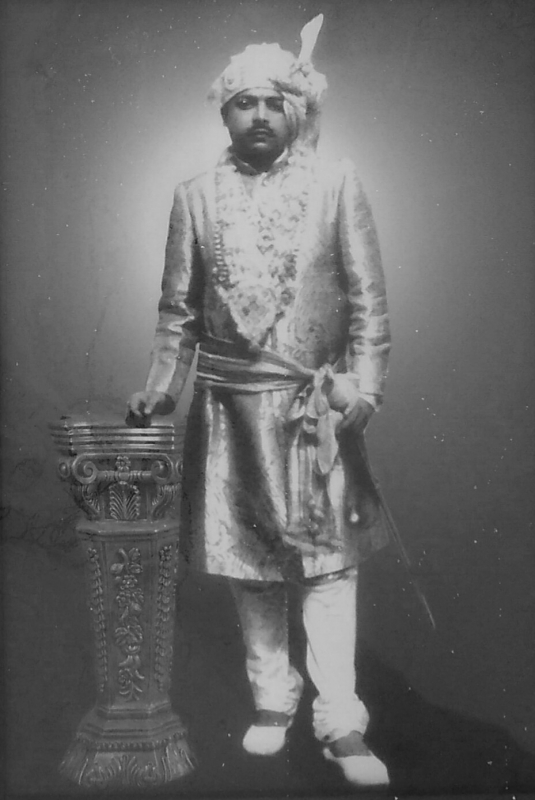
Present Head
- Yuvraj Abhishek Chandra Dhir Deb, born , educated at The Scindia School, Gwalior; graduated from BJB Autonomous College, Bhubaneshwar and Xavier Institute of Management & Entrepreneurship, Bangalore (M.B.A.); presently employed with ICICI Bank in Mumbai; married.
- Rajkumari Aradhana Devi, born in , educated at St. Joseph’s High School, Cuttack; graduated from Kalinga Institute of Medical Sciences, Bhubaneshwar (M.B.B.S.).
History
Origin and Foundation
The traditional history of the Balarampur Zamindari begins with the arrival of Balabhadra Dhir, a scion of the Suryavanshi Rajput lineage hailing from Joyapore (modern-day Jaipur region). According to historical family chronicles, Balabhadra Dhir embarked on a pilgrimage to the sacred Jagannath Temple in Puri in 553 AD. His journey subsequently took him to Jajpur, which was then a prominent seat of power in Odisha ruled by Raja Surya Keshari of the legendary Kesari (Lion) dynasty.
While at the royal court, Balabhadra Dhir displayed immense courage by saving the Raja's life from a tiger attack. In recognition of this act of bravery, Raja Surya Keshari granted him a compact tract of land in the hilly borderlands. This newly established principality was named Balarampur in honor of its founder, and Balabhadra Dhir was decorated with the hereditary title of Birbar Harichandan Mahapatra, which his descendants proudly carried through successive generations.
Geographical and Strategic Significance
Balarampur was established as a compact, impartible estate spanning approximately 65 square kilometers and comprising 28 Mouzas (revenue villages) in the Cuttack District of Odisha. The estate occupied a critical geopolitical position, serving as a buffer zone and connecting link between the fertile alluvial plains of coastal Cuttack to the east and the rugged, mountainous regions of the Orissa Feudatory States to the west.
Bound by the powerful neighboring forts and estates of Sukinda, Dhenkanal, Madhupur, and Chousathipara, Balarampur was characterized by dense forests, steep hills, and wild terrain. To secure his realm, the founder constructed the Balarampur Fort on a flat tableland at the summit of a steep, easily defensible hill. The fort was designed as a military stronghold, featuring thick walls perforated with loop holes for musketry to repel invaders and maintain regional stability.
Mughal, Maratha, and British Periods
Throughout the medieval and early modern periods, Balarampur maintained its semi-autonomous status. During the Mughal administrative settlements introduced by Raja Todar Mal and the subsequent Maratha rule in Odisha, the estate was categorized as a Killah (fortified estate). Instead of direct land revenue assessment, the rulers of Balarampur paid a fixed tribute (peshkash) to the sovereign authority, maintaining internal administrative and judicial autonomy.
Following the British conquest of Odisha in 1803, Balarampur was integrated into the British colonial administrative setup. Under the Bengal Presidency, it was classified as an impartible Zamindari estate. The British recognized the hereditary rights and traditional authority of the Birbar Harichandan Mahapatra family, stabilizing the estate's boundaries and revenue obligations under the permanent settlement regulations of the Cuttack collectorate.
Post-Independence and Modern Era
With India's independence in 1947 and the subsequent integration of princely states and estates, the Balarampur Zamindari transitioned into the modern democratic era. The estate was formally abolished following the implementation of land reform legislations in Odisha during the early 1950s. Despite the loss of formal ruling privileges, the family of the Suryavanshi rulers continues to be highly respected in the region, preserving their ancestral traditions, festivals, and cultural heritage. Today, the ruins of the ancient Balarampur Fort stand as a historical landmark, illustrating the rich martial heritage of Odisha's frontier zamindaris.
Genealogy
- Raja BALABHADRA DHIR Birabar Harichandan Mahapatra
- Raja PURUSHOTTAMA DHIR Birabar Harichandan Mahapatra
- Raja JAGGANATH DHIR Deb
- Raja NILADRI DHIR Deb
- Raja SUDARSHAN DHIR Deb
- Raja PADMANABH DHIR Deb I
- Raja JANARDAN DHIR Deb
- Raja NARASINGH DHIR Deb I
- Raja BHAGWAN DHIR Deb I
- Raja HARERAM DHIR Deb
- Raja PARSURAM DHIR Deb
- Raja BRAJA SINGH DHIR Deb
- Raja DINABANDHU DHIR Deb
- Raja HARE KRISHNA DHIR Deb
- Raja TRILOCHAN DHIR Deb
- Raja BALUNKESWARA DHIR Deb
- Raja KUNJA BIHARI DHIR Deb
- Raja BALARAM DHIR Deb
- Raja KRUSHNA CHANDRA DHIR Deb I
- Raja BANCHANIDHI DHIR Deb
- Raja CHINTAMANI DHIR Deb
- Raja NAARSINGH DHIR Deb II
- Raja PADMANABH DHIR Deb II
- Raja HARIHAR DHIR Deb I
- Raja RATNAKAR DHIR Deb
- Raja UDHAVA DHIR Deb
- Raja JOGENDRA DHIR Deb
- Raja BANAMALI DHIR Deb
- Ram KRISHNA DHIR Deb
- Raja SATYABADI DHIR Deb
- Raja GOVARDHAN DHIR Deb
- Raja MUSOLI DHIR Deb
- Raja RAGHUNATH DHIR Deb
- Raja MADHUSUDAN DHIR Deb
- Raja BAMBIKA DHIR Deb
- Raja KRUSHNA CHANDRA Dhir Deb II
- Raja BHAGAWAN DHIR Deb II, adopted son of his predecessor.
- Raja HARIHAR DHIR Deb II
- Raja GHANASHYAM DHIR
- Raja RAMCHANDRA DHIR Deb
- Raja NILADRI DHIR Birabar, 41st Raja of Balarampur, he ruled in the beginning of the 19th century; married and had issue, two sons and one daughter.
- Raja Braja Bihari Dhir Birabar (qv)
- Raja Dasarathi Dhir Birabar (qv)
- Rajkumari (name unknown), married the Raja of Athgarh.
- Raja BRAJA BIHARI DHIR Birabar, 42nd Raja of Balarampur, he ruled around the middle of the 19th century; married a daughter of the Raja of Bodogada in Ganjam District. He died sp and was succeeded by his brother.
- Raja DASARATHI DHIR Birabar, 43rd Raja of Balarampur, he succeeded his elder brother, who died without issue; married 1stly, Rani Satyabati Badamanima from Talcher, married 2ndly, Rani Lavanya Sanamanima from Khuntapada, and had issue.
- Raja PURNA CHANDRA DHIR Deb Birabar, 44th Raja of Balarampur, he died sp of typhoid. His mothers, Rajmata Satyabati Badamanima and Rani Lavanya Sanamanima, adopted Kumar Prabodh Chandra Deb in 1938, son of Dewan Bahadur Pramod Chandra Deb of Talcher, and he succeeded as Raja Prabodh Chandra Dhir Birabar, Raja Saheb of Balarampur (qv)
- Raja PRABODH CHANDRA DHIR Deb Birabar, 45th Raja of Balarampur, born as Kumar Prabodh Chandra Deb, son of Dewan Bahadur Pramod Chandra Deb of Talcher, he was adopted by the two Ranis of Raja Dasarathi Dhir Birabar in 1938; a very keen marksman and founder of Shikar India; he married Rani Jogmaya Devi, daughter of Kumar Saheb Sourendra Singh Deo of Nua Pacca I (see Seraikella), and his wife, Kumarani Padmavati Devi, daughter of the Raja of Jeypore in Orissa, and had issue, two sons and two daughters. He died .
- Rani Jyoti Devi, born , married 1981, Raja Shivendra Bijoy Malla Deb of Jhargram in West Bengal, and has issue, one son.
- Yuvraj Vikramaditya Malla Deb, born .
- Raja Prabir Chandra Dhir Deb Birabar (qv)
- Rajkumar Pattayet Subir Chandra Dhir Deb, born , educated at Rajkumar College, Raipur; an industrialist, married Kumari Nandita Devi, daughter of Kumar Nirmal Singh of Maheshpur, and his wife, Rajkumari Usha Devi, daughter of Raja Bahadur Pratap Chandra Singh Mardaraj Jagadev of Hindol, and has issue.
- Kumari Sunaina Dhir Deb, born in , educated at DAV Public School, Bhubaneshwar; graduated from BJB Autonomous College, Bhubaneshwar; Post Graduate Diploma in Management and working in Aditya Birla Group.
- Rani Prabha Devi, born married 1984, Raja Digvijay Deo Bhanj, 19th Raja Sahib of Daspalla, and has issue, two sons.
- Yuvraj Jaideep Chandra Deo Bhanj, born .
- Rajkumar Rajdeep Chandra Deo Bhanj, born .
- Rani Jyoti Devi, born , married 1981, Raja Shivendra Bijoy Malla Deb of Jhargram in West Bengal, and has issue, one son.
- Raja PRABIR CHANDRA DHIR Deb Birabar, 46th Raja of Balarampur (see above)