
Present Head
- Yuvraj Harshendra Singh, born , an electrical engineer and professional marketer working in one of the leading Government organizations, married Yuvrani Jyoti Singh of Bidwal, and has issue, a son
- Kumar Shri Aaryamann Singh, born .
History
Origin and Foundation of Sathamba Province
The state of Sathamba was a princely state ruled by the Solanki (Chaulukya) clan of Rajputs, situated in the Mahi Kantha region of Gujarat. The Solankis, who trace their ancestry to the legendary Chaulukya Dynasty of Anhilwara Patan, established several small principalities in the region following the disintegration of their imperial power in Patan during the 13th century. The founders of Sathamba migrated to the rugged, forested terrains of the Vatrak and Mahi river valleys to carve out an independent lordship, securing their domain through marital alliances and military prowess.
Medieval Era and the Solanki Dynasty
During the medieval period, the Solankis of Sathamba maintained a highly localized form of sovereignty. Surrounded by larger powers such as the Sultanate of Gujarat and later the Mughal Empire, the Thakors (rulers) of Sathamba preserved their autonomy by exploiting the difficult terrain of the Mahi Kantha hills. They operated under a feudal structure, defending their borders against neighboring Koli and Rajput chieftains. The rulers of Sathamba belonged to the same lineage as the rulers of Mansa State and Ranasan, maintaining strong kinship ties across the Sabarkantha and Mahikantha regions.
Mughal and Maratha Period
With the rise of the Mughal Empire in Gujarat, Sathamba, along with other Mahi Kantha states, paid nominal tribute to the Mughal Subahdars at Ahmedabad. When Mughal authority waned in the early 18th century, the Marathas, under the Peshwa and the Gaekwads of Baroda, swept into Gujarat. Sathamba was subjected to the Mulkgiri (military tribute collection expeditions) of the Gaekwad of Baroda. The Thakors of Sathamba resisted these incursions but were eventually forced to agree to pay annual tribute (known as Ghasdana) to the Marathas to secure peace and maintain their internal administrative rights.
British Raj and Administrative Relations
In the early 19th century, the British East India Company intervened in the region to establish order and regularize the tribute payments of the Mahi Kantha chiefs to the Gaekwad. Under the Mahi Kantha Settlement of 1812, negotiated by Major Ballantyne, Sathamba became a British protectorate under the Mahi Kantha Agency.
Sathamba was classified as a non-salute third-class (and later fourth-class) state. The state occupied an area of approximately 18 square miles and comprised several villages. The British administration respected the internal autonomy of the Thakor, though serious criminal judicial powers were vested in the British Political Agent stationed at Sadra. The tribute collected from Sathamba was paid to the Gaekwad of Baroda through the British treasury.
Post-Independence and Modern Era
Following India's independence in August 1947, the last ruling Thakor of Sathamba signed the Instrument of Accession, merging the state into the Dominion of India. On June 10, 1948, Sathamba formally integrated into the Bombay Province under the integration scheme of the Mahi Kantha states.
Following the linguistic reorganization of states in 1960, the territory of Sathamba became part of the newly formed state of Gujarat. Today, Sathamba is a prominent town and revenue division located in the Bayad Taluka of the Aravalli District (formerly part of Sabarkantha district) in Gujarat. The historical palace and remnants of the Solanki rulers still stand as a testament to the town's princely past.
References and Historical Sources
- The Imperial Gazetteer of India - Digital South Asia Library (University of Chicago)
- Gazetteer of the Bombay Presidency: Cutch, Palanpur, and Mahi Kantha (Vol. V) - Internet Archive
- Mahi Kantha Agency Historical Records - Wikipedia
Genealogy
- Thakore Saheb SARDARSINHJI, Thakore Saheb of Sathamba 1840/1867
- Thakore Saheb AJABSINHJI, Thakore Saheb of Sathamba 1867/1895, born (1838), succeeded 1867.
- Thakore Saheb VIJAYSINHJI, Thakore Saheb of Sathamba 1895/1918, born , died .
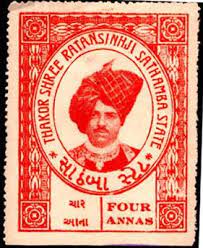
- Thakore Saheb RATANSINHJI, Thakore Saheb of Sathamba 1918/1941, born , succeeded 17th May 1919, the administrative system was revamped during his reign. He founded a hospital, library and schools which exist even today. Founder of one of the first farmers' co-operative organizations in 1923. This farmer co-operative exists to this day and is very successful in its mission of upliftment of rural peasants of the region, married and had issue, four sons.
- Thakore Saheb Sursinhji Ratansinhji (qv)
- Kumar Shri Mulsinhji Ratansinhji, educated at Rajkumar College, Rajkot (1948); married and had issue.
- Chandrabhansingh Mulsinhji
- Manvendrasingh Chandrabhansinghji
- Vanrajsingh Mulsinhji
- Yagvendrasingh Vanrajsinghji
- Chandrabhansingh Mulsinhji
- Kumar Shri Lakshmansinhji Ratansinhji, educated at Rajkumar College, Rajkot (1949).
- Kumar Shri Bahadursinhji Ratansinhji, educated at Rajkumar College, Rajkot (1950).
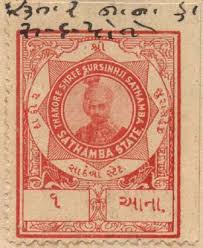
- Thakore Saheb SURSINHJI RATANSINHJI, Thakore Saheb of Sathamba 1941/- , ruler till the merger into the Indian Union in 1948, educated at Rajkumar College, Rajkot.
- Thakore Saheb Indravijaysinhji Sursinhji (qv)
- Kumar Shri Jayendrasinhji Sursinhji Solanki, educated at Rajkumar College, Rajkot (1960).
- Vijendrasinh Jayendrasinh Solanki
- Pushprajsinh Vijendrasinh Solanki
- Vijendrasinh Jayendrasinh Solanki
- Kumar Shri Ghanshyamsinhji Sursinhji Solanki, educated at Sainik School, Jamnagar (1961) and Rajkumar College, Rajkot.
- Parakram Singh Ghanshyam Singh Solanki
- Veerbhadra Singh Parakram Singh Solanki
- Rituraj Singh Ghanshyam Singh Solanki
- Divyaraj Singh Rituraj Singh Solanki
- Alka Kunwar, married to Abhimanyu Singh Deora of Thikana Bankli (Rajasthan).
- Aditya Pratap Singh Deora
- Parakram Singh Ghanshyam Singh Solanki
- Kumar Shri Mahendrasinhji Sursinhji Solanki, educated at Rajkumar College, Rajkot (1961).