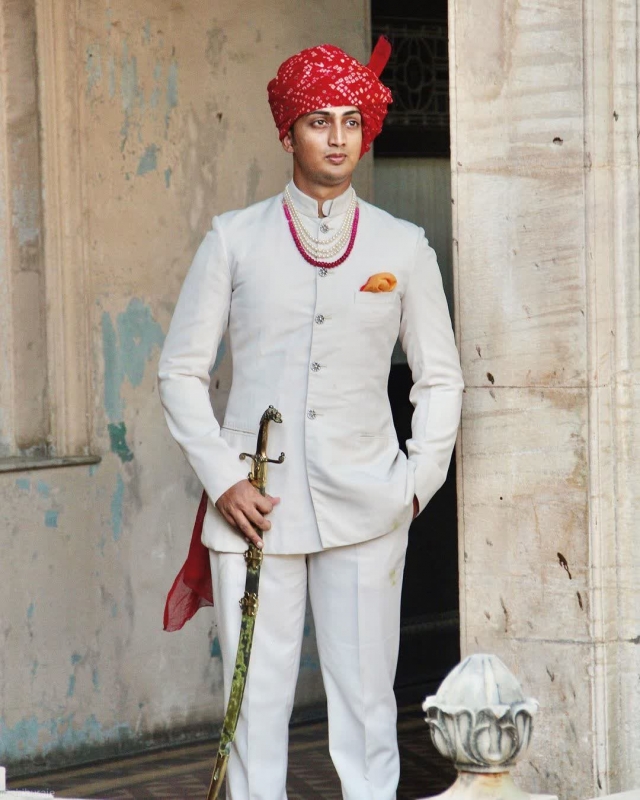
Present Head
- Yuvraj Saheb Shri Ravirajkumar Satyajitkumar Khachar
- Kumar Shri Shivrajkumar Satyajitkumar Khachar
History
Introduction and Geographic Significance
Jasdan was an influential princely state situated in the historic Saurashtra (Kathiawar) peninsula of Gujarat, western India. Geographically nestled in the heart of the Kathiawar highlands, Jasdan commanded a strategic position controlling key trade routes traversing the central plateau. Classified as a Third Class state during the British Raj, the principality was ruled by the Kathi Kshatriyas of the Khachar clan. The state was renowned for its rich equestrian heritage, resilient administrative structures, and fierce independence throughout the Mughal, Maratha, and British colonial epochs.
Origin and Foundation of Jasdan State
The state of Jasdan was founded prior to 1665. The ruling family belongs to the Khachar branch of the Kathi tribe, a martial community that migrated from Sindh through Kutch into the Saurashtra region between the 13th and 15th centuries. According to regional annals, the Kathis established their dominance over the territory by displacing local pastoral communities and older Rajput branches. The Khachar clan, in particular, consolidated their hold over the fertile tracts of central Kathiawar, with Jasdan emerging as their principal seat of power.
In its early decades, Jasdan functioned as a confederacy of Kathi landholders who operated under a clan-based system of governance. Unlike the highly centralized Rajput states, early Jasdan was characterized by a democratic division of land among brothers, a system known locally as Bhayati or Bhagdar. However, to withstand external military pressures, the state gradually evolved a more centralized chiefdom under a singular ruling head, the Darbar Saheb.
The Mughal and Maratha Epochs
During the zenith of the Mughal Empire, Jasdan maintained a semi-autonomous status, paying nominal tribute to the Mughal Subahdar at Ahmedabad. With the decline of Mughal authority in the early 18th century, Saurashtra plunged into a period of geopolitical instability. This power vacuum was quickly exploited by the Maratha Empire, led by the Peshwa and the Gaekwad dynasty of Baroda, who initiated periodic military expeditions known as Mulk-giri to extract tribute from the Kathiawar states.
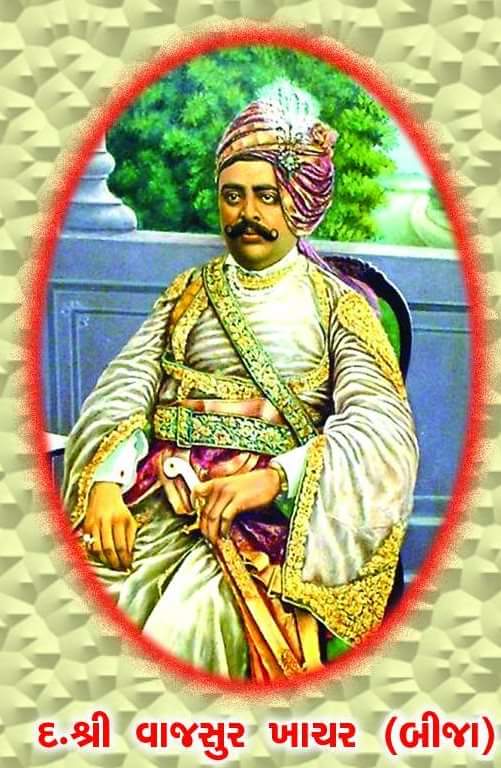
Under the visionary leadership of Darbar Shri Vajsur Khachar I (reigned in the late 18th and early 19th centuries), Jasdan successfully resisted several Maratha incursions. Vajsur Khachar was a legendary warrior-statesman who fortified Jasdan, constructed defensive outposts, and expanded the state's boundaries. He successfully asserted Jasdan's sovereignty against the aggressive encroachments of neighboring states like Junagadh and Bhavnagar, establishing Jasdan as one of the premier Kathi states in the region.
The British Period and Walker's Settlement (1807–1808)
To bring peace and fiscal stability to the war-torn Saurashtra peninsula, the British East Indian Company, led by Colonel Alexander Walker, intervened in 1807. The landmark Walker's Settlement of 1807–1808 permanently fixed the boundaries of the Kathiawar states and stabilized the tribute (peshkash) payable to the Gaekwad of Baroda and the British Crown.
Vajsur Khachar I represented Jasdan during these historic negotiations, securing British recognition of his state's sovereignty. Jasdan was subsequently placed under the political supervision of the Kathiawar Agency (later the Western India States Agency). Under British classification, Jasdan was designated a Third Class state, possessing wide civil and criminal jurisdictional powers over its subjects.
State Administration, Reformers, and Military Strength
In the late 19th century, Jasdan underwent significant modernization under the stewardship of progressive rulers, notably Darbar Shri Ala Khachar. The state administration was systematically reorganized along modern lines:
- Revenue and Land Reforms: The traditional, arbitrary tax collection methods were replaced by a structured cash-based revenue system. Land surveys were conducted, and security of tenure was granted to farmers.
- Judicial and Social Reforms: Modern courts were established, and caste-based disputes were settled through codified laws. Female education was actively promoted, and healthcare facilities, including state-funded dispensaries, were introduced.
- Infrastructure: Roads were laid connecting Jasdan to major trading centers, and the state invested in the extension of railway lines through central Kathiawar.
Despite its modernization, the state maintained a robust military apparatus to ensure domestic security and guard its borders. As of 1893, the Chief of Jasdan maintained a disciplined military force consisting of 60 cavalry, 354 infantry, and 5 guns. This force, while modest, was highly trained and played an active role in maintaining law and order, particularly in suppressing outlawry (baharvatiya) in the rugged hills of the region.
State Heraldry, Flag, and Cultural Heritage
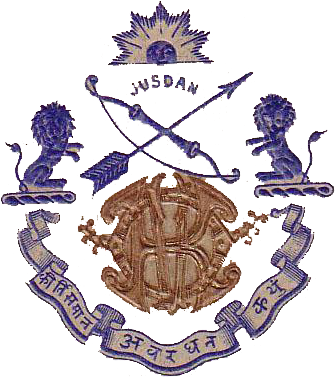
The cultural identity of Jasdan is deeply intertwined with its heraldic symbols. As devout followers of the solar deity, the Kathi rulers placed the Sun (Surya) at the pinnacle of their state symbolism.
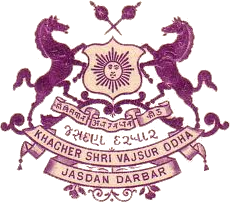
The State Coat of Arms features a shield depicting the sun in splendor, signifying light, power, and the Suryavanshi lineage of the Kathis. The supporters flanking the shield are traditionally Kathiawari horses. The Kathiawari horse, famous for its loyalty, stamina, and distinctive inward-curving ears, was highly prized by the rulers of Jasdan, who maintained some of the finest breeding studs in Western India. The state flag was a swallow-tailed pennant of sacred saffron color, representing martial valor and spiritual devotion.
Post-Independence and Modern Era
Following India's independence from British rule in August 1947, the last ruler of the state, Darbar Shri Ala Vajsur Khachar, signed the Instrument of Accession to the Dominion of India. On 15 February 1948, Jasdan officially merged into the United State of Kathiawar (later renamed Saurashtra State), which subsequently integrated into Bombay State in 1956, and finally became part of the newly formed state of Gujarat on 1 May 1960.
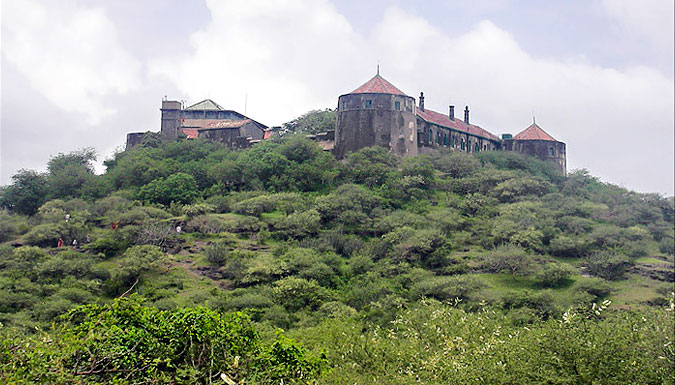
Today, the legacy of Jasdan State lives on through its historical landmarks. The historic Darbargadh (the royal palace complex) in Jasdan city stands as an architectural marvel, showcasing a blend of traditional Kathi woodwork, Rajput architecture, and colonial influences. The descendants of the ruling family continue to be respected as custodians of the region's cultural heritage, horse breeding traditions, and local philanthropy.
References and Bibliography
- Imperial Gazetteer of India, v. 14, p. 95 - Jasdan
- Gazetteer of the Bombay Presidency, Volume VIII: Kathiawar (1884)
- Indian Culture Portal - Ministry of Culture, Government of India
Genealogy
- Darbar Shri VIKA KHACHAR, 2nd Darbar Saheb of Jasdan -/1683, married and had issue. He died .
- Darbar Shri Chela Vika Khachar I (qv)
- Kumar Shri Manasia Vika Khachar, married and had issue.
- Kumar Shri Vika Manasia Khachar
- Kumar Shri Kandho Vika Khachar
- Kumar Shri Lunvir Vika Khachar
- Darbar Shri CHELA VIKA KHACHAR I, 2nd Darbar Saheb of Jasdan 1683/-, married and had issue.
- Darbar Shri Odha Chela Khachar (qv)
- Darbar Shri ODHA CHELA KHACHAR, 3rd Darbar Saheb of Jasdan, married and had issue.
- Darbar Shri Vajsur Odha Khachar (qv)
- Kumar Shri Vagha Odha Khachar, married and had issue..
- Kumar Shri Odha Vagha Khachar
- Kumar Shri Jiwa Vagha Khachar, married and had issue.
- Kumar Shri Surag Jiwa Khachar
- Kumar Shri Punaj Odha Khachar, married and had issue.
- Kumar Shri Ugo Punaj Khachar, married and had issue.
- Kumar Shri Nag Ugo Khachar
- Kumar Shri Lakha Ugo Khachar
- Kumar Shri Ugo Punaj Khachar, married and had issue.
- Darbar Shri VAJSUR ODHA KHACHAR, 4th Darbar Saheb of Jasdan -/1809, married and had issue. He died .
- Darbar Shri Chela Vajsur Khachar II (qv)
- Darbar Shri CHELA VAJSUR KHACHAR II, 5th Darbar Saheb of Jasdan 1809/1851, married and had issue. He died .
- Darbar Shri Ala Chela Khachar (qv)
- Kumar Shri Vajsur Chela Khachar
- Darbar Shri ALA CHELA KHACHAR, 6th Darbar Saheb of Jasdan 1852/1904, born (1833), C.S.I. [cr.1897], he was awarded the Kaiser-i-Hind Gold Medal in 1900, married and had issue. He died .
- Darbar Shri Odha Ala Khachar II (qv)
- Kumar Shri Jiwa Ala Khachar, married and had issue.
- Kumar Shri Raning Jiwa Khachar
- Kumar Shri Rawat Jiwa Khachar
- Kumar Shri Meram Jiwa Khachar
- Kumar Shri Mansur Ala Khachar, educated at Rajkumar College, Rajkot and Cambridge University (Magdalen College).
- Kumar Shri Ram Ala Khachar, married and had issue.
- Kumar Shri Amra Ram Khachar
- Kumar Shri Vira Ram Khachar
- Darbar Shri ODHA ALA KHACHAR II, 7th Darbar Saheb of Jasdan 1904/1912, married and had issue. He died .
- Darbar Shri Vajsur Odha Khachar II (qv)
- Darbar Shri VAJSUR ODHA KHACHAR II, 8th Darbar Saheb of Jasdan 1912/1919, married Bai Shri Kamribai, she was awarded the Kaiser-i-Hind Gold Medal, and had issue. He died .
- Darbar Shri Ala Vajsur Khachar (qv)
- Kumar Shri Jiwa Vajsur Khachar
- Kumar Shri Lavkumar Jiwa Khachar
- Kumar Nrupendrasinh Khachar
- Kumari Mohini Khachar
- Kumar Meghadityasinh Khachar
- Kumari Padminidevi Khachar
- Shivsingh Jagjitsingh
- Kumar Nrupendrasinh Khachar
- Kumari Anandkuvarba Jiva Khachar, married Shri Bhupatbhai Dhadhal
- Durgeshbhai Dhadhal
- Yashpalbhai Dhadhal
- Diya Dhadhal
- Urvi Dhadhal
- Rudra Patel
- Yashpalbhai Dhadhal
- Harpalbhai Dhadhal
- Janki Dhadhal
- Devyani Wala
- Janki Dhadhal
- Jaidevbhai Dhadhal
- Manisha Dhadhal
- Aarav Chavda
- Suryadev Dhadhal
- Manisha Dhadhal
- Durgeshbhai Dhadhal
- Kumar Shri Lavkumar Jiwa Khachar
- Kumar Shri Amra Vajsur Khachar, married and had issue, one daughter.
- Rajkumari Sushiladevi, married Shrimant Prabhat Gaekwad of Baroda (now known as Sarkar Hirojirao Patankar), and has issue.
- Chote Sarkar Udaysinghrao Patankar, married 26th February 1993 in Mandi, Rajkumari Sidheshwari Kumari, born in Mumbai, Maharashtra, daughter of HH Raja Sri Ashokpal Sen of Mandi, and his wife, HH Rani Sahiba Kiran Kumari, and has issue, one daughter.
- Kumari Chitrangana U. Patankar
- Chote Sarkar Udaysinghrao Patankar, married 26th February 1993 in Mandi, Rajkumari Sidheshwari Kumari, born in Mumbai, Maharashtra, daughter of HH Raja Sri Ashokpal Sen of Mandi, and his wife, HH Rani Sahiba Kiran Kumari, and has issue, one daughter.
- Rajkumari Sushiladevi, married Shrimant Prabhat Gaekwad of Baroda (now known as Sarkar Hirojirao Patankar), and has issue.
- Darbar Shri ALA VAJSUR KHACHAR, 9th Darbar Saheb of Jasdan 1919/1973, born , he succeeded to the gadi on 1st December 1924, educated at Rajkumar College, Rajkot, married 1stly, Bai Shri Rani Kamlabai Sahib, born , died , married 2ndly, Rani Madhvi Devi, daughter of Rajkumar Gambhir Chand of Jubbal, and had issue. He died .
- Rajkumari Leela Ba (by Rani Kamlabai), married and has issue, one son and one daughter.
- Yashadhara Ba, married Erach Khavar, a businessman of Mumbai, and has issue.
- Ms. Eshaya Khavar
- Mahendra Singh, presently working as a Saturation Diving Superintendent, married Kumari Alka Devi, sister of the Thakore Sahib of Gunavati, and has issue, one daughter.
- Miss Aradhana Singh
- Yashadhara Ba, married Erach Khavar, a businessman of Mumbai, and has issue.
- Darbar Shri Shivrajkumar Ala Khachar (by Rani Kamlabai) (qv)
- Rajkumari Indumati Devi (by Rani Madhvi Devi), born , married 1956, Wing Cdr. (retd.) Maharajkumar Ran Vijay Singh of Dumraon, and has issue, three children.
- HH Maharani Gita Devi (by Rani Madhvi Devi), born , married 1957 at New Delhi, Brig. HH Maharaja Sri Sukhjit Singh Sahib Bahadur of Kapurthala, and has issue.
- Rajkumar Pratap Singh (by Rani Madhvi Devi), born , educated at The Doon School, Dehra Dun and at St. Stephens College, Delhi; married Rajkumarani Sushila Devi [née Hem Rajya Lakshmi Devi], daughter of His Excellency Cdg. General Maharajkumar Sir Bahadur Shumsher Jung Bahadur Rana of Nepal, First Nepalese Ambassador to England, and his second wife, Rani Lakshmi Kumari Devi, and has issue, a daughter and a son. (Mumbai, India)
- Kumari Abhilasha Devi, born .
- Kunwar Abhimanyu Singh, born ; married on February 2004 in Mumbai to Zareen Sequeira and has issues, one son and a daughter.
- Kunwar Arhaan Singh, born .
- Alika Kumari Singh, born .
- Kumar Shri Nirmalkumar Ala Khachar
- Rajkumari Leela Ba (by Rani Kamlabai), married and has issue, one son and one daughter.
- Darbar Shri SHIVRAJKUMAR ALA KHACHAR, 10th Darbar Saheb of Jasdan 1973/1989, born , educated at Rajkumar College, Rajkot (1946), married Rani Pramila Raje Gaekwad Sahib of Baroda, and had issue. He died .
- Kumari Gayatri Devi, born in Bombay, married Shri Daulatrao Y. Chowgule, an industrialist from Goa, and has issue, two daughters.
- Kumari Uttara Chowgule, married to Late Tejomayraje Khardekar and has issues, two sons.
- Adirajraje Khardekar, born .
- Rishabhraje Khardekar, born .
- Kumari Tillottama Chowgule, married to Rohan Sinai Gaitonde and has issues, one son and a daughter.
- Harshraj Chowgule, born .
- Mridvika Gaitonde, born .
- Kumari Uttara Chowgule, married to Late Tejomayraje Khardekar and has issues, two sons.
- Darbar Shri Satyajitkumar Shivraj Khachar (qv)
- Kumari Gayatri Devi, born in Bombay, married Shri Daulatrao Y. Chowgule, an industrialist from Goa, and has issue, two daughters.
- Darbar Shri SATYAJITKUMAR SHIVRAJ KHACHAR, 11th Darbar Saheb of Jasdan (see above)