
Present Head
- Yuvraj Kumar Shri Krishnarajsinh Virbhadrasinhji Chudasama, born in .
History
Introduction and Mythological Origins
The Chudasama Rajputs of Gamph trace their lineage to the ancient Lunar Dynasty (Yaduvansha), claiming direct descent from Lord Krishna. According to bardic chronicles (Barot records), their ancestors migrated from Shonitpur to the northwest regions of modern-day Afghanistan before returning to settle in Saurashtra. The Yaduvanshi clan subsequently branched into three major royal lineages: the Chudasamas (descendants of Gajpat), the Jadejas (descendants of Narpat), and the Bhatis of Jaisalmer (descendants of Bhupat). Gajpat is recorded as having captured Ghazni after defeating King Firozshah, establishing a temporary stronghold before the clan turned its eyes back toward western India.
Establishment of the Dynasty in Saurashtra
Under Samma, a prominent leader of the clan, the Yaduvanshis migrated to Saurashtra. Samma’s son, Chudachandra (who ruled from 875 to 907 CE), was a devout follower of Lord Shiva. He was granted the territory of Vanthali (Wamansthali) by his maternal grandfather, Valaram, who died without a direct male heir. From Chudachandra, the clan adopted the name "Chudasama."
His grandson, Raa Vishvarah (915–940 CE), was the first to adopt the title of "Raa," which became the hereditary title for the rulers of Junagadh. His successor, Raa Graharipu (940–983 CE), cleared the dense forests of Girnar and rebuilt the ancient, abandoned citadel, naming it the Uparkot Fort. The dynasty faced constant conflicts with the Solanki rulers of Anhilwad Patan. Notably, Raa Diyas (1003–1010 CE) bravely sacrificed his life during an invasion by Durlabhsen Solanki. His son, Raa Navghan I (1025–1044 CE), successfully recaptured Junagadh, restoring the Chudasama glory.
The Branching of Gamph: The Sacrifice of Bhimji
The origin of the Gamph estate lies in a noble sacrifice of succession. During the reign of Raa Navghan II (1067–1098 CE), a marriage alliance was proposed by the Rao of Idar. Raa Navghan II declared that any son born from the Idar princess would succeed him to the throne of Junagadh. The eldest son and heir-apparent (Yuvraj), Bhimji, out of deep respect for his father's vow, willingly renounced his claim to the throne of Junagadh in favor of his younger brother, Raa Khengar II.
In lieu of the throne, Bhimji was granted the appanage (fiefdom) of Bhadli, Sarva, Vansavad, and parts of the Bhal region. Bhimji's descendants who settled in the Amreli pargana came to be known as the Sarvaiya Rajputs, while those who established themselves in the Dhandhuka and Gondal regions retained the name Chudasama.
Migration to the Bhal Region and the Founding of Gamph
Over the centuries, the descendants of Bhimji consolidated their presence in the fertile but marshy Bhal region. During the reign of Raisalji I, a major conflict arose when Raighanji Chudasama of Rojka sought assistance against Radha Mer of Dhandhuka. Raisalji I successfully defeated the Mer forces and secured Dhandhuka. However, during his absence, the Khuman Kathis launched a surprise attack and captured Bhadli. Consequently, Raisalji I relocated his seat of power and established a new capital at Gorasu in 1572 CE.
In 1633 CE, Thakore Amarsinhji, the grandson of Raisalji I, decided to abandon Gorasu due to strategic and administrative reasons. He founded the town of Gamph, which henceforth served as the capital of the Chudasama Rajputs in the Bhal region. The Gamph State exercised suzerainty over 52 estates in the Bhal area, which were governed by its bhayats (cadet branches).
Mughal, Maratha, and British Periods
During the Mughal era, the Chudasamas of Gamph maintained a degree of semi-independence by paying tribute to the Mughal Subahdars of Gujarat. Following the decline of the Mughal Empire, the region fell under the influence of the Maratha Gaekwads of Baroda, who imposed the ghasdana (tribute). With the expansion of the British East India Company, the Kathiawar Agency was established to stabilize the region.
Under the British Raj, Gamph was classified as a third-class state under the Dhandhuka agency (and later the Western India States Agency). The British recognized the Thakore of Gamph as a non-salute state ruler with civil and criminal jurisdictions within his territory. Detailed records of Gamph’s administration, land revenue, and historical boundaries can be found in the Gazetteer of the Bombay Presidency: Ahmedabad District (Volume IV), which highlights the agrarian economy of the Bhal region and the strategic position of the Chudasama talukdars.
Heraldry and State Symbols
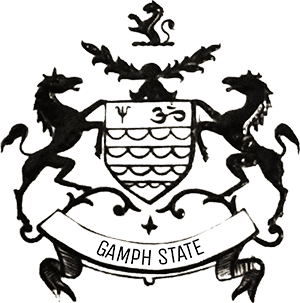
The rulers of Gamph, being of the Yaduvanshi lineage, utilized traditional heraldic symbols of the Chandravanshi (Lunar) dynasty. The state emblem featured a shield depicting a crescent moon, symbolizing their descent from the moon god (Chandra) and Lord Krishna. The shield was often supported by Rajput warriors or traditional symbols of authority like swords and spears, reflecting their martial heritage and their role as protectors of the Bhal frontier.
Post-Independence and the Modern Era
At the dawn of Indian independence, the state of Gamph was ruled by Thakore Saheb Vikramsinhji Manharsinhji Chudasama. Recognizing the need for a unified India, the Thakore Saheb signed the Instrument of Accession, merging the princely state of Gamph into the Indian Union in 1947. The territory was initially integrated into the Saurashtra State and later became part of the bilingual Bombay State, before finally being incorporated into the state of Gujarat in 1960. Today, the royal descendants of Gamph continue to be respected as community leaders, preservationists of Rajput heritage, and patrons of local cultural traditions in the Ahmedabad and Bhal regions.
References and Historical Citations
- Gazetteer of the Bombay Presidency: Ahmedabad (Volume IV), 1879
- The Golden Book of India by Sir Roper Lethbridge, 1893
- The Imperial Gazetteer of India - Digital South Asia Library
Genealogy
- Raa Navghanji 2 of Junagadh (1067-1098),married and had issue.
- Raa Bhimji, he was tilayat kunvar he recieved Bhadli, Sarva, Vansavad, Gamph.
- Satrasalji, received Aatham Chorasi (Rojka, Pipli, Badi etc.).(Chudasama)
- Devghanji, received Osam Chorasi (Khakhijalia, Kolki etc.).(Baria Chudasama)
- Savghanji, received Lath and Bhimora with other villages.(Lathiya Chudasama)
- Raa Khengar, succeeded on Gaddi of Junagadh.( Raizada)
- Bhimji 1 Raa Navghanji 2 Chudasama of Sarva (1084-1120), he established his capital at Hingolgadh, married and had issue.
- Generations
- Bhojrajji Bhimji 2 Chudasama.
- Generations
- Bhojrajji Bhimji 2 Chudasama of Bhadli (1375-1400), he moved his capital from Sarva To Bhadli. married and had issue.
- Generations
- Bhimji 3 Khengarji Chudasama.
- Generations
- Bhimji 3 Khengarji Chudasama of Bhadli (1515-1555), married 1. Jethwa Rani of Chaya (Porbandar), 2. Jadeji Rani of Nagar, 3. Vaghela Rani of Sardhar, 4. Jadeji Rani of Dhrol, daughter of Jam Hardholji, and had issue 4 sons;
- Navghanji Bhimji 3 Chudasama(1564-1572), son of Jadeji Rani of Dhrol. His descendants known as Chudasamas of Bhal. Married and had issue.
- Raisalji 1 Navghanji Chudasama.
- Kanaji Bhimji 3 Chudasama, received Chital, Vavdi and other villages.(Sarvaiya)
- Karanji Bhimji 3 Chudasama, received Chatrasa, Keshwala, Vekri and other villages, some known as Sarvaiya and as Chudasama.
- Naranji Bhimji 3 Chudasama, received Vansavad.(Sarvaiya)
- Navghanji Bhimji 3 Chudasama(1564-1572), son of Jadeji Rani of Dhrol. His descendants known as Chudasamas of Bhal. Married and had issue.
- Thakore Saheb Shri Raisalji 1 Navghanji Chudasama, 1st Thakore Saheb of Gorasu(1572-1595), Raisalji established his capital at Gorasu. Married 1. Gohil Rani of Mitli, 2. Parmar Rani of Muli, 3. Gohil Rani of Vadgam, 4. Vaghela Rani of Balol, 5. Gohil Rani of Shihor, 6. Vaghela Rani of Utelia, and had issue 10 sons;
- Yuvraj Kumar Shri Devaji 1 Raisalji 1 Chudasama.
- Kumar Shri Bhojrajji Raisalji 1 Chudasama of Bhadiad (son of Parmarrani)
- Kumar Shri Ranaji Raisalji 1 Chudasama of Ambli and Unchadi (son of Parmarrani)
- Kumar Shri Merji Raisalji 1 Chudasama of Kadipur- Dholera (son of Gohilrani-Vadgam)
- Kumar Shri Gheloji Raisalji 1 Chudasama of Sandhida (son of Gohilrani-Vadgam)
- Kumar Shri Rajoji Raisalji 1 Chudasama of Vadhela (son of Gohilrani-Vadgam)
- Kumar Shri Radhoji Raisalji 1 Chudasama of Otaria (son of Gohilrani-Vadgam)
- Kumar Shri Pratapsinhji Raisalji 1 Chudasama of Pipli and Kamyala (son of Vaghelarani-Balol)
- Kumar Shri Ranmalji Raisalji 1 Chudasama of Bavalyari (son of Gohilrani-Shihor)
- Kumar Shri Pragji Raisalji 1 Chudasama of Kharad (son of Vaghelarani-Utelia)
- Thakore Saheb Shri Devaji 1 Raisalji 1 Chudasama, 2nd Thakore Saheb of Gorasu(1595-1616), Son of Gohil Rani of Mitli, married 1. Vaghela Rani of Sardhar, 2. Sindha Rani of Sarod, 3. Gohil Rani of Lathi, 4. Parmar Rani of Muli and had issue 7 sons;
- Yuvraj Kumar Shri Amarsinhji 1 Devaji 1 Chudasama.
- Kumar Shri Vibhaji Devaji 1 Chudasama of Cher (son of Vaghelarani)
- Kumar Shri Karshansinhji Devaji 1 Chudasama of Jaska (son of Sindharani)
- Kumar Shri Vamoji Devaji 1 Chudasama of Anyali (son of Sindharani)
- Kumar Shri Chandoji Devaji 1 Chudasama of Sangasar (son of Gohilrani)
- Kumar Shri Amroji Devaji 1 Chudasama of Hebatpur (son of Gohilrani)
- Kumar Shri Meloji Devaji 1 Chudasama of Tagdi (son of Parmarrani)
- Thakore Saheb Shri Amarsinhji 1 Devaji 1 Chudasama, First Thakore Saheb of Gamph (1616-1657), son of Vaghela Rani of Sardhar, he moved from Gorasu and established new capital Gamph in 1633. Bulit Darbargadh of Gamph. Married 1. Rani Shri Sajjankunverba of Pethapur, 2. Rani Shri Keshaba of Muli, daughter of Akherajji Parmar, 3. Radhajiba of Utelia-Vaghela and had issue 2 sons by Sajjankunverba.
- Yuvraj Kumar Shri Nagjirajji 1 Amarsinhji 1 Chudasama.
- Kumar Shri Visaji Amarsinhji 1 Chudasama of Polarpur.
- Thakore Saheb Shri Nagjirajji 1 Amarsinhji 1 Chudasama, Second Thakore saheb of Gamph (1657-1679), son of Sajjankunverba, married 1. Rani Shri Ratankunverba Jhala of Pachham, 2. Rani Shri Premkunverba Parmar of Muli, daughter of viramji parmar, 3. Rani shri Samkunverba Chauhan of Mandli, 4. Rani Shri Manba Sindha of Sarod, Ranu Shri Kesharkunverba Gohil of Pachegam and had issue 5 sons;
- Yuvraj Kumar Shri Raisalji 2 Nagjirajji 1 Chudasama.
- Kumar Shri Vejoji Nagjirajji 1 Chudasama of Zinzer, Shared Zinzer with his brother (son of Premkunverba)
- Kumar Shri Kavatji Nagjirajji 1 Chudasama of Zinzer, Shared Zinzer with his brother (son of Premkunverba)
- Kumar Shri Khodaji Nagjirajji 1 Chudasama of Vagad, Shared Vagad with his brother (son of Samkunverba)
- Kumar Shri Manoji Nagjirajji 1 Chudasama of Vagad, Shared Vagad with his brother (son of Samkunverba)
- Thakore Saheb Shri Raisalji 2 Nagjirajji 1 Chudasama, Third Thakore Saheb of Gamph (1679-1701), son of Ratankunverba, married 1. Rani Shri Bajiba Sindha of Sarod, 2. Rupjiba Gohil of Vadgam, 3. Rani Shri Amjiba Jadeja of Patri jagir in Kutch , daughter of Panchanji Jadeja, and had issue 3 sons;
- Yuvraj Kumar Shri Devaji 2 Raisalji 2 Chudasama.
- Kumar Shri Merji Raisalji 2 Chudasama of Parabadi (son of Rupjiba)
- Kumar Shri Meloji Raisalji 2 Chudasama of Rojka (son of Amjiba)
- Thakore Saheb Shri Devaji 2 Raisalji 2 Chudasama, forth Thakore Saheb of Gamph (1701-1722), son of Bajiba, married Rani Shri Laduba Gohil of pachegam in Bhavnagar, daughter of Raisinhji Gohil and had issue one son;
- Yuvraj Kumar Shri Amarsinhji 2 Devaji 2 Chudasama.
- Thakore Saheb Shri Amarsinhji 2 Devaji 2 Chudasama, Fifth Thakore Saheb of Gamph (1722-1743), married 1. Rani Shri Kesharkunverba Sindha of Sarod, daughter of Amarsinhji Sindha, 2. Rani Shri Surajkunverba Gohil of Vadgam, daughter of Sabalsinhji Gohil, 3. Rani Shri Keshaba Parmar of Muli, daughter of Sujaji parmar, 4. Rani Shri Ajuba Gohil of Shihor, daughter of Vaghji Gohil and had issue 8 sons;
- Yuvraj Kumar Shri Nagjirajji 2 Amarsinhji 2 Chudasama.
- Kumar Shri Bharoji Amarsinhji 2 Chudasama, died young. (son of Kesharkunverba)
- Kumar Shri Ranchodji Amarsinhji 2 Chudasama of Kothadiya and Bhalgamda, Shared Kothadiya and Bhalgamda with his brother (son of Surajkunverba)
- Kumar Shri Khodidasji Amarsinhji 2 Chudasama of Kothadiya and Bhalgamda, Shared Kothadiya and Bhalgamda with his brother (son of Surajkunverba)
- Kumar Shri Ranmalji Amarsinhji 2 Chudasama, died young (son of Surajkunverba)
- Kumar Shri Bharoji Amarsinhji 2 Chudasama, died young (son of Surajkunverba)
- Kumar Shri Katatji Amarsinhji 2 Chudasama of Panchi (son of Keshaba)
- Kumar Shri Malji Amarsinhji 2 Chudasama of Hebatpur (son of Ajuba)
- Thakore Saheb Shri Nagjirajji 2 Amarsinhji 2 Chudasama, Sixth Thakore Saheb of Gamph (1743-1785), son of Kesharkunverba, married Rani Shri Amarba Parmar of Muli, daughter of Sujaji Parmar and had issue one son;
- Yuvraj Kumar Shri Raisalji 3 Nagjirajji 2 Chudasama.
- Thakore Saheb Shri Raisalji 3 Nagjirajji 2 Chudasama, Seventh Thakore Saheb of Gamph (1785-1805), he was great Diplomatic and Generous king, poets praised him. Married 1. Rani Shri Rajkunverba Gohil of Vadgam, daughter of Karansinhji Gohil, 2. Rani Shri Indrakunverba Parmar of Muli, daughter of Chandaji Parmar and had issue one son by Rani Shri Rajkunverba.
- Yuvraj Kumar Shri Meloji Raisalji 3 Chudasama.
- Thakore Saheb Shri Meloji Raisalji 3 Chudasama, Eight Thakore Saheb of Gamph (1805-1816), he was also known as Melangdev, married 1. Rani Shri Rupkunverba Parmar of Muli, daughter of Ranaji Parmar, 2. Rani Shri Dhankunverba Sindha of Sarod, daughter of Bhagvanji Sindha, 3. Rani Shri Daulatkunverba Chavda of Ambod, daughter of Kuberji Chavda and had issue 3 sons;
- Yuvraj Kumar Shri Amarsinhji 3 Meloji Chudasama.
- Kumar Shri Arjunsinhji Meloji Chudasama of Ankevalia (son of Rupkunverba)
- Kumar Shri Rupsinhji Meloji Chudasama of Pipaliya (son of Dhankunverba)
- Thakore Saheb Shri Amarsinhji 3 Meloji Chudasama, Ninth Thakore Saheb of Gamph (1816-1835), married 1. Rani Shri Ajabkunverba Gohil of Khokhra in Bhavnagar, daughter of Manabhai Gohil, 2. Rani Shri Jamba Parmar of Muli, daughter of Vasaji Parmar had issue one son by Ajabkunverba.
- Yuvraj Kumar Shri Nagjirajji 3 Amarsinhji 3 Chudasama.
- Thakore Saheb Shri Nagjirajji 3 Amarsinhji 3 Chudasama, Tenth Thakore Saheb of Gamph (1835-1877), married 1. Rani Shri Sujaba Parmar of Muli, daughter of Jasmatsinhji Parmar, 2. Rani Shri Sotiba Gohil of Vadgam, daughter of Jalamsinhji Gohil, 3. Rani Shri Daguba Jadeja of Manjal Jagir in Kutch, daughter of Veraji Jadeja and had issue one son by Sujaba.
- Yuvraj Kumar Shri Rahubha Nagjirajji 3 Chudasama.
- Thakore Saheb Shri Rahubha Nagjirajji 3 Chudasama, Eleventh Thakore Saheb of Gamph (1877-1899), married 1. Rani Shri Hariba Chavda of Amboda, daughter of Kuberji Chavda, 2. Rani Shri Naniba Jadeja of Kotda Sangani, daughter of Bhavsinhji Jadeja, 3. Rani Shri Sunderba Jadeja of Umrala, daughter of Gagjibhai Jadeja and had issue one son by Hariba.
- Yuvraj Kumar Shri Amarsinhji 4 Rahubha Chudasama.
- Thakore Saheb Shri Amarsinhji 4 Rahubha Chudasama, Twelth Thakore Saheb of Gamph (1899-1923), married 1. Rani Shri Baisahebba Parmar of Muli, daughter of Patabhai Parmar, 2. Rani Shri Monghiba of Jaliya, 3. Rani Shri Vakhtuba Gohil of Vadgam, daughter of Mulubha Gohil, 4. Rani Shri Devkunverba Jadeja of Shahpur, daughter of Bhupatsinhji Jadeja, 5. Rani Shri Devkunverba Jhala of Karmath, daughter of Akherajsinhji Jhala, 6. Rani Shri Rupaliba Jadeja of Jivapar, daughter of Khodubha Jadeja and had issue one son by Jadeji Rani Devkunverba.
- Yuvraj Kumar Shri Manharsinhji Amarsinhji 4 Chudasama.
- Thakore Saheb Shri Manharsinhji Amarsinhji 4 Chudasama, Thirteenth Thakore Saheb of Gamph (1923-1934), married two daughter of Bharatsinhji Chauhan of Aeral, 1. Rani Shri Anandkunverba, 2. Rani Shri Sushilkunverba and had issue 4 sons;
- Yuvraj kumar Shri Vikramsinhji Manharsinhji Chudasama.
- Kumar Shri Gambhirsinhji Manharsinhji Chudasama (son of Sushilkunverba)
- Kumar Shri Dilavarsinhji Manharsinhji Chudasama (son of Sushilkunverba)
- Kumar Shri Pravinsinhji Manharsinhji Chudasama (son of Sushilkunverba)
- Thakore Saheb Shri Vikramsinhji Manharsinhji Chudasama, Forteenth Thakore Saheb of Gamph (1934-1982), son of Anandkunverba. He merged Gamph into Indian union in 1947. In 1971 Indira gandhi government amended the Indian Constitution to remove his position as a "ruler" and his right to receive privy-purse payments. Married Rani Shri Rohiniindrakunverba Rathod, daughter of Raja Jagganathsinghji Rathod of Daulatpur ( M. P) and had issue one son;
- Yuvraj Kumar Shri Virbhadrasinhji Vikramsinhji Chudasama.
- Thakore Saheb Shri Virbhadrasinhji Vikramsinhji Chudasama, fifteenth and present Thakore Saheb of Gamph (see above)