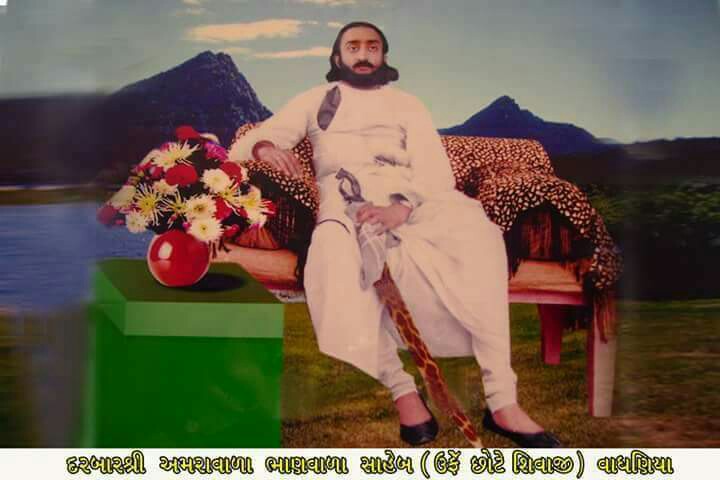
Present Head
History
Origin and Foundation of the State
The Barwala Princely State, located in the historic Saurashtra (Kathiawar) region of Gujarat, was ruled by the Kathis of the Wala (Vala) dynasty. The lineage of the Wala clan is deeply intertwined with the ancient history of the peninsula. They claim descent from the celebrated Maitraka dynasty, which ruled the prosperous kingdom of Vallabhi (modern-day Vallabhipur) from the 5th to the 8th centuries CE. Following the fall of Vallabhi, a branch of the ruling royal family migrated and intermarried with the Kathis—a martial, nomadic community that had entered Saurashtra from Sindh. This union gave rise to the prominent Wala Kathi clan, which established several principalities and estates across Saurashtra, including Jetpur, Bilkha, Bagasra, and Barwala.
Medieval Period and Regional Hegemony
During the medieval era, the Wala rulers of Barwala successfully maintained their local authority amidst the shifting tides of regional empires. As the Gujarat Sultanate and later the Mughal Empire extended their influence over Kathiawar, the Wala Kathis of Barwala adapted to the changing political landscape. They retained internal administrative autonomy over their ancestral lands while paying periodic tributes to the imperial authorities in Ahmedabad. The strategic location of Barwala made it an important local hub for trade and agriculture, fortified by the martial prowess of its ruling clan.
Maratha Influence and the British Raj
With the decline of the Mughal Empire in the 18th century, the Maratha Empire, led by the Peshwas and the Gaekwads of Baroda, penetrated the Saurashtra peninsula. Barwala, like many other Kathiawar states, was subjected to the levy of Chauth and Ghasdana (military tribute) by the Maratha forces. This period of instability was resolved with the intervention of the British East India Company in the early 19th century.
In 1807–1808, the historic Walker's Settlement was enacted by Colonel Alexander Walker, which stabilized the tribute system and guaranteed the territorial integrity of the Kathiawar states. Under this settlement, Barwala was recognized as a non-salute princely state (or taluka) under the administrative supervision of the Kathiawar Agency (later the Western India States Agency). The Wala rulers were designated as Talukdars, exercising civil and judicial authority within their domain while being under the political superintendence of the British Resident.
Post-Independence and Modern Era
Following India's independence from British rule in August 1947, the ruling family of Barwala, aligned with other Kathiawar rulers, chose to integrate with the newly formed democratic nation. The state signed the Instrument of Accession, merging into the United State of Kathiawar (Saurashtra State) in February 1948. This administrative unit was later integrated into the bilingual Bombay State in 1956. Following the Mahagujarat Movement and the subsequent linguistic reorganization of states in 1960, Barwala became a part of the Botad district (formerly under Ahmedabad and Bhavnagar districts) in the state of Gujarat, India.
Historical References
For further academic reading and historical documentation on the Wala dynasty and the Kathiawar region, please refer to the following resources:
- The detailed administrative and political history of Kathiawar states can be explored in the Gazetteer of the Bombay Presidency, Volume VIII: Kathiawar (1884) on Archive.org.
- Information regarding the territorial divisions and tribute settlements under the British Raj is archived in the Imperial Gazetteer of India hosted by the Digital South Asia Library (DSAL), University of Chicago.
Genealogy
- Wala Shri OGHAD VIRA, married and had issue.
- Wala Shri ALA OGHAD WALA, ancestor of the Talukdars of Bilkha [Kathad Naja Wala's Estate].
- Kumar Shri Chomla Oghad Wala, married and had issue.
- Kumar Shri Rawat Chomla Wala
- Wala Shri SATA OGHAD (qv)
- Wala Shri SATA OGHAD, married and had issue.
- Wala Shri BHIMA SATA (qv)
- Wala Shri BHIMA SATA, married and had issue.
- Wala Shri ALA BHIMA, ancestor of the Talukdars of Bilkha [Rawat Ram's Estate].
- Wala Shri DESA BHIMA (qv)
- Wala Shri DESA BHIMA, married and had issue.
- Kumar Shri Bhima Desa Wala
- Wala Shri BHAN DESA (qv)
- Wala Shri BHAN DESA 1892/1937, born , succeeded 24th July 1892, married and had issue. He died .
- Wala Shri AMRA BHAN (qv)
- Kumar Shri Kalu Bhan Wala
- Kumar Shri Desa Bhan Wala
- Kumar Shri Rawat Bhan Wala
- Kumar Shri Naja Bhan Wala
- Kumar Shri Lakshman Bhan Wala
- Kumar Shri Raning Bhan Wala
- Kumar Shri Ram Bhan Wala
- Wala Shri AMRA BHAN 1937/-, born , succeeded 27th October 1937, educated at Rajkumar College, Rajkot, married and had issue.
- Wala Shri RANA AMRA (qv)
- Kumar Shri Bhima Amra Wala, educated at Rajkumar College, Rajkot (1955); married and had issue.
- Kumar Shri Vira Bhima Wala, educated at Rajkumar College, Rajkot (1972)
- Kumar Shri Punja Bhima Wala
- Kumar Shri Nirmala Bhima Wala
- Kumar Shri Surag Amra Wala, married and had issue.
- Kumar Shri Samat Surag Wala
- Kumar Shri Jilu Surag Wala
- Wala Shri RANA AMRA, educated at Rajkumar College, Rajkot (1955); married and had issue. He died after 1970.
- Wala Shri MULU RANA (qv)
- Kumar Shri Ram Rana Wala, educated at Rajkumar College, Rajkot (1978)
- Kumar Shri Deva Rana Wala
- Wala Shri MULU RANA (see above)