Present Head
- Kumar Shri Pratapsinhji Raghavendrasinhji B.E. (Civil), born in Bhadwa, married in Bhadwa, Kumari Brindakumariba, and has issue.
- Kumar Arjunsinhji Pratapsinhji
- Kumari Jyotikumariba
History
Origin and Foundation
The Bhadwa State was founded in the early 18th century, circa 1726, as an offshoot of the princely state of Kotda-Sangani. The genesis of this state lies in the traditional Rajput practice of granting appanages (patrimony or giras) to younger sons of ruling houses. Kumar Shri Hakoji, the third son of Thakore Shri Sangoji, the ruler of Kotda-Sangani, received a patrimony of six villages, establishing his independent seat at Bhadwa.
The Jadeja Dynasty and Family Cadets
The rulers of Bhadwa belonged to the prestigious Jadeja clan of Chandravanshi (Yadu) Rajputs, who held dominant sway over the Kathiawar peninsula. Over generations, the estate underwent internal divisions to sustain cadet branches of the family. Out of the original six villages, Hadamtala and Kharrera were partitioned and granted to the family's cadets, Tamachiji and Raghabhai, respectively. Despite these internal land grants, the core lordship of the Bhadwa Taluka remained intact, governed strictly by the rule of primogeniture, ensuring that the main title and remaining estate devolved solely to the eldest son.
British Era and Judicial Administration
During the British Raj, Bhadwa was situated in the Halar Prant (division) of the Kathiawar Agency (later part of the Western India States Agency). Under the British classification system of the native states, Bhadwa was categorized as a Sixth Class State. This classification limited the administrative and judicial autonomy of its ruling Talukdar.
According to the historical records compiled in the Gazetteer of the Bombay Presidency, the jurisdictional powers of the Bhadwa State were limited to:
- Criminal Jurisdiction: Power to award up to three months of rigorous imprisonment and impose fines up to 200 Rupees.
- Civil Jurisdiction: Authority to hear and decide cases involving property or disputes up to the value of 500 Rupees.
Matters exceeding these judicial limits were referred to the court of the British Political Agent stationed at Rajkot.
Post-Independence and Modern Era
Following India's independence in August 1947, the last ruler of Bhadwa signed the Instrument of Accession, merging the state into the United State of Kathiawar (later known as Saurashtra State) in February 1948. Through subsequent administrative reorganizations, Saurashtra was merged into the Bombay State in 1956, and eventually, upon the linguistic bifurcation of the state in 1960, Bhadwa became a part of the Rajkot district in the modern state of Gujarat. Today, the historical legacy of the Jadeja rulers of Bhadwa is preserved through their descendants and local heritage landmarks.
Genealogy
- Thakore Shri HAKOJI SANGAJI, 1st Thakore Saheb of Bhadwa, married and had issue.
- Thakore Shri Khengarji Hakoji (qv)
- Kumar Shri Ajuji Hakoji, received Aniala.
- Kumar Shri Tamachiji Hakoji, received Hadamtala.
- Thakore Shri KHENGARJI HAKOJI, 2nd Thakore Saheb of Bhadwa, married and had issue.
- Thakore Shri Nayoji Khengarji (qv)
- Kumar Shri Radabhai Khengarji, received Kharrera.
- Thakore Shri NAYOJI KHENGARJI, 3rd Thakore Saheb of Bhadwa, married and had issue.
- Thakore Shri Vanoji Nayoji (qv)
- Kumar Shri Atoji Nayoji, received Devalia.
- Thakore Shri VANOJI NAYOJI, 4th Thakore Saheb of Bhadwa, married and had issue.
- Thakore Shri Dadaji Vanoji (qv)
- Kumar Shri Motiji Vanoji
- Kumar Shri Sujaji Vanoji
- Thakore Shri DADAJI VANOJI, 5th Thakore Saheb of Bhadwa -/1843, married and had issue.
- Thakore Shri Bhavsinhji Dadaji (qv)
- Thakore Shri BHAVSINHJI DADAJI, 6th Thakore Saheb of Bhadwa 1843/-, born , married and had issue.
- Thakore Shri Madhavsinhji Bhavsinhji (qv)
- Thakore Shri MADHAVSINHJI BHAVSINHJI, 7th Thakore Saheb of Bhadwa, married and had issue.
- Thakore Shri Pratapsinhji Madhavsinhji (qv)
- Kumar Shri Kalubha Madhavsinhji, married and had issue.
- Thakore Shri Chandrasinhji Kalubha (qv)
- Bhupendrasinhj Chandrasinhji Jadeja, married to Yashvantkunvarba daughter of late Darbar Shree Ramsinhji Mansinhji Gohil of Vavadi State.
- Kirtisinhji Bhupendrasinhji Jadeja, married to Anjanikumariba, daughter of Vanrajsinhji Bhimsinhji Zala of Minapur.
- Omdevsinhji Kirtisinhji Jadeja
- Kirtisinhji Bhupendrasinhji Jadeja, married to Anjanikumariba, daughter of Vanrajsinhji Bhimsinhji Zala of Minapur.
- Bhupendrasinhj Chandrasinhji Jadeja, married to Yashvantkunvarba daughter of late Darbar Shree Ramsinhji Mansinhji Gohil of Vavadi State.
- Thakore Shri Chandrasinhji Kalubha (qv)
- Kumar Shri Shivsinhji Madhavsinhji
- Thakore Shri PRATAPSINHJI MADHAVSINHJI, 8th Thakore Saheb of Bhadwa, married and had issue.
- Thakore Shri Bhavsinhji Pratapsinhji (qv)
- Thakore Shri BHAVSINHJI PRATAPSINHJI alias Balsinhji, Thakore Saheb of Bhadwa 1901/1926, born , succeeded 12th March 1901; married and had issue. He died .
- Thakore Shri Natwarsinhji Bhavsinhji (qv)
- Thakore Shri NATWARSINHJI BHAVSINHJI, 10th Thakore Saheb of Bhadwa 1926/-, born , died spm.
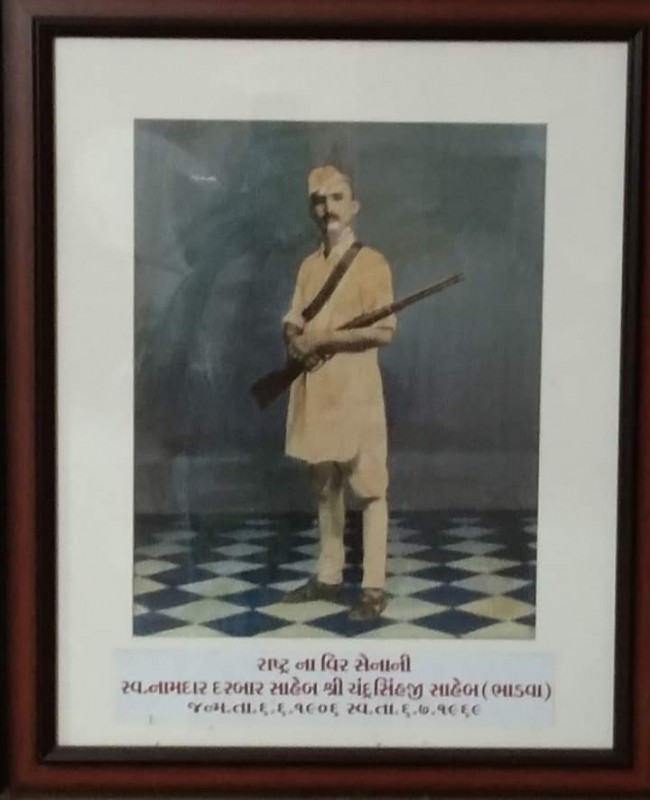
- Thakore Shri CHANDRASINHJI POLUBHA, 11th Thakore Saheb of Bhadwa, married and had issue.
- Thakore Shri Raghavendrasinhji Chandrasinhji (qv)
- Kumar Shri Dharmendrasinhji Chandrasinhji
- Kumar Shri Bhupendrasinhji Chandrasinhji, married Kumari Yashvantba, and had issue.
- Kumar Shri Kirtisinhji Bhupendrasinhji, educated (T.Y.B.A. Econ.), born in Bhavnagar, married 13th February 2005 in Bhadwa, Kumari Anjanikumariba, and has issue, one son.
- Kumar Omdevsinhji Kirtisinhji
- Kumar Shri Kirtisinhji Bhupendrasinhji, educated (T.Y.B.A. Econ.), born in Bhavnagar, married 13th February 2005 in Bhadwa, Kumari Anjanikumariba, and has issue, one son.
- Thakore Shri RAGHVENDRASINHJI CHANDRASINHJI, 12th Thakore Saheb of Bhadwa (see above)